

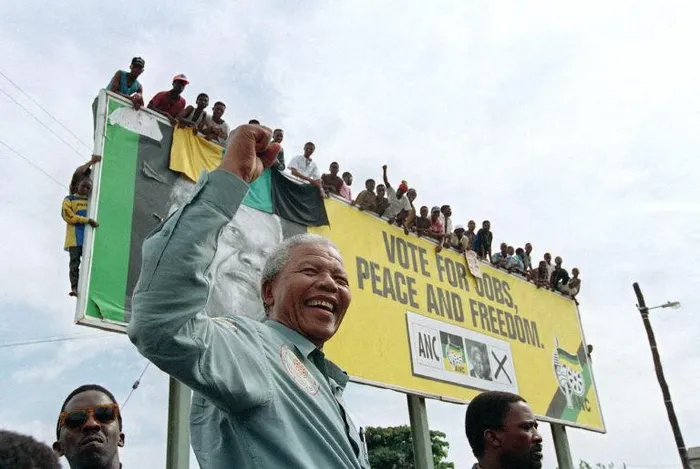
FILE.South Africa’s 2026 Freedom Day reflects on 32 years of democracy, highlighting persistent inequality, youth unemployment, corruption, and the urgent need to transform political liberation into tangible socio-economic justice. Picture: AFP
Image: AFP
By Thelela Ngcetane-Vika
On 27 April 2026, South Africa marks Freedom Day, the anniversary of the first democratic election in 1994 and the formal end of apartheid’s policy rule, albeit through a neoliberal type of public administration and management system.
Thirty-two years on, the day should be less a ceremonial pause than a national audit. Swartz (2010) developed the concept of aesthetic relational values to examine how planning and development decisions are shaped not only by technical rationality, but by the felt, lived, and symbolic relationships people have with place, memory, and one another, including the generation of 1994.
In the context of South African democracy, these relational values provide a lens to ask whether the political freedoms secured in 1994 have translated into spatial, social, and economic environments that citizens experience as dignified, inclusive, and just. It should force us to ask, with honesty and urgency: what kind of freedom have we built, who has it, who does not, and what remains of the moral compact that animated our democracy?
The easy story is familiar. South Africa won political liberation, wrote a progressive constitution, and built one of the most admired legal frameworks in the world. That is not nothing. It is, in fact, historic. But history is not self-fulfilling. A democracy can win the vote and still lose the future. The deeper question of Freedom Day in 2026 is not whether apartheid ended in law. It is whether freedom has been made materially legible in the lives of ordinary people.
For a 62 million population of South Africans, freedom remains suspended between aspirations and grievances, that is, the unmet socio-economic costs (Peter Kallawy, 1993). The right to vote has not translated into reliable electricity, safe streets, decent schooling, safe drinking water, adequate sanitation services, or a fair chance to work.
A young person born after 1994 has lived their entire life in democracy, yet too many have inherited unemployment, spatial exclusion, and schools that still reproduce inequality rather than reverse it. South Africa’s youth unemployment rate (ages 15–24) has been around 45%–60%, which is extremely high (Statistics South Africa Labour Force Survey).
Whereas, national surveys indicate significant alcohol, cannabis, and other drug use among adolescents and young adults, which can undermine school attendance, completion, and employability (South African Youth Risk Behaviour Survey; SACENDU). More concerning, teenage pregnancy continues to affect schooling and long-term labour-market outcomes for girls and young women.
Recent South African studies and DHS-based estimates show adolescent fertility remains highest in poorer provinces, with the Eastern Cape, KwaZulu-Natal, Limpopo, and Mpumalanga generally reporting the highest teen birth rates, and the Western Cape and Gauteng, the lowest.
What does freedom mean when your postcode still determines your prospects? What is the value of constitutional dignity if daily life is governed by broken infrastructure and chronic insecurity? This is not an argument against democracy. It is an argument against complacency. South Africa’s tragedy is not that freedom failed; it is that freedom was too often mistaken for arrival.
The transition of 1994 was not the destination. It was the beginning of a difficult and unfinished National Democratic Revolution (NDR) to convert political rights into socio-economic justice. The Constitution promised equality before the law; it did not promise that inequality would dissolve on its own.
Yet the post-apartheid public administration state has too often behaved as if moral legitimacy was permanent, rather than something that must be renewed through competence, integrity, and delivery of sustainable services for the 62 million population.
As a democratic administration rooted in socio-economic justice and human rights, there is a need to speak plainly about the nature of our disappointments. Corruption has not merely stolen money; it has hollowed out trust.
The Zondo Commission was born out of years of mounting evidence that state capture had hollowed out South Africa’s institutions, from procurement scandals to political interference in key state-owned entities. Its findings laid bare a sprawling network of corruption, patronage, and deliberate looting that thrived because accountability was repeatedly delayed.
Yet the most glaring scandal may now be the apparent absence of consequence management, as many implicated figures remain untouched while the public is left waiting for justice. State capture was not only a scandal of procurement and patronage; it was an assault on the idea that the post-apartheid state belonged to the people.
When public office becomes a route to private accumulation, democracy begins to look like a ceremonial shell. How can citizens be asked to believe in freedom while witnessing the systematic looting of the institutions meant to secure it?
Yet anger alone is not analysis. There is a temptation, especially among the affluent and the disillusioned, to speak as though South Africa is a failed experiment. That is too lazy, too evasive, and too convenient. It ignores the extraordinary achievements of democratic South Africa: the extension of citizenship, the expansion of social grants, the broadening of access to basic services, the transformation of the legal order, and the emergence of a public sphere where contestation is possible.
These gains are real. They matter. They should not be sacrificed to cynicism. But neither should they be used to excuse failure. The most uncomfortable truth of the last 32 years is that freedom has been unevenly distributed.
The wealthy have often experienced democracy as stability; the poor as waiting. Urban elites celebrate rights that rural and township citizens struggle to convert into outcomes. Women continue to bear the violence of patriarchy in homes, workplaces, and public spaces. Young people are told they are the future while being denied the present. The land question remains unresolved.
Security of the state has been concerning to many: the immigration policy is neither about international law nor human rights, but more the ANC’s ambivalence to South African sovereignty and statehood. The presence of huge numbers of illegal immigrants in South Africa is a cause for concern, with allegations that some of those are involved in various forms of economic sabotage, including hijacking of properties, central business areas, among others.
The Madlanga Commission has highlighted allegations that criminal networks may have penetrated parts of South Africa’s police and security structures, while the judiciary remains burdened by backlogs, delay tactics, and slow-moving corruption cases. The result is a system where whistleblowers feel exposed, accountability is delayed, and public confidence keeps eroding.
This raises a more profound question: can a society remain free if it reproduces radical inequality and insecurity? Political freedom without economic dignity can become a performance. It can protect the right to speak while leaving intact the conditions that silence it.
South Africa’s democratic project must therefore confront a hard truth: redistribution is not a technical policy preference; it is the moral core of freedom itself.
Freedom Day should also be a day of memory, not as a ritual, but as an instruction. Memory can be an act of radical remembrance. The liberation struggle was never only about access to power. It was about human dignity, collective belonging, and the refusal to normalise humiliation.
If today’s South Africa feels morally exhausted, perhaps it is because we have allowed the language of freedom to be emptied of discipline and responsibility.
Freedom without Capability, Accountability, and Responsiveness (CAR) degenerates into entitlement. Freedom without aesthetic relational values in planning and development and civic ethic becomes noise (Swartz, 2010). Freedom without institutional CAR becomes frustration. The task now is not to romanticise the past, nor to denounce the present in apocalyptic tones. It is to recover seriousness on one hand.
The triple complex challenges of abject poverty, systemic unemployment, and increased inequalities should be addressed through integrated rural and urban resilience and infrastructure investment programmes, exemplified by the Asian tigers. The paucity of concrete developments in municipalities may necessitate some questions.
To ask why municipalities fail so routinely? Are the current tools of investment like PFMA and MFMA appropriate for the local government developmental agenda (LGDA), or do we need to adopt a long-term Asian Tiger infrastructure investment model like the People’s Republic of China, which has addressed rural and urban as well as class disparities in the past 50 years? To ask why public education still reproduces class and race hierarchies so stubbornly? To ask why economic growth has not become broad-based opportunity? To ask why the social compact between state and citizen feels frayed?
And perhaps most importantly, to ask whether those who inherit power understand that liberation movements, when they become governing parties, are judged not by their memory but by their results.
In a nutshell, using the wisdom of hindsight and a forecasting lens, historical antecedents and liabilities have not been addressed at a significant level. For example, the intergenerational deficits in educational quality, skilled labour supply, and fiscal sustainability for the post-1994 cohort are palpable and demoralising.
Consequently, the application of the future Capability, Accountability, and Responsiveness (CAR) model, drawing on best-practice modalities from the Asian Tigers notably Singapore’s alignment of curriculum with industrial policy, South Korea’s merit-based teacher professionalisation and performance accountability, and Taiwan’s decentralised responsiveness to local labour market demand, indicates the need for a re-orientation of our modus operandi and modus vivendi.
Therefore, unless the state institutionalises binding capability targets, transparent accountability for learning outcomes, and responsive feedback loops between schooling, skills pipelines, and economic planning, the trajectory of the born-free generation will remain constrained by structural youth unemployment and recurrent remedial expenditure (Kallaway, 1993).
At thirty-two years, South Africa is neither newborn nor old. It is mature enough to be held accountable. A postcolonial reading reveals that political independence has not yet dismantled the material architectures of exclusion, whilst a grounded-theoretical evaluation of lived experience amongst the born-free cohort confirms that freedom is encountered as partial and contingent, measured not in constitutional text but in access to quality education, dignified work, and effective institutions.
Freedom Day must therefore become a day not only of celebration but of confrontation with our myths, our evasions, and our unfinished business. If we are honest, the question is not whether 1994 mattered. It did. The question is whether we have the courage, the capacity, and the socio-economic and political imagination to ensure that 2026 is not simply another year of solemn speeches over a democracy that too many experience as distant. Freedom is not a monument. It is a daily contract. And contracts, unlike slogans, must be honoured. A luta continua!
*Thelela Ngcetane-Vika is an award winning Academic and published Scholar based at the Wits Schoolof Governance, University of Witwatersrand, South Africa. Her research focus sits on the nexus ofInternational Trade Law, Governance (both Public and Corporate) and Gender Studies. Her workweaves through Sub-Saharan Africa, Asia- Pacific, Europe and the Americas, with a signaturestrength in South-South dialogues and the evolving BRICS landscape. She writes extensively oninternational law, Gender and Liberal Democracies across the world, especially on Northernhegemonies versus Southern democratic imaginaries and alternative developmental models.
* The views expressed are not necessarily the views of IOL or Independent Media.
** JOIN THE CONVERSATION: Send us an email with your comments, thoughts or responses to iolletters@inl.co.za. Letters should be a maximum of 500 words, and may be edited for length. Anonymous correspondence will not be published. Submissions should include a contact number and physical address (not for publication).