

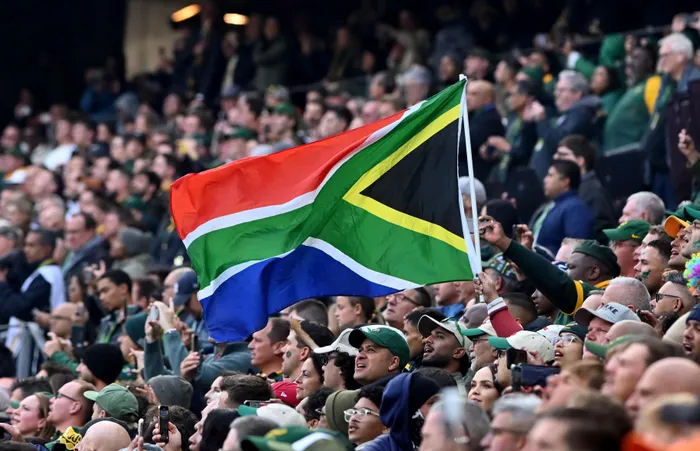
The South African flag was first hoisted on April 27, 1994, coinciding with the start of the country's first democratic elections and the birth of Freedom Day.
Image: Ayanda Ndamane Independent Media
Thirty-two years after the fall of apartheid, South Africa pauses to mark Freedom Day. It is a moment intended for national reflection and the celebration of a hard-won democracy. Yet, for millions living in the shadow of gang violence and systemic neglect, the festivities feel increasingly disconnected from reality.
As the country looks back at the end of a despotic era, a growing and urgent debate is emerging around whether the concept of freedom, particularly as it relates to safety, dignity, and freedom of movement, is being fully realised in today’s context.
Professor Mias de Klerk, Emeritus Professor of Leadership and Organisational Behaviour at the Stellenbosch Business School, suggests that while the birth of a new South Africa ended a despotic government, the promise of freedom remains unfulfilled for many.
He argues that freedom possesses two distinct meanings: "freedom from something" and the "freedom to decide one’s own destiny." While South Africans achieved "freedom from" state-sponsored racial oppression in 1994, the lived experience of many communities suggests that the transition to a truly free life is stalled.
In the Western Cape, the statistics provide a harrowing backdrop to these philosophical debates. A crime report compiled by Fight Against Crime SA revealed a terrifying surge in violence across Cape Flats communities just a week before this year’s celebrations.
Between April 13 and 19, 57 incidents were recorded.
The figures reflect a relentless cycle of gang activity and firearm-related crime, with 22 people reported dead or injured and 10 in critical condition. The week began with a triple murder in Gugulethu and a shooting in Mitchells Plain that left two victims seriously wounded.
By Tuesday, nine incidents were reported across Hanover Park, Bonteheuwel, and Athlone, including a fifteen-year-old shot and multiple injuries involving children.
For those living in these hotspots, the constitutional right to safety is a hollow sentiment. Crime expert Chad Thomas argues that the daily reality for millions contradicts the constitutional ideal of liberty.
"The majority of South Africans are not free. They are held in the grip of merciless criminals," he said. Thomas points to persistent violence in vulnerable communities where families live in constant fear. Children are at risk simply walking to school, and residents are frequently caught in the crossfire of gang-related shootings.
"The psychological and physical damage is immeasurable. It’s literally like these families are living in war zones."
This atmosphere of fear creates a stark disparity in how freedom is experienced across class lines. Dr Guy Lamb, a crime and policing expert from Stellenbosch University, said that inequality in South Africa is no longer just about income, but about safety itself. "The disparity in freedom and safety is evident; wealthier South Africans can move freely at any time with minimal risk, while those in poorer neighbourhoods face serious threats."
"Wealthy residents invest in private security, electric fencing, and surveillance, effectively purchasing the safety the state fails to provide. In contrast, poorer communities must depend on an overstretched police service with limited resources.
The failure of the state to protect its citizens is often traced back to a crisis of leadership and accountability. Professor De Klerk highlights the erosion of freedom caused by widespread fraud, corruption, and wasteful government spending. He points to the irony of a leadership meant to serve and protect.
"Crime and gangster violence are rampant, while the Minister of Police is suspended for corruption and the Police Commissioner is under investigation for fraud." With little action taken against corruption, he suggests it is "reasonable to question if South Africa is truly free from despotic governance."
Even military intervention has failed to stem the tide. Roegshanda Pascoe, an activist and whistleblower, says the deployment of the army to the Cape Flats has not brought meaningful change.
"The army has been brought to our communities but no lives have been saved," she said.
Pascoe describes the ongoing toll of gang violence, where families frequently lose loved ones. "Where is the freedom for those affected by gang warfare?" She points to deeper systemic failures, alleging that some firearms used in gang conflicts originate from state sources.
For Pascoe, the top-down approaches of the government have failed, and she believes "real change must come from within the communities themselves."
This sentiment is echoed by Abie Isaacs, Chairperson of the Cape Flats Safety Forum, who fought for freedom in the late 1980s.
He laments that the current state of affairs is not the future he and his peers envisioned.
"When you speak about freedom, you have to use what the Constitution gives us. We don’t even have the freedom to move. Gun violence is continuously unabated."
The impact of this insecurity extends into the very halls where justice is meant to be dispensed. Neelan Karikan, President of the Judicial Officers Alliance of South Africa, argues that "true liberty, as our Constitution itself intimates in its transformative ethos, is substantive: it is the lived capacity of every citizen to realise their potential without the fetters of systemic injustice."
"In the magistrates’ courts, where more than ninety-five per cent of all judicial business is transacted, the inequalities of society are laid bare. It is here that judicial officers preside over the protection of women and children from gender-based violence and the enforcement of rights against an "often-unresponsive state."
If Freedom Day is to remain relevant, it must move beyond nostalgia. As Chad Thomas suggests, the day should serve as a moment of accountability.
"If South Africans could overcome an oppressive regime, then surely we can work together to break the grip of criminality."
Professor De Klerk reminds us that freedom comes with the duty to act responsibly and hold leaders accountable.
"We must use our freedom to vote responsibly, choosing leaders who demonstrate responsibility and a willingness to be held accountable. Voting is not just a right, but an obligation to protect the future of our country."
For the residents of Delft, Lavender Hill, and Elsies River, the 27th of April remains a reminder of a promise yet to be realised. Until a child in Hanover Park can walk to school with the same sense of security as a child in a gated suburb, the revolution remains unfinished. Now is the time to "celebrate freedom with responsibility and help build a better South Africa."
tracy-lynn.ruiters@inl.co.za
Weekend Argus
The South African flag was first hoisted on April 27, 1994, coinciding with the start of the country's first democratic elections and the birth of Freedom Day.
Image: Ayanda Ndamane Independent Media