

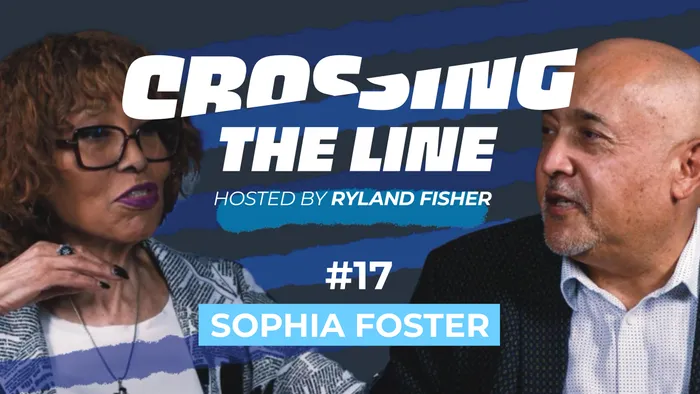
On the Crossing the Line podcast this week, veteran entertainer, Sophia Foster, talks to host Ryland Fisher about the hardship of performing during the apartheid days, surviving spousal abuse, and the lessons that she shares with young singers who form part of her foundation.
Image: Supplied / Crossing The Line
Veteran singer and performer, Sophia Foster, the special guest on the Crossing the Line podcast this week, describes herself as “one of the original pop stars of South Africa”, along with Richard Jon Smith, Jonathan Butler, Lionel Petersen, Ronnie Joyce and Neville Nash among others.
Speaking to host Ryland Fisher on the podcast show, she said: “We would have security with dogs to keep the people away from us, because the people used to mob us when we arrived at a venue. One day, they almost overturned the kombi that we had arrived in. We could not see anything, because of the number of people surrounding us. They wanted us to get out so that they could touch us. Jonathan was still a laaitie. It was scary, as much as it was an amazing feeling. We were the South African pop stars. We were the first coloured faces that you saw on television.”
Crossing the Line is a podcast series started by Fisher, a media veteran and former editor of the Cape Times, last year. As part of our partnership, every week, IOL features one of the podcasts and a guest on our platforms.
Foster, who turned 80 in April, said she knew at an early age that she wanted to be a singer and performer. As a teenager, she auditioned successfully for the Golden City Dixies, one of the popular groups of performers in the 1960s and 1970s.
Life with the Dixies was difficult because they were a group of coloured and black performers who performed mainly for white, Afrikaans audiences throughout the country at the height of apartheid.
“In most towns, we had nowhere to sleep. We had to sleep in the halls where we were performing. We travelled with our stretchers everywhere.
“When I went on stage, I used to sing with so much aggression. That was my way of getting rid of my frustration.”
She said that she performed in neighbouring countries, such as Lesotho, Zimbabwe (then Rhodesia) and Mozambique, where there was no apartheid. “It felt strange for us, coming from a country where we were divided along racial lines and where there was a lot of inequality.”
Foster said he mom, who was very religious, did not approve of her singing career. “She felt I was singing for the devil. That is why no one from my family came to my opening nights. My mom just saw me perform once.
Foster spoke about surviving an abusive relationship and why she stuck to the relationship for a long time, despite the abuse.
“I was scared that, if I left him, he would kill me. I felt it was better to stay. Eventually, I could no longer take it and left him while he was out, and never returned. I arranged my own divorce.”
Foster also spoke about her Fostering Foundation, which teaches youth from the Cape Flats performance techniques. Many of the youth, she said, dealt with serious socio-economic problems in the townships where they lived.
“The foundation allows me to give back to talented people in my community who have no chance of succeeding in life because of where they live. Sometimes, the kid would phone me to tell me they cannot make it for rehearsal because of a shooting in the area.
“Despite their problems, when they are performing, it seems like all their problems have disappeared. Music has this healing effect.
“I have tried to teach them more than performance techniques. They need to understand that, while we call if show business, it is also their business.”
Foster said that, if she could do things over, she would learn how to control her anger, which was supposed to be directed at one person, her abuser, but ended up being directed at everyone with whom she came into contact.
Her advice to young people, who might want to follow in her footsteps? “Always check out who you are getting involved with. Not everyone is going to put you on a silver platter. Please learn from others in the industry. You have to be brave, courageous and tenacious. Don’t give up.”