

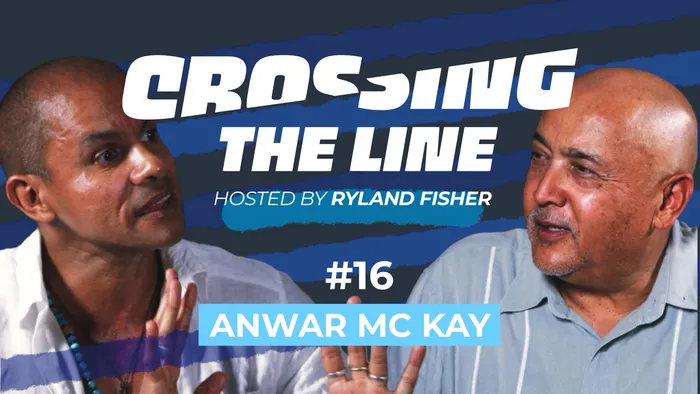
Anwar Mc Kay speaks to Ryland Fisher on the Crossing the Line podcast.
Image: Crossing The Line
Anwar Mc Kay, author of The Invisible Boy from Bramble Way, which tells the story of a young boy growing up Muslim and gay on the Cape Flats during the final decades of apartheid, is the special guest on the Crossing the Line podcast series this week.
The book deals with the personal pain and trauma he suffered growing up in Bonteheuwel during the 1980s and 1990s, but it also chronicles the pain and trauma suffered by South Africa and South Africans during the painful years of apartheid.
“One cannot separate the personal from the political. It is intertwined and, especially in the 1980s, the drumbeats of the revolution were beating very hard,” he told Crossing the Line host, Ryland Fisher.
Fisher is a veteran journalist and former editor of the Cape Times. He started the podcast series in the middle of last year and has already posted 16 interviews online.
Mc May spoke about the standards of identity in his growing up years.
“I grew up in a Muslim family, according to Cape Malay culture, and in the 1980s, Muslim people could be very racist and judgemental. Maybe the culture has changed since then. But at that time, if you were fair and had straight hair, your future was secured.”
Mc Kay said he wrote the book because he felt there were certain things he wanted to share about his growing up years. “I felt there were certain parts of Anwar that I needed to explore. I wrote the book because of the invisibility that I felt growing up.”
He spoke about the difficulties of growing up Afrikaans and studying at the English-medium University of Cape Town.
“When I went to UCT, I realised that the kind of Afrikaans I grew up with was only functional on the Cape Flats and I needed to learn a completely new form of Afrikaans, which I could never really accept.”
He said that, throughout his life, he had to deal with prejudice based on looks and appearance, the language he spoke and his sexual orientation.
He also spoke about how he realised his childhood dream of one day living in Clifton.
“One day, when I still a small boy, I went to work with my granny at a house in Clifton and, when I saw the sea, I told myself that I was going to live there some day. I had no business thinking that. I was a brown boy and this was in 1983, at the height of apartheid. Eventually, I ended up living in Clifton, right opposite house where my granny worked.”
The book also deals with his strong relationship with his mother.
“My mom always instilled a spiritual foundation in me, because she was so spiritual. She was always connected to a higher being. She would always encourage me to pray. I always felt that something bigger and better was going to happen to me.”
He spoke about the difficult moment when he told his mom he was gay. “Even though her legs gave in when I told her, it was not because she was ashamed. It was more because it was an attack on the stereotypes that she had been brought up to believe in. I never once doubted her love for me.
“It took me long to come out about being gay, because in the early years, I was just trying to survive. I knew I had to get my degree because education was the only thing that could save me from the life that I was living.”
Watch the full interview on YouTube.