

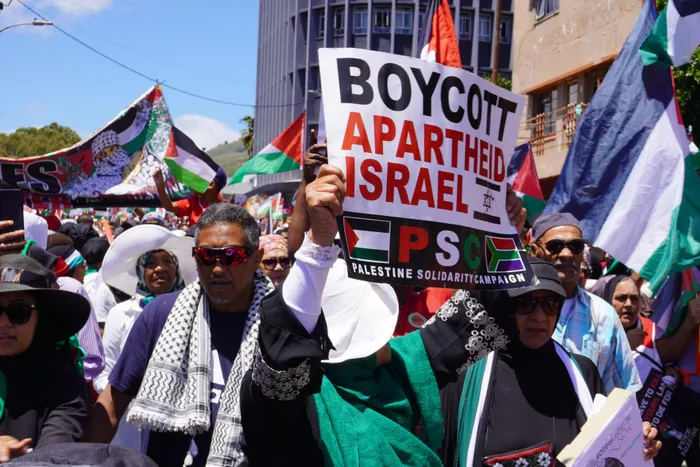
Dear SA has asked South African to comment on a Private Members Bill brought by Al Jama-ah tjat seeks to criminalise support for Israel.
Image: File
The organisation Dear SA has urged South Africans to have their say on a Private Members Bill drafted by Al Jama-ah party seeking to criminalise support for Israel. It has so far garnered 50,000 responses to its online call for participation.
"Al Jama-ah has introduced a Private Member’s Bill aimed at criminalising support for what it describes as an “apartheid state” in Israel. The initiative to domesticate the 1973 UN Apartheid Convention into South African law has ignited heated discussions within the political landscape of the nation.
"The Bill, championed by Al Jama-ah leader Ganief Hendricks, carries significant implications, marking a potentially pivotal shift in how South Africa engages with international human rights issues.
“Israel is an apartheid state and those South Africans who support it, are therefore complicit and must face the full might of the law,” Hendricks declared emphatically. His statements suggest a direct linkage between support for Israel and the perpetuation of apartheid, asserting that individuals backing Israel may face criminal charges under this proposed legislation.
While South Africa has already recognised apartheid as a crime against humanity under the Rome Statute Act of 2002, the Bill aims to enhance legal definitions, creating a stand-alone crime with a broad scope that includes extraterritorial implications. If passed, South African courts would have the authority to prosecute individuals—regardless of their location—if they are accused of supporting, committing, or aiding acts of apartheid, particularly in relation to the ongoing Israeli-Palestinian conflict.
Dear SA said the Bill, though introduced by Al Jama-ah, is not a solitary endeavour; it has been piloted on behalf of a coalition comprising eight political parties, including the African National Congress (ANC), Economic Freedom Fighters (EFF), and the Pan Africanist Congress (PAC). This broad cross-party support within what is termed the “progressive” bloc of Parliament underscores the potential significance of the proposed legislation.
Proponents of the Bill tout it as a moral imperative, aiming to close the “impunity gap” that allows human rights violators to escape accountability. Advocates highlight the necessity of aligning South African law with international legal standards, referencing ongoing cases at the International Court of Justice (ICJ) and the UN Convention as foundational support for their argument.
However, dissenting voices in the political sphere raise substantial concerns. Critics argue that the Bill’s provisions may be constitutionally vague, challenging the practicality and enforceability of its terms. They worry that it may serve primarily to antagonise Israel and divert essential parliamentary resources from pressing domestic issues. As the debate unfolds, the viability of the Bill will be tested against these critical perspectives.