

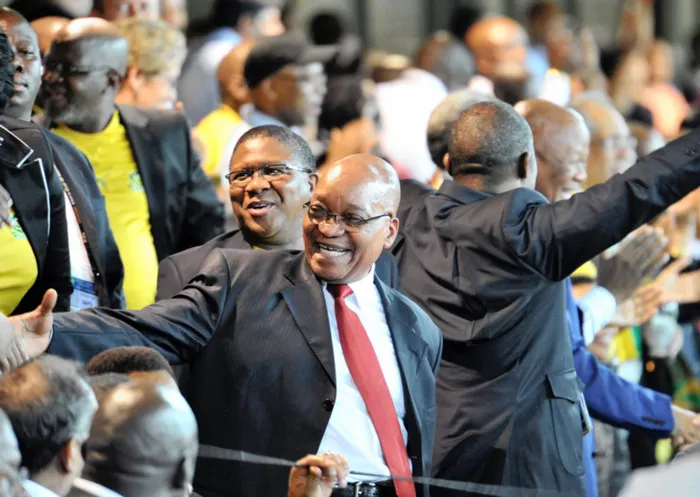
ON THE BALL: President Jacob Zuma is joined by Minister of Sports Fikile Mbalula in celebrating Bafana Bafana's opening goal against Mali on Sunday. The writer says South Africans no longer expect that Zuma will be answerable to accountability. ON THE BALL: President Jacob Zuma is joined by Minister of Sports Fikile Mbalula in celebrating Bafana Bafana's opening goal against Mali on Sunday. The writer says South Africans no longer expect that Zuma will be answerable to accountability.
The January issue of The Economist has as its cover page a picture of US President Barack Obama looking at himself in a mirror as he puts on his tie, with the headline: “How will history see me?” If one had to extend this question to our president, would he even care? Accountability in the “new” South Africa is an alien concept.
On a daily basis South Africans are talking openly about the level of corrupt practices in the government. Engaging with a lone fisherman on an embankment one evening we asked him whether it was safe for him to be fishing alone at night.
He assured us, in jest, that it was a lot safer than what the government was doing in stealing the people’s money. He was a simple, uneducated man, but he seemed to have a bold and clear view of how his country was being ravaged. So widespread is the malaise that this sentiment is spreading daily in every corner of our country – not without justification. There are rumours, half-truths, personal tales and interesting stories circulating in our popular parlances about the corruption our leaders engage in.
The media is filled with depressing stories and e-mails are flying back and forth among readers. Are we rapidly losing the moral war against corruption?
In the face of this, our leaders pull out their political credentials from the past to justify their plundering exploits. Self-deception, denialism and false accusations against the media and enemies of the state emerge as collective paranoia.
The recent exposé of the Maharaj family feud is just a drop in the ocean of corrupt practices. Mac’s sister-in-law, who has spilled the beans on kickbacks, tenders and private Swiss accounts, will be dismissed as a neurotic. She will not be lauded for her moral stance in disapproving of such practices.
Our president’s imbongi (praise singer), a once “upright fighter for freedom”, will simply rationalise his behaviour and dismiss criticism as a political ploy to discredit him.
Currently we see that South Africans are divided along a tessellated landscape of a number of divisive forces.
There are those who pander to the government for personal gain and there are the quiet resisters, who are hanging on to some sense of morality. Both camps love their country for different reasons. Let’s call them the procurers and the critics. The procurers see themselves as the winners and the critics as the losers, crying foul because they are not ahead of the game.
I received a call from a close friend who I feel is a living example of a successful businessman who hasn’t compromised himself in seeking government tenders. He worked very hard in the apartheid days, travelling throughout the country, sleeping in his car as he manoeuvred his way through racial slurs and closed hotel facilities.
Now, after all the apparent free opportunities for trade, this businessman is scarred by the corrupt practices that he has had to contend with in the new South Africa. Pay up front for a licence; give more than 50 percent to black partners regardless of the fact that many, not all, have little financial acumen in terms of cash or competency to add to the pseudo-partnership.
“I want to be clean,” he says, “but how can I when I am expected to pay a sum of money up front before certain government officials will even consider my proposal? I am giving jobs to so many unemployed youth. I have trained them and given them a sense of hope. If I do not give in to these demands I will be a loser. Yet my conscience will not allow me to make this compromise… What do I do?”
This is not an isolated story. The grapevine is laden with “fruits of wrath” as the leeches feed hungrily on its nectar. An important observation made by Raymond Louw, a former editor of the now defunct Rand Daily Mail, applies. He observed that the newly rich black capitalists have not, on the whole, displayed much talent in creating wealth. They use their racial status to demand as large a share as possible of the existing wealth generated by their non-black counterparts.
A partnership is then forged on the basis of a symbiotic dependency, where one group provides the political badge of opportunity based on their connectivity to the ruling party and the other provides the expertise and knowledge. It’s pretty much like a beehive of worker bees and queen bees, except for the fact that there are more queen bees than worker bees in our hive.
The by-products of corruption are too horrific to contemplate. Like a cancer it will eventually eat at the very core of the nation, destroying its people and ravaging its natural resources and downgrading its infrastructure until the old dream of a free South Africa will dissipate into thin air.
Do we want this? Did we applaud our freedom fighters to free us for the purposes of the sole mandate to plunder? Whose country is this anyway? All thinking and feeling South Africans must and should stand up together against corruption.
Through the churches, mosques, synagogues and temples let the sermons flow on the virtues of morality and our duty to the poor, disempowered masses.
l Dr Devi Rajab is a psychologist, academic and author.