

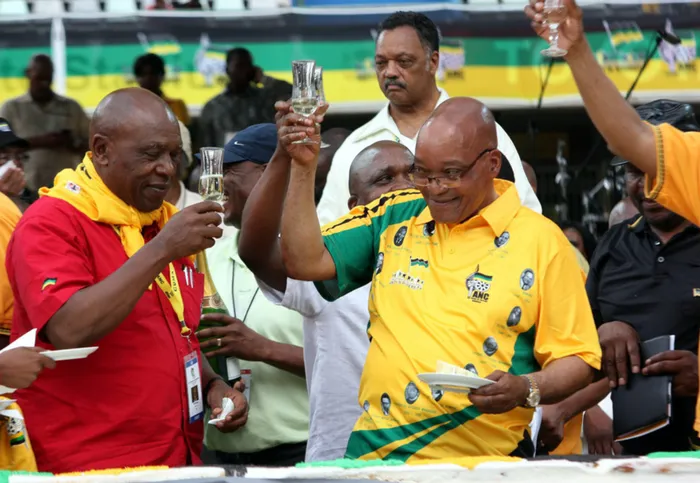
PARTY TIME: Tokyo Sexwale, left, and President Jacob Zuma share a toast in the packed Free State Stadium at the ANC's centenary celebrations held in Bloemfontein on Sunday. Zuma lost the plot in claiming unequivocal successes in every area of the ANC government administration, says the writer. Picture: Motshwari Mofokeng PARTY TIME: Tokyo Sexwale, left, and President Jacob Zuma share a toast in the packed Free State Stadium at the ANC's centenary celebrations held in Bloemfontein on Sunday. Zuma lost the plot in claiming unequivocal successes in every area of the ANC government administration, says the writer. Picture: Motshwari Mofokeng
If there is anything one learns as an educator, it is that no matter how great a lecture, listeners have an attention span of little more than 35 minutes.
For any longer presentation, one would have to stand on one’s head to keep them entertained.
So when our president delivered a two-hour speech at the centenary celebrations of the ANC, he was pretty much talking to himself.
The only positive aspect of a long speech is that one can come and go as one pleases, daydream, sleep, wake up and take loo breaks. No wonder the Germans say “Zeit ist Geld”– time is money.
We seem, as a nation, to wantonly waste time rather than use it to good purpose.
I heard snippets of the speech in my car and I must say our president has a lovely sonorous voice and a smooth cadence in his delivery. One could almost fall under his spell if one allowed the intellect to slip.
As he went on to claim unequivocal successes in every area of the ANC government administration, from housing to health, education to social welfare and even crime and corruption, it was so clear that he had lost the plot completely and was trying to reduce us to a state of perpetual gullibility.
Does he not know or does he not care about the shocking health facilities offered at hospitals?
Does he not know about the appalling state of our education system, about the corruption in the police force, about wanton crime that is claiming the lives of South Africans daily?
Does he not know of the crippling unemployment of our young people, of the grave shortage of suitable skilled labour?
Does he not care about how he has been responsible for sullying the ANC name in trying to thwart the freedom of the press and compromise democracy?
A good leader fearlessly acknowledges the ghosts that hamper our progress as a nation and balances the roles that he has to play as a president of a nation and as a leader of a political party.
They are not the same, but each has its place in our history and our democracy.
The question arises: what does one celebrate as the years go on?
Longevity or endurance?
Growth or deterioration?
Tradition or change, metamorphosis or calcification? Harmony or discontent?
In celebrating 100 years of an organisation such as the ANC, one remembers the history of the Struggle and in the process painfully recall the trials and tribulations of great stalwarts.
It is also an opportunity to assess the psychological legacy of three centuries of colonial rule, culminating in apartheid, and to take stock of the deeply embedded psychological damage to people.
In his book Black Skin, White Masks, Frantz Fanon outlines the debilitating effects that institutionalised racism has on the minds and personalities of oppressed people, long after the event.
Victims tend to see the world through the eyes of their oppressors and accordingly imitate their actions.
The hierarchical nature of such societies presents the ruling class as culturally superior and oppressed masses as culturally inferior. When the oppressed end up adopting this view, they become alienated from themselves and their cultures.
Fanon calls this the “scarring of the black psyche”.
Some of the symptoms of this condition include a socially induced inferiority complex, self-hatred, low self-esteem, racial jealousy, suppressed aggression, anxiety and sometimes a defensive romanticisation of indigenous culture and a self-embellishing, cultural narcissism.
In the new SA there is ample evidence of these symptoms.
We see it in the expensive lifestyles of an emerging wealthy class – for example, in the indulgence of magnates who eat sushi served off the bellies of young, nubile, multi-hued women.
Also, the call recently by Julius Malema for white domestic workers to replace black ones may be interpreted as the ANC Youth League leader having an unresolved issue with racism. Though many may say Malema grew up outside of apartheid, the impact of being a child of a lesser race group is deeply embedded in his psyche.
Steve Biko recognised this syndrome when he stressed that psychological and cultural liberation of the black mind was a precondition for political freedom and urged black South Africans to reclaim their minds.
In the light of this, the time has come for the ANC to stop wasting funds on parties and to leave behind a heritage that is tangible and memorable to all South Africans in particular and the world in general.
Why not build a museum that documents the Struggle and highlights the lives of all the stalwarts for eternity?
l Devi Rajab is a psychologist and author of several books, the most recent being Women: South Africans of Indian Origin (Jacana, 2011)