

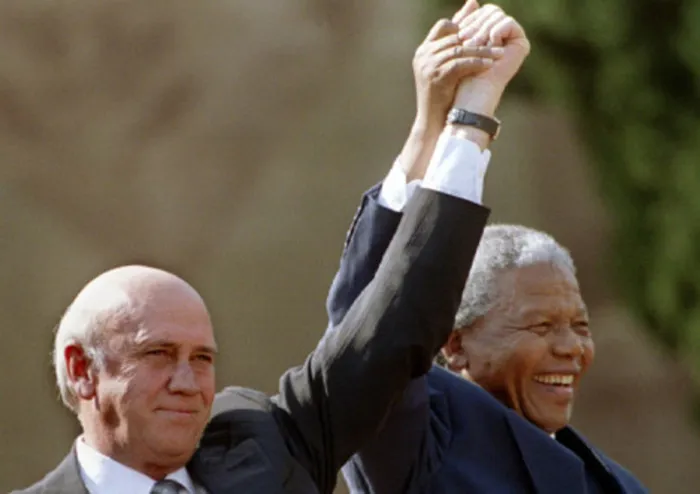
FW de Klerk led the National Party out of the Government of National Unity with Nelson Mandela's ANC, harming reconciliation aims. REUTERS/Juda Ngwenya/Files FW de Klerk led the National Party out of the Government of National Unity with Nelson Mandela's ANC, harming reconciliation aims. REUTERS/Juda Ngwenya/Files
Not only is it a myth Madiba brought about unity in the 1990s, but he linked restoration to nation-building, says Joel Netshitenzhe.
Nelson Mandela was a representation of our being as a nation; an embodiment of what we stand for and aspire to. But, repeated as ritual, the words of praise can become the stuff of folklore; they can lose their meaning, become tiresome and annoying, and evoke dissent. All the more so if elements of Mandela’s legacy are cited out of context or for opportunistic gain.
Remembering Mandela encourages us to learn from history, to interrogate its varied interpretations, and to draw appropriate lessons for the long walk that has not ended.
This applies to the notion of reconciliation that has become associated with his name. It would not be correct to select a particular time in history, the 1990s, and elevate it as being representative of Mandela’s leadership attributes.
The popular mythology about Mandela and reconciliation can overlook the fact that when it became apparent that change could not be extracted from the powers that be, he and his peers mobilised for intensified mass action and armed struggle.
By the time they were released from prison, the apartheid regime had realised it could not defeat the popular revolt. However, the liberation movement had not mustered the capacity to defeat the apartheid regime.
As a consequence, the leaderships of the contending forces concluded that continued conflict would result in a wasteland.
We can take a leaf out of the first chapter of Marx and Engels’s Communist Manifesto: “The history of all hitherto existing society is the history of class struggles. (The classes) carried on an uninterrupted, now hidden, now open fight, a fight that each time ended in a revolutionary reconstitution of society at large or in the common ruin of the contending classes.”
The question is whether, having averted that “common ruin”, South Africa has attained the ultimate purpose, the revolutionary reconstitution of society, or significant progress towards this.
The theory and praxis of reconciliation need to be understood as more than the cuddly embrace of Mandela and the Rivonia grandfathers. Reconciliation was an instrument of revolutionary change.
What do we mean by this?
First, given the global and domestic balance of forces then, it became necessary to use negotiations to capture a beachhead from which to attain the long-term objective of racial and gender equality in political, social and economic relations.
Second, with South Africa’s reality of colonialism of a special type, characterised by a large settler community who had developed deep roots, the responsibility of transformative leadership also meant the obligation to lead that settler community.
It was necessary, through persuasion, incentive and disincentive, to make it realise its long-term interests could be served only by the liberation of the majority of the people, which would also constitute its liberation.
Third, the compromises were a means to an end, not an end in themselves. That end is articulated in the basic law of the land; and on those issues of principle, Nelson Mandela, more than anyone else, was not prepared to compromise.
As a consequence, we emerged from negotiations with a constitution that not only guarantees political freedoms, but which encompasses economic, social, environmental, gender and informational dimensions.
And so, we had tactical acumen to manage a delicate transition, without compromising on the content of the ultimate objective. Mandela fully appreciated that reconciliation and restoration were conjoined. Over and over again, he coupled “nation-building and reconciliation” with “reconstruction and development”.
The impression is sometimes created that the constitution is to blame for the woes that persist, particularly the high rates of unemployment, poverty and inequality.
The land issue illustrates this even more starkly. The country has not met its target for land restitution and redistribution - 30 percent by 2014. Some have laid this failure at the door of the constitutional settlement.
Is this true? To quote then-Deputy Chief Justice Dikgang Moseneke, speaking at the 2014 Mistra conference on 20 years of democracy: “The constitution does not protect property. It merely protects an owner against arbitrary deprivation. Deprivation that is not arbitrary is permissible.
“The property clause does not carry the phrase willing buyer, willing seller’, which is often blamed for an inadequate resolution of the land question; Market price is but one of five criteria the constitution lists for a court to set fair compensation.”
In 20 years our court has not resolved a single case of land expropriation by the government for a public purpose. The courts have not been called upon to give meaning to the property clause in the context of land expropriation or to decide what is just and equitable compensation.
The Community Survey released earlier this month by Statistics SA confirms that the social profile of our nation has changed for the better in terms of, among other things, educational attainment; access to water, electricity and other basic services; people living below the poverty datum line; life expectancy; and the absolute number of people in employment.
However, to each achievement there is a qualification. More people may be employed, but they account for a much smaller proportion of the economically active population; more people may have access to basic services, but the quality of these services in many instances leaves much to be desired; fewer people may be living below the poverty datum line, but the intensity of poverty has increased; income inequality between black and white may have declined, but inequality in the black community has increased.
What is the relevance of this to reconciliation and transformation? If, as Mandela argued, these objectives need to be coupled, then we should accept the reality that reconciliation is nothing more than work in progress.
The belief that, under the first democratic national administration, we were reconciled, and that this reconciliation unravelled after Mandela, is misplaced.
It can be argued that we could have moved much faster. But we should not exaggerate that possibility. The policy choices made had to take into account realities, such as the availability of resources, the inherited macroeconomic environment, and the global macroeconomic paradigm.
Subjective factors also inhibited faster movement. Some may prevail today, and new ones have emerged.
The social tinder that is society, reflected in poverty, unemployment and exclusion, is threatening to catch fire on a grand scale. This is in part because, among the privileged, the narrative continues to rationalise entitlement to historical privilege; greed continues to manifest in income differences that defy description; and workers and the poor are not embraced as kindred spirits, but seen as irritants.
The social tinder is becoming more flammable because the hope that has sustained the poor is starting to dissipate. Expectations rise with progress. But the decline in hope also derives from poor state capacity, an element of which is a result of poor employment decisions in government, instability in senior management structures, and irrational approaches that encourage mediocrity and corruption in state-owned enterprises.
The social tinder threatens to ignite because the conduct of elements of the leadership leaves much to be desired, with some showing the middle finger to state legality and legitimacy. This creates an opening for those who all along have sought to undermine transformation, to act out their racist ideas.
Some leaders seem so taken with the power they temporarily wield that they can sabotage the cause of social transformation.
All this boils down to quality of leadership across society. Mandela and those who led the negotiations process understood each sector had a role to play.
It is in part because of a weakness of leadership - especially in relation to the white community - that elements of the founding political pact were sullied. While the liberation movement, under Mandela’s leadership, continued to counsel patience in its constituency, the National Party withdrew from the Government of National Unity, and the Democratic Party adopted a “fight back” approach that encouraged resistance to change.
Both parties played to the base instincts of a white community apprehensive about transformation, and this had the effect of hardening attitudes. But that is about history!
Today, South Africa has an appropriate frame of reference for a new level of partnership: to translate the political pact of the 1990s into a social compact as envisaged in Vision 2030 and the National Development Plan (NDP).
If each sector were to identify and implement actions required of them to realise objectives set out in the NDP, we would move on to a higher growth and development path.
All sectors would have to embrace the discomfort of making compromises, without abandoning the ultimate objective, and appreciating that the path to a better life is a long one.
In Mandela’s words, “with freedom comes responsibilities, and I dare not linger, for my long walk is not yet ended”.
* Netshitenzhe is the executive director of the Mapungubwe Institute (www.mistra.org.za). This is a collection of extracts from a presentation at the Nelson Mandela Annual Seminar organised by Unisa and the National Institute for Humanities and Social Sciences.
** The views expressed here are not necessarily those of Independent Media.
The Sunday Independent