

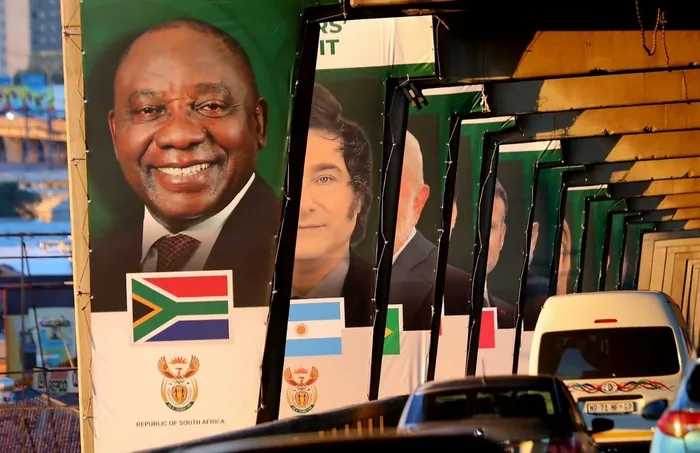
The uMkhonto weSizwe Party has issued a scathing critique of the G20 Leaders' Declaration adopted in Johannesburg, calling it a reinforcement of 'neocolonial economic domination' that undermines African sovereignty while falsely claiming to embody Ubuntu principles. The G20 Summit concluded today.
Image: TIMOTHY BERNARD Independent Newspapers
The uMkhonto weSizwe (MK) Party has sharply criticised the recently adopted G20 Leaders' Declaration, dismissing it as a continuation of global power imbalances and an assault on African sovereignty.
In a statement released on Sunday, the party said the declaration, adopted in Johannesburg, was "not a triumph for the African continent" but rather a document reinforcing "neocolonial economic domination" under the guise of multilateralism, solidarity and Ubuntu (humanity).
The MK Party argued that the declaration was drafted to entrench global hegemonies whose interests include controlling African minerals, shaping fiscal policies and dictating energy transitions.
According to the party, the G20's use of the term Ubuntu amounted to "philosophical theft", accusing global powers of appropriating African moral language while sustaining systems that limit African agency through international financial institutions.
"The G20 cannot coexist with a global financial architecture that enforces debt dependency and dictates national policies to African nations," the statement read.
Criticisms of Debt and Financial Frameworks
The party also criticised proposals on debt transparency, IMF-World Bank leadership in debt restructuring and the call to strengthen the Common Framework, claiming they placed debtor nations at the mercy of powerful creditor states.
"These are not solutions. They are chains," the MK Party said, through its national spokesperson Nhlamulo Ndhlela.
The party accused G20 states of ignoring their own roles in global instability, military interventions and resource extraction, while presenting themselves as partners in development.
Energy Transition and Critical Minerals
Significant criticism was directed at the declaration's Just Energy Transition commitments. The MK Party said these frameworks imposed externally engineered models that threatened national autonomy and ignored Africa's right to industrialise using its own pace and resources.
The party argued that G20 proposals on critical minerals amounted to a new scramble for Africa, warning that the G20’s "Critical Minerals Framework" risked becoming a de facto governance tool over African mineral policy.
Global Governance and Representation
MK dismissed the G20's proposal for a "25th chair for Sub-Saharan Africa" at the IMF as cosmetic, claiming it offered representation without power or reform.
It accused the IMF and World Bank of upholding global inequality and said African nations remained marginalised within the quota-based voting system.
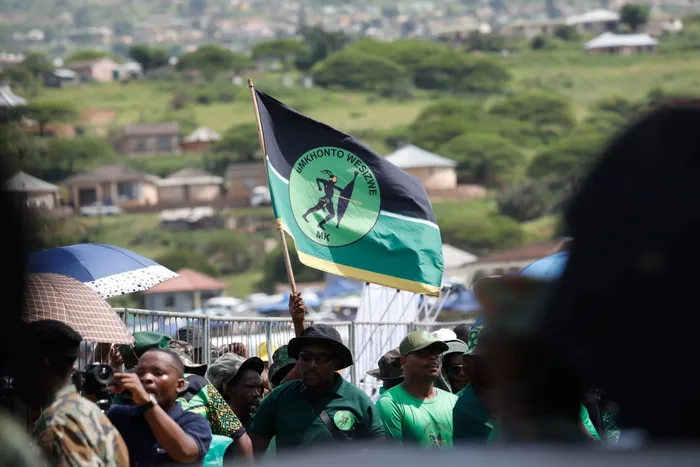
The uMkhonto weSizwe Party has branded the G20 Leaders' Declaration which was adopted in Johannesburg in the historic G20 held for the first time on African soil a reinforcement of neocolonialism.
Image: DOCTOR NGCOBO Independent Newspapers
Concerns Over Trade, Taxation and Digital Governance
The statement further criticised references to open agricultural trade, international tax conventions and digital governance frameworks, arguing that these initiatives could erode African nations' ability to design independent economic and development strategies.
Party’s Vision for Africa
The MK Party said Africa did not need a G20 "speaking on its behalf" but rather a development path based on:
economic liberation from external control,
domestic mineral beneficiation,
independent fiscal and monetary policy,
a people-centred energy transition,
an African financial architecture outside Bretton Woods institutions, and
protection of land, agriculture and food systems from global market capture.
MK Party's Commitments
Should it come into power, MK said it would pursue state-led industrialisation and beneficiation, reject IMF/World Bank conditionalities and promote African-centred financial models.
It also pledged to reclaim energy sovereignty and advance development partnerships based on reciprocity.
The party concluded by asserting that South Africa "must not be a junior partner in global forums" but should instead position itself as "a leader in the struggle against global inequality, resource exploitation and neocolonialism."
SUNDAY TRIBUNE