

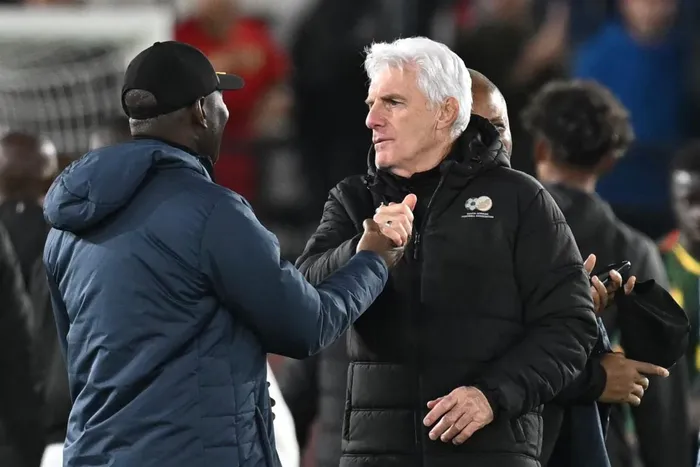
South Africa's head coach Hugo Broos (R) shakes hands with Cameroon's head coach David Pagou after the Africa Cup of Nations (CAN) round of 16 football match at Al Medina Stadium in Rabat earlier this month.
Image: Paul Ellis/AFP
Bafana Bafana will undergo a significant transformation, with coach Hugo Broos identifying specific tactical improvements.
These include defensive organisation and attacking patterns, as well as mental resilience strategies like focus and stress management, ahead of the 2026 FIFA World Cup.
Broos, a seasoned tactician, will revisit the team’s tactical approach after the AFCON disappointment. He will integrate modern football philosophies that emphasise ball retention, quick transitions, and an attacking style that creates scoring opportunities.
Here are five factors that will help Bafana Bafana make a significant impact on the world stage.
It will be crucial for the squad to engage in international friendly matches that reflect the playing styles of their group opponents, fostering confidence and optimism among fans and players alike.
The friendlies not only set the stage for the matches during the tournament but also foster optimism for the nation that will rally around the team.
The yellow-card debacle served as a glaring example of the current management’s ineptitude.
The recent AFCON logistics fiasco in the last-16 round. Management failed to heed CAF’s advice on the need for feedback, a critical oversight that occurred five months before the tournament.
These issues have underscored the pressing need for a leadership overhaul, inspiring confidence in a stronger, more capable team on the world stage.
Bafana Bafana’s current leadership appears to lack this essential sophistication, making it imperative to ‘cast out the dead wood’ and bring in leaders who possess the foresight and capability required for international competition.
By now, the coaching staff would have evaluated performance data and player fitness during AFCON. The landscape of international football is evolving, and adaptability is key.
Managers must dissect match footage, identify potential gaps, and judiciously assess the bios of players currently in form, especially those plying their trade in the domestic leagues abroad.
It follows that there should be a strategic overhaul in player selection to strengthen the squad’s chances against their World Cup group opponents.
At AFCON, in Morocco, it became clear that the team's spirit fell short of expectations.
Such lapses in cohesion can significantly affect a squad’s performance under pressure. To address this shortcoming, Broos must take concerted steps to cultivate an environment conducive to teamwork and collaboration.
As the team looks ahead to the World Cup, building team spirit and cohesion must be prioritised. In a sport where every moment counts, unity could very well be the missing link to unlocking the squad’s true potential.
To prepare for the rigours of the World Cup, Broos must focus on strategies to strengthen players’ mental resilience. This includes working with sports psychologists and integrating mental conditioning sessions into training routines.
Ensuring players can cope with the pressures of competition at this level will not only help them perform better but will also build confidence both individually and as a team. Mental resilience plays a pivotal role in a team’s overall performance.