

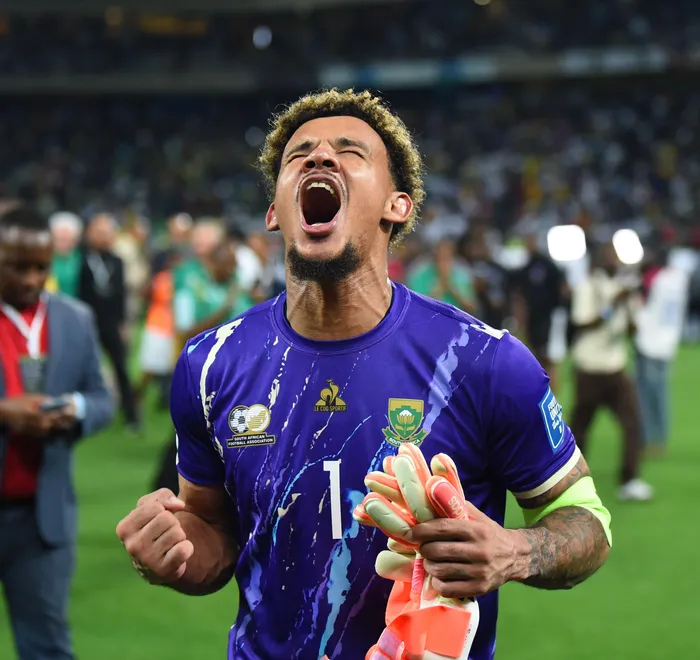
Ronwen Williams led Bafana Bafana wil aplomb this year. Photo: Backpagepix
Image: BACKPAGEPIX
South African football has rarely felt as alive as it did in 2025. After years spent searching for identity, consistency and belief, Bafana Bafana finally rediscovered their pulse — and, in doing so, reignited the pride of a nation.
An unbeaten run stretching across the entire calendar year, qualification for both AFCON and the Fifa World Cup, and a surge of promise from the junior national teams signalled a long-awaited revival.
For the first time in a generation, South Africa can look ahead with genuine optimism, convinced that its “football nation” spirit has returned.
Twenty-five games unbeaten — and counting. Bafana Bafana have had a calendar year for ages, so far. They didn’t only create their own fortunes; they also left endearing marks for generations to follow.
It had been almost a lifetime since South Africa last felt like the “football nation” it has prided itself on being — with the national team, who are supposed to carry the country’s torch on the international stage, having fallen into ruin.
But 2025 rewrote that script. The football gods finally rewarded the hard work and resilience of this Bafana team, as they awakened the sleeping giant and guided it back to the biggest continental and global showpieces — back-to-back, and for the first time in 15 years, respectively.
Yes, Bafana will be back in the Africa Cup of Nations this month in Morocco, making a successive return to the finals after their incredible third-place finish in the last edition in Ivory Coast. And that’s why they will be one of the teams to beat.
That’s not all. Bafana will also be one of the dark horses in Morocco due to their return to the biggest stage — the Fifa World Cup, via the upcoming edition in North America — their first since hosting the tournament in 2010.
These achievements would not have been possible without the brains behind the operation: Hugo Broos. The Belgian didn’t only bring together a group of players from across the PSL and a few from abroad, but he also forged a united family that thrived through solid brotherhood.
Broos will be the first to admit that he doesn’t have the most naturally talented squad at his disposal — most of his key players are based locally — but he has players with heart, who have shown that representing the national team is an honour and a privilege.
That was evident when Bafana didn’t only play but fought in Bloemfontein to snatch a draw with Nigeria in the World Cup qualifiers. On another day, the Super Eagles would have landed at Bram Fischer Airport almost certain of walking away with three points without breaking a sweat.
Of course, Broos will also admit that things could have been better on and off the field. Bafana are head and shoulders above neighbours Zimbabwe, yet they somehow failed to beat the Warriors in the penultimate World Cup qualifier.
Their stuttering also stemmed from nerves, while Zimbabwe knew they needed to frustrate them — especially after being docked three points and handed a 3–0 defeat by FIFA for fielding an ineligible Teboho Mokoena in their 2–0 win over Benin in the March qualifiers.
Granted, Broos and Mokoena were partially to blame for forgetting that he entered that match under suspension, but the buck stopped with team manager Vincent Tseka, who is responsible for all operational matters regarding the team.
Tseka incredibly missed that detail, later giving a flimsy excuse that he had missed the yellow card in the previous qualifier because he had gone to fetch ice for the team. If that was true, it exposed Safa’s administrative shortcomings — where a team manager has to run around collecting ice in the middle of a World Cup qualifier.
Nevertheless, Broos and his side had the final laugh. They left it late in the final qualifier against Rwanda as they shone bright and kissed the stars, helped by an unlikely source — Nigeria — who beat Benin in their last qualifier at home.
Thanks to those combined efforts, Bafana will now play the opening game of the World Cup against co-hosts Mexico on June 11 at the iconic Estadio Azteca — a match rich with sentiment, as it will be a repeat of the 2010 opener on home soil.
It will be important for Bafana not to suffer from stage fright or fear, but to carry courage into their next match, which will feature the winners of the play-offs between Denmark, North Macedonia, Czech Republic and the Republic of Ireland, before they face South Korea in the final clash of Group A.
But before then, there is still the matter of going all the way at AFCON — beginning with winning Group D, which includes Zimbabwe, Angola and Egypt. Bafana are capable of doing exactly that. They have laid the foundation with their unbeaten run this year, and now it’s time to build the structure in Morocco and put the roof on in North America.
The future of Bafana Bafana couldn’t have been brighter in 2025, thanks largely to the efforts of their junior national teams — the U20s (Amajita) and U17s (Amajimbos).
Amajita etched their names into the history books in May when they participated in the Africa Youth Championship — the U20 AFCON — in Egypt and won their maiden title.
It wasn’t only a battle won on the field, but off it as well. With limited preparation on home soil — both on and off the pitch — due to Safa’s shortcomings, Amajita put on the hats of warriors and defied the odds.
The tournament proved rewarding in many ways. Several players, such as Grant Gomolemo, earned promotion to the senior team at Mamelodi Sundowns, while the best player of the tournament, Tylon Smith, secured a move to English Championship side Queens Park Rangers from Stellenbosch’s reserves.
Amajita continued their dominance in the region by winning the COSAFA Region 5 Youth Games tournament after AFCON.
They carried that momentum into the FIFA U20 World Cup in Chile, where they reached the knockout stage — matching the class of 2009, which achieved the same feat in Egypt.
Under coach Raymond Mdaka, the team made significant strides. Mdaka has allowed passion and commitment to youth development to drive him, despite reports that Safa inadequately compensated him. His work saw two of his players, Smith and Shandre Campbell, included in Bafana’s final squad for AFCON.
And that’s not all. One of his standout performers, Mbekezeli Mbokazi, who has already become a regular for Bafana, but he is set to move abroad after next year’s AFCON to join the Chicago Fire in Major League Soccer.
Credit must also go to Amajimbos, who proudly represented the country by reaching the knockout stage of AFCON in Morocco and qualifying for the World Cup in Qatar, where they were eliminated in the group stage.
They will use those setbacks as a learning curve, having already booked their place at next year’s AFCON after winning the COSAFA Cup — an achievement that can only bode well for the senior teams, particularly Bafana Bafana.
October 14, 2025: Bafana Bafana rewrote the history books, erasing a horrific chapter at a stadium long associated with shame.
At a buzzing Mbombela Stadium, Bafana thrashed Rwanda 3–0 to finish top of Group C and qualify automatically for the 2026 FIFA World Cup — their first automatic qualification in 23 years, and the first since they last hosted the tournament 15 years ago.
It was a night that restored the nation’s pride, with both the team and supporters proudly reclaiming the identity of being a “football nation” after years of disappointing records.
And that wasn’t all. New, special memories were made in Mbombela, especially considering that the last time the team played a defining match at the venue, they were involved in the infamous “dance of shame” in 2011, believing they had qualified for the 2012 AFCON.
Ronwen Williams’ 2025 proved why he stood above every South African footballer.
As Mamelodi Sundowns’ first-choice goalkeeper, he delivered one of the league’s best save ratios and led a stable defence throughout the 2024/25 campaign and also helped the side reach the final of the CAF Champions League.
Internationally, he captained Bafana Bafana to their long-awaited qualification for the 2026 FIFA World Cup after anchoring a disciplined, resilient back line into a third place finish at the start of the year in the AFCON.
His excellence earned him nomination for CAF African Goalkeeper of the Year and inclusion on FIFA’s shortlist for The Best Men’s Goalkeeper — recognition placing him among the world’s elite .
These achievements make him South Africa’s standout player of 2025.
At 20-years old, Mbekezeli Mbokazi enjoyed a breakout season with Orlando Pirates, breaking into the first team, becoming vice-captain and earning “man-of-the-match” honours early on.
He made his senior debut for Bafana Bafana in May 2025 and quickly became part of the national-team setup.
Then in December, he completed a major move abroad. Chicago Fire signed him on a long-term contract (until 2029, with a 2030 option), slotting him into their U-22 roster — a sign of serious investment in his long-term development.
With rapid progress from debutant to international and now an MLS transfer, Mbokazi’s 2025 rise marks him as arguably South Africa’s most promising young talent.