

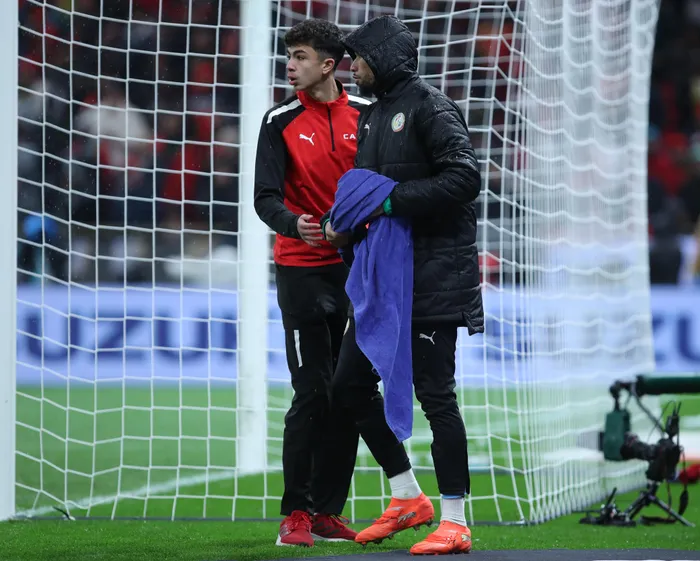
DIRTY TACTICS... From stealing the opposition goalkeeper's towels to other shenanigans, Morocco were undeservingly awarded the Fair Play Award, with their coach also named the best of the tournament.
Image: BackpagePix
With Morocco’s increasing dominance in African football and its world-class facilities, other nations urgently need to enhance their competitive edge or risk becoming mere spectators.
The future landscape of African football hinges on collaborative investment and regional development, a reality CAF is aware of. Kenya, Uganda, and Tanzania were named co-hosts for the 2027 Africa Cup of Nations (AFCON). It will be the first time a tournament returns to the CECAFA region since 1976.
The ongoing controversy surrounding the Africa Women’s Cup of Nations (WAFCON) has raised critical questions about Morocco’s recent ascendancy and the sport’s future competitiveness across the continent.
While the nation has cemented its status as a football powerhouse, other nations must take urgent action to avoid surrendering their football destiny to a single dominant player.
Morocco’s impressive infrastructure investments and its hosting of prestigious tournaments, including successive WAFCON events and the recent AFCON tournaments, underscore its prominence in the region’s football landscape.
As Morocco prepares to host the 2026 edition, the Confederation of African Football (CAF) is under pressure to expand hosting opportunities beyond this single nation.
Despite the need for diversity, Morocco’s dominance in tournament hosting raises concerns. The recent request from Morocco to postpone the WAFCON due to a congested football calendar has sparked widespread debate among analysts and fans alike.
With the nation juggling domestic obligations and plans to co-host the 2030 FIFA World Cup with Spain and Portugal, many speculate that this request reflects deeper frustrations within the Moroccan football establishment.
This tension escalates when considering the aftermath of Morocco’s recent defeat in the Africa Cup of Nations (AFCON) final, where sentiment around the tournament can easily turn contentious.
The emotional intensity within African football often leads to passionate responses, and Morocco’s position seems increasingly precarious.
Hosting rights inherently provide numerous advantages — familiarity with local pitches and the support of passionate home crowds — but even with those benefits, Morocco’s recent history shows vulnerability.
The nation has stumbled at pivotal moments, finishing as runners-up in its last three tournaments as hosts.
Losses to Nigeria in WAFCON 2024, South Africa in 2022, and Senegal in AFCON 2025 spotlight the unpredictable nature of football. These setbacks further raise questions about Morocco’s future as a host of tournaments, especially if the organisation of these events shifts amid growing tensions.
With growing frustration over Morocco’s role in CAF decisions, the question of how this will affect future tournaments looms large.
If CAF turns down Morocco’s request to postpone WAFCON, or if political disagreements escalate to the point of Morocco withdrawing as a host, the ramifications could be significant and far-reaching, with the organisation scrambling to secure viable alternatives.
As the current impasse unfolds, it becomes increasingly apparent that African football is at a crucial juncture.
Other countries must invest in infrastructure and actively pursue hosting rights for these prominent tournaments.
Without collective growth and strategic development, African football risks being overshadowed and defined by Morocco’s capabilities in the sport.