

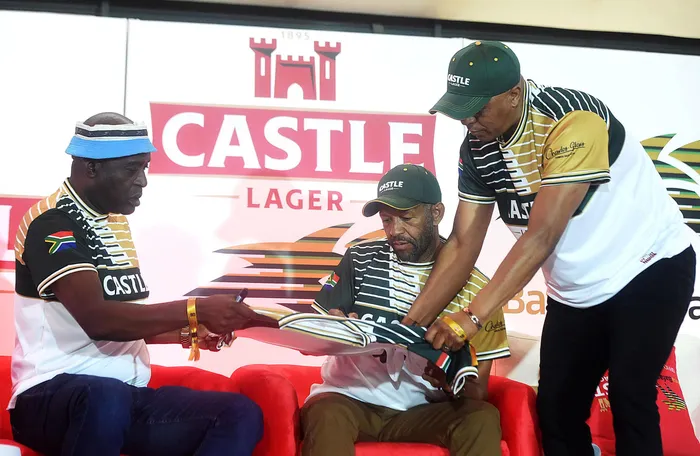
Mark Williams and the Class of 96 remain the standard, but as we look towards the 2026 World Cup, is it time for our legends to take the lead in the boardroom? Photo: Itumeleng English Independent Media
Image: Itumeleng English Independent Media
Three decades on, Mark Williams remains the nation builder: a revered hero celebrated even by those who never saw him play, although he would rather that mantle was passed on to a much younger player.
But until Bafana Bafana win another Africa Cup of Nations or, as predicted by Sports Minister Gayton McKenzie, are crowned world champions at the Fifa 2026 World Cup, Williams and the rest of the Class of 1996 will remain the standard by which all national teams are measured.
There are those who feel it is a sad indictment of the local game that the senior national team has not scaled the dizzy heights of that glorious Saturday on a hot Highveld afternoon at a packed FNB Stadium, when Bafana became African champions.
It is hard to believe that it was exactly 30 years ago today, for the memories of the day remain so vivid. But such is the nature of impactful events: they linger until they are replaced by something better.
As the country remembers that 2-0 victory over Tunisia, the question on many people’s lips is whether the nation's game has improved or regressed since then. The fact that we are yet to win the tournament again supports the notion of regression. Bafana Bafana have only reached the final once thereafter (in 1998) and were bronze medallists on two occasions (in 2000 and three years ago).
It is simply not good enough.
Yet, while no other group of players has shone as brightly as the Class of 96, it would be unfair to suggest the country has not reaped the benefits of hosting and winning the biennial showpiece.
The same core group qualified for a maiden Fifa World Cup appearance in 1998, with the majority participating in France. Because of 1996, young South African players began dreaming big, leading to participation in the 2000 Olympic Games and the 2002 World Cup.
Currently, questions are being raised as to why members of the Class of 96 are not playing an integral part in developing the game at different levels. With Safa's presidential elections approaching, the name of Lucas Radebe — a key defender in 1996 and later Bafana captain — is being bandied about as a potential candidate. However, the reality is that "Rhoo" does not, and probably will not, meet the criteria needed to contest the elections.
Ronnie Zondi, a former professional player with Orlando Pirates and SuperSport United, raised concerns about the exclusion of these heroes from the administration of the game:
“I write with deep concern regarding the continued contradiction in South African football, where the nation proudly celebrates Bafana Bafana’s historic 1996 Africa Cup of Nations triumph, while many former professional footballers remain systematically excluded from meaningful participation in the management and governance of the sport.
"The 1996 AFCON victory stands as a symbol of unity, sacrifice, and national pride ... Yet, three decades later, those same players are largely absent from decision-making structures. Former professional footballers possess invaluable institutional knowledge and a deep understanding of the game’s realities.
"Their marginalisation weakens football development.”
Zondi has a point, but the onus is also on the players to ensure these imbalances are addressed. The reality is that very few former players show interest in administration. Many prefer coaching or becoming TV analysts.
Consequently, the "politicians" continue to run the game, unlike in other parts of the world where former players serve as federation presidents.
Could it be that on this, the 30th anniversary of Bafana Bafana’s triumph, the penny will finally drop for former players?
They are needed in the administration of the game.