

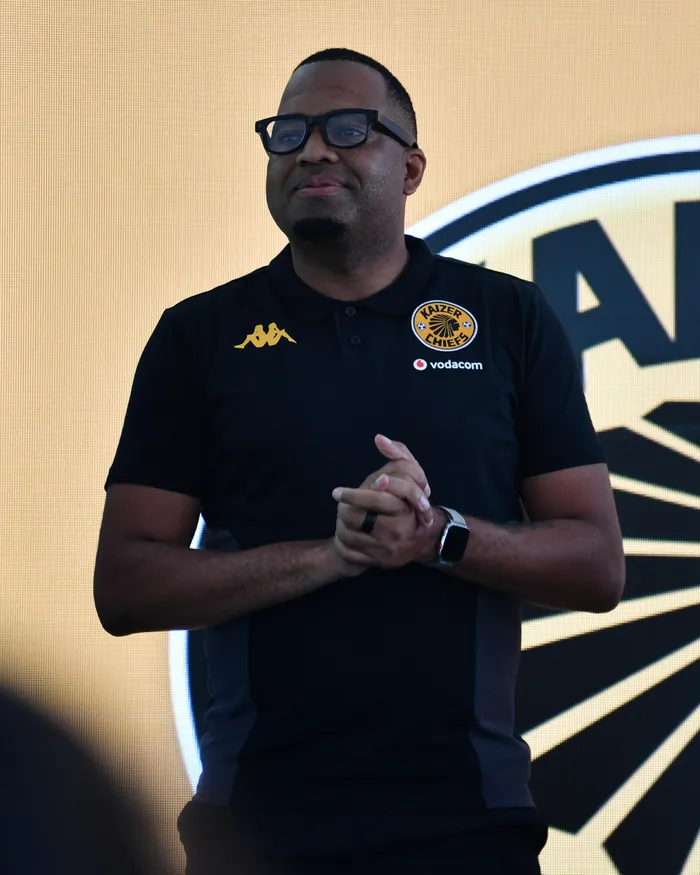
Itumeleng Khune reveals how an accidental miskick on the training ground became his greatest weapon. From Argentina’s Roberto Abbondanzieri to a tactical revolution at Kaizer Chiefs — here is the story of a Mzansi icon. Photo: Backpagepix
Image: Backpagepix
There is a moment in every great sporting career that splits life neatly into a "before" and an "after". For Itumeleng Khune, that moment did not arrive under the floodlights of a cup final or inside a roaring Soweto derby.
It came on a training ground, in silence, disguised as failure. A miskick.
Khune laughs when he recalls it now, but that scuffed strike would eventually morph into the most recognisable distribution style ever produced by a South African goalkeeper. It became a weapon that altered how teams pressed Kaizer Chiefs and how young goalkeepers across the country imagined their craft.
But to understand how that mishit ball became a trademark, you must travel back to a teenage Khune watching grainy footage of an Argentine goalkeeper thousands of kilometres away.
Like many goalkeepers of his generation, Khune grew up studying reflex saves and aerial command. Distribution was an afterthought. The goalkeeper’s job, as convention dictated, ended with the catch. What happened next belonged to midfielders.
And then came Roberto Abbondanzieri.
During the early 2000s, Khune became obsessed with the Argentine’s performances. He hunted down his Boca Juniors clips, analysed angles, and replayed sequences repeatedly, fascinated less by the saves and more by what happened after them. Abbondanzieri didn’t simply clear the danger; he launched attacks.
“He is the one who introduced me to the distribution of the ball,” Khune said, during a group interview at a Chiefs sponsorship event, crediting the Argentine with expanding his imagination of what a goalkeeper could be.
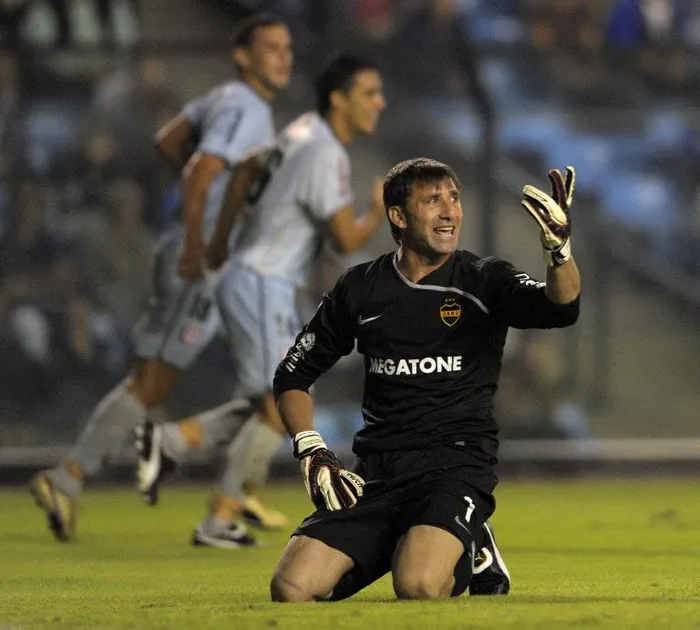
Roberto Abbondanzieri of Argentina. Photo: AFP
Image: AFP
The revelation was reinforced when Boca Juniors faced Chiefs in the Peace Cup in Korea. Suddenly, the theory had a physical form. The technique was not a TV trick; it was executable.
Back home, senior keepers Brian Baloyi and Rowen Fernandes began experimenting with long distribution, bringing fragments of that Argentine influence into the PSL. Khune, still straddling academy football and first-team training, became a sponge. He practised relentlessly.
“When I got promoted to the first team, Rowen and I used to practice it a lot,” he recalls.
Then came the miskick.
During a repetition session, Khune caught the ball awkwardly and his strike skimmed the turf instead of rising high. Instinctively, he cursed the error. But the ball travelled with venom, slicing through the air horizontally and landing perfectly at a teammate’s feet. It was ugly, but it was effective.
“Rowen and Brian were kicking it high. I did a miskick, but it went to the target. And I was like, no, man, let me continue doing more repetitions and hopefully get it right in matches.”
He tried again and again. Khune started chasing the feel of the strike — the exact foot angle, the body lean, the contact point. Hours dissolved into muscle memory. The low, driven trajectory became intentional. He had accidentally discovered a delivery that was faster, harder to intercept, and devastating in transition.
“I did so many repetitions to a point where I made it my own.”
While others lifted the ball high, Khune weaponised the ground-skimming missile. When he broke into regular first-team action, the PSL had never seen anything like it. He didn’t just adopt a style; he made it iconic.
“I made it fashionable,” he chuckles.
Former Chiefs coach Muhsin Ertugral would later underline how perfectly Khune fit the tactical revolution the club was pursuing. A raised defensive line required a goalkeeper who could operate as an auxiliary defender — quick off his line, brave in space, and comfortable receiving under pressure.
Khune ticked every box. Training sessions stretched long after teammates had showered. Specialist goalkeeper coach Rainer Dinkelacker drilled him on short and long passing until distribution was no longer a skill but an instinct. The result was a goalkeeper who treated the ball like a midfielder borrowing gloves.
This evolution did more than elevate Khune; it forced opponents to adjust. Teams could no longer press Chiefs casually; Khune could bypass entire defensive structures with a single strike. Young goalkeepers watching from townships to academies suddenly understood that the position had expanded. A goalkeeper could start attacks.
Khune’s rise coincided with an era when South African football was renegotiating its identity. Technical fluency was no longer optional. Coaches demanded players comfortable in possession. Khune embodied that shift at the most conservative position on the pitch.
Children began imitating his kicks in dusty fields, scuffing boots in search of that laser-guided trajectory. Goalkeeper coaches incorporated distribution drills into sessions that once prioritised shot-stopping alone. A generation recalibrated its priorities.
And yet, Khune insists his innovation was never premeditated genius. It was curiosity layered over discipline. The “triple-Ds” of discipline, determination, and dedication governed his routine. He knew he was inheriting a jersey heavy with history and refused to wear it casually.
“I guess it was the triple-Ds that helped me. I've been dedicated to the game for the longest time. I knew that I was taking the jersey from Brian, who had done so well for the club, and from Rowen, who had even gone overseas.
"As a footballer, you're always motivated to always elevate yourself. By so doing, you just have to remain disciplined and be a hard worker in everything that you do.”
What separated Khune from imitators was not merely the kick but the intelligence behind it. Distribution without decision-making is theatre. Khune scanned constantly: defensive shape, winger positioning, opponent fatigue. His strike was informed by geometry and timing.
The miskick had given him a tool; study turned it into a system. In many ways, that mirrors football’s broader truth. Progress rarely arrives as a lightning bolt; it sneaks in through mistakes noticed by obsessive minds. Khune saw possibility where others saw error, and South African goalkeeping quietly pivoted.
Today, when young keepers fire low missiles into midfield, they are echoing that training-ground accident.
They are participating in a lineage born from curiosity and refined by work ethic. Khune’s career will be remembered for trophies, saves, and leadership. But hidden inside that highlight reel is a scuffed strike that refused to be dismissed — a reminder that innovation often begins with the courage to chase a mistake instead of burying it.
* Matshelane Mamabolo is a veteran football reporter and senior contributor for Independent Media