

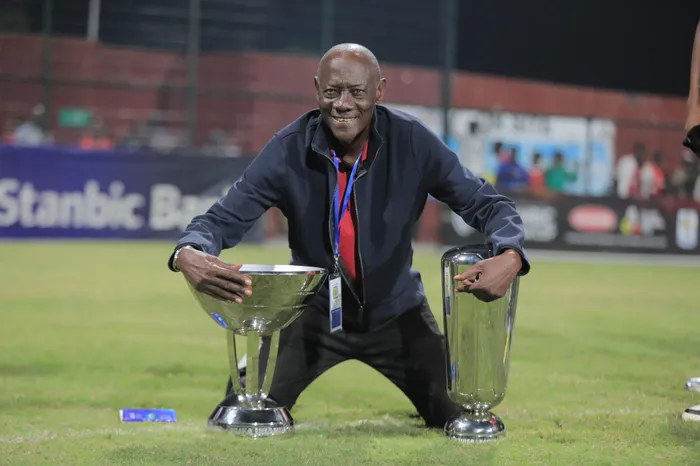
In 1996, while the world watched Mark Williams and Nelson Mandela, one man ensured the football took centre stage. Ugandan referee Charles Masembe shares his incredible journey from the group stages to the whistle that defined a generation. Photo: @OfficialFUFA on X
Image: Photo: @OfficialFUFA on X
Thirty years on, the images remain vivid: a packed FNB Stadium, a nation rediscovering itself through football and a final that would come to define a generation.
When South Africa beat Tunisia to lift the 1996 Africa Cup of Nations, the spotlight quite rightly fell on Mark Williams, on Bafana Bafana, and on Nelson Mandela’s beaming presence. Yet, in the middle of that historic night stood a man whose calm authority helped the occasion become what it was: Ugandan referee Charles Masembe.
Masembe’s story is one of quiet surprise rather than calculated ambition. Even now, he speaks with disbelief about how he found himself in charge of Africa’s biggest match. There were, by his own admission, referees he considered more experienced, more decorated, and more obvious choices.
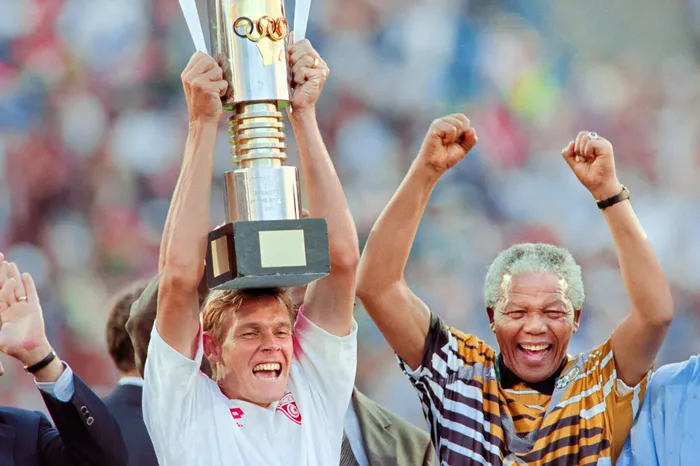
Bafana Bafana captain Neil Tovey, alongside Nelson Mandela, holds aloft the Africa Cup of Nations trophy in 1996. | AFP
Image: AFP
He had handled games in Port Elizabeth, moved on to a quarter-final in Bloemfontein, and quite reasonably assumed that his tournament was nearing its end. That assumption lingered even as subtle signs emerged.
Accommodation arrangements were being made in Johannesburg. Training sessions continued. Colleagues departed, while Masembe remained.
Still, the thought of the final never crossed his mind. It was only in a Johannesburg hotel, during the official appointments meeting, that reality finally arrived.
As the names were read out, Masembe waited to hear where he would fit in. Fourth official, perhaps. Assistant, maybe. Instead, when the centre referee for the final was announced, it was his name that echoed back at him.
“Oh my God,” he recalls. “It is me.”
What followed was not panic, but focus. Masembe speaks of nerves, of barely being able to eat, and of the weight of the moment pressing down on him. Yet he also speaks of faith, of kneeling in prayer, and of finding calm through belief. That inner grounding would be tested almost immediately.
Walking onto the pitch, he was greeted by Nelson Mandela himself. The moment could have overwhelmed anyone. Instead, Mandela disarmed him with warmth and humour, asking after Uganda and President Yoweri Museveni before shaking his hand.
Then came the words Masembe has never forgotten: “You are now South African.”
For a referee, there can be no greater challenge than remaining neutral in a stadium filled with 85 000 expectant fans, all pulling for one outcome. Masembe insists that the handshake with Mandela did not distract him; it sharpened him. It became motivation rather than pressure. He had been entrusted with something sacred, and he was determined to see it through.
The final itself unfolded without controversy — a referee’s dream. Two clear goals, no defining flashpoints, and no lingering disputes. When the final whistle blew and South Africa were crowned champions, Masembe had done what every elite official hopes to do: officiate a great match without becoming the story.
Looking back, that is perhaps his greatest legacy. On a night when history demanded perfection, Charles Masembe delivered it quietly, professionally, and with dignity. In doing so, he ensured that the memories South Africans cherish today remain unclouded by debate, and that Africa’s biggest football celebration belonged entirely to the game.