

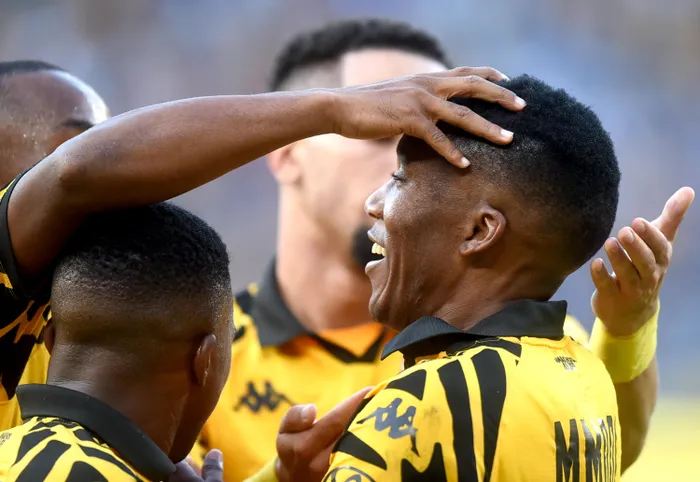
Kaizer Chiefs player Pule Mmodi celebrates after scoring against Orlando Pirates during their Betway Premiership League at the FNB stadium in Soweto this past Sunday. Photo: Itumeleng English Independent Media
Image: Itumeleng English Independent Media
COMMENT
The latest Soweto Derby offered a familiar lesson in South African football — when artistry meets pragmatism, the latter often dictates the outcome. And in this case, Kaizer Chiefs leaned heavily into a “North African” approach to neutralise Orlando Pirates.
The 1-1 draw at the FNB Stadium was not shaped by fluid attacking football, but by control and disruption — exactly the kind of contest Chiefs needed after their 3-0 defeat in the reverse fixture. It was not pretty. It was not fluid. But it was effective.
Across the continent, North African clubs have built a reputation for mastering the so-called “dark arts” — slowing the tempo, breaking rhythm, turning matches into battles rather than spectacles. It is a style rooted in control, disruption and emotional intelligence as much as tactical structure.
Chiefs, coming into the derby off the back of that heavy loss, clearly recognised that going toe-to-toe with Pirates in an open, technical contest would likely lead to the same outcome. So, they changed the script.
Instead of engaging in Pirates’ high-tempo, attacking game, Amakhosi reduced the contest to duels, second balls and moments.
The stop-start nature of the match, frequent fouls, and calculated breaks in play all served one purpose — to prevent Pirates from finding any sustained rhythm. And it worked, even though Tunisian Chiefs coach Khalil Ben Youssef wouldn’t admit to it after the game.
Pirates, the league’s most potent attacking side, were repeatedly forced into frustration. Their usual fluency in the final third was replaced by rushed decisions and broken sequences.
Even their most dangerous outlets found themselves isolated more often than not. This was not accidental. It was strategic.
Chiefs understood the context. They were not the favourites. They were not the more fluid side. But they were the side that could dictate how the game was played.
In many ways, this was less about what Chiefs did with the ball and more about what they denied Pirates without it. The psychological layer was just as important. By turning the game into a scrap, Chiefs dragged Pirates into uncomfortable territory — a space where patience wears thin and decision-making becomes reactive.
The longer the game stayed tight, the more it suited Amakhosi. That is the essence of the North African blueprint.
Critics will argue it detracts from the spectacle. And perhaps it does. But football at this level is rarely about aesthetics — it is about outcomes.
Chiefs, a club with a rich history of expressive football, made a conscious decision to prioritise competitiveness over identity on the day. And given the circumstances, it was a necessary compromise.
For Pirates, it raises questions: When Plan A is disrupted, how quickly can they adapt?
When space is limited and tempo is controlled, where do the solutions come from? Because as this derby showed, the title run-in will not always be played on their terms. Sometimes, it will be a fight.