

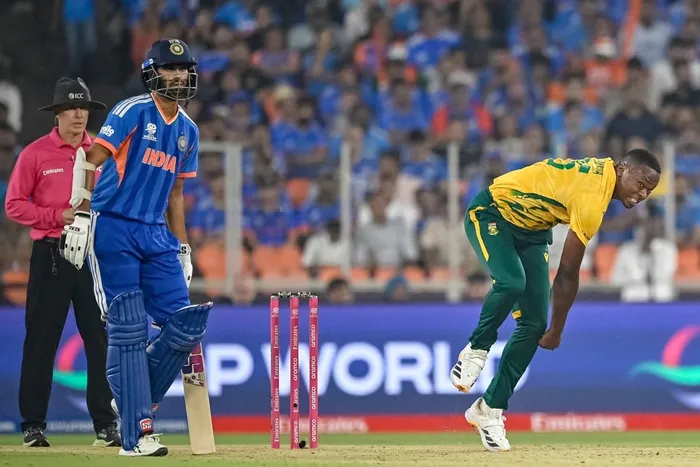
Despite going wicketless against India, Proteas speedster Kagiso Rabada seemed to find some much-needed rhythm at the T20 World Cup.
Image: afp
Seven months ago Kagiso Rabada was on top of the world, having just played a massive role in the Proteas' victory over Australia in the World Test Championship final at Lord's.
Before that, he had spent a month out of the game after testing positive for cocaine, and people were wondering how he managed to perform to his usual high levels without playing any cricket during that time. The question on everybody’s lips was, “What makes Kagiso Rabada such a great of the game?”
At the time, it was a question that made him ponder for a few minutes during a press conference after taking a five-wicket haul in the first innings. He normally answers the media’s enquiries with confidence and in his own laid-back manner, but this one seemed to stump him.
“My attributes… pace, bounce, movement and doing that consistently," Rabada said after a slight pause.
Star Australian batsman Steve Smith had the same response when he was quizzed about Rabada.
“He’s got good skills,” Smith said. “He can shape the ball away; he can nibble it both ways. He’s relentless, he’s always at you, he’s always up for the challenge, he charges in all day. His record speaks for itself, and he showed that again today.”
Upon his return to South Africa, he was asked if he had “stewed over the question a bit more”. This time, however, his answer wasn’t of a technical nature. It wasn’t about his ability to nip the ball both ways with a wobble seam or a deadly accurate bouncer. It was about a trait that makes one rise above the good and into the echelons of the great.
“I guess it’s about being willing to sacrifice everything to get the result that you want. It’s just determination," he said.
Rabada has long stood as South Africa’s premier fast bowler. Yet, as the ongoing ICC Men’s T20 World Cup moved into the high-stakes Super Eight stage, the narrative surrounding the Proteas’ spearhead has shifted from awe to apprehension.
After a difficult start to the tournament, some have begun to question whether he should be dropped, especially after that final over in the match against Afghanistan, where he almost lost the game for the Proteas.
However, to doubt Rabada at this juncture is to ignore the very DNA of his career. "KG" is not merely a fast bowler; he is a big-match player who thrives when the lights are brightest and the pressure is most suffocating.
Big-match players possess a psychological resilience that allows them to compartmentalise failure. Rabada’s difficult start to this tournament is an anomaly rather than a decline. History suggests that for Rabada, a quiet group stage is often the precursor to a deafening knockout phase.
He is a rhythm bowler; as the intensity of the competition increases, his technical precision typically follows suit. In the Proteas’ hammering of India on Sunday, there were signs that it was all starting to come together. He bowled a few deliveries over the 145km/h mark, and, while he didn’t pick up any wickets, it was clear that his rhythm was starting to come back.
South Africa’s bowling attack has been fantastic at this tournament, with Lungi Ngidi, Marco Jansen, Corbin Bosch and Keshav Maharaj stepping into the breach. But Rabada is the emotional heartbeat of the Proteas’ bowling attack and he understands the weight of expectation. Don’t be surprised if he catches fire when the heat is really on, and when his team needs him the most.
Like he said seven months ago, “it’s about being willing to sacrifice everything to get the result that you want. It’s just determination”.
Write off Kagiso Rabada if you must. But one thing is for certain: he hasn’t written off himself.
* John Goliath is Independent Media's Cape regional sports editor and a contributor on The Last Word on Rugby on our YouTube channel The Clutch.