

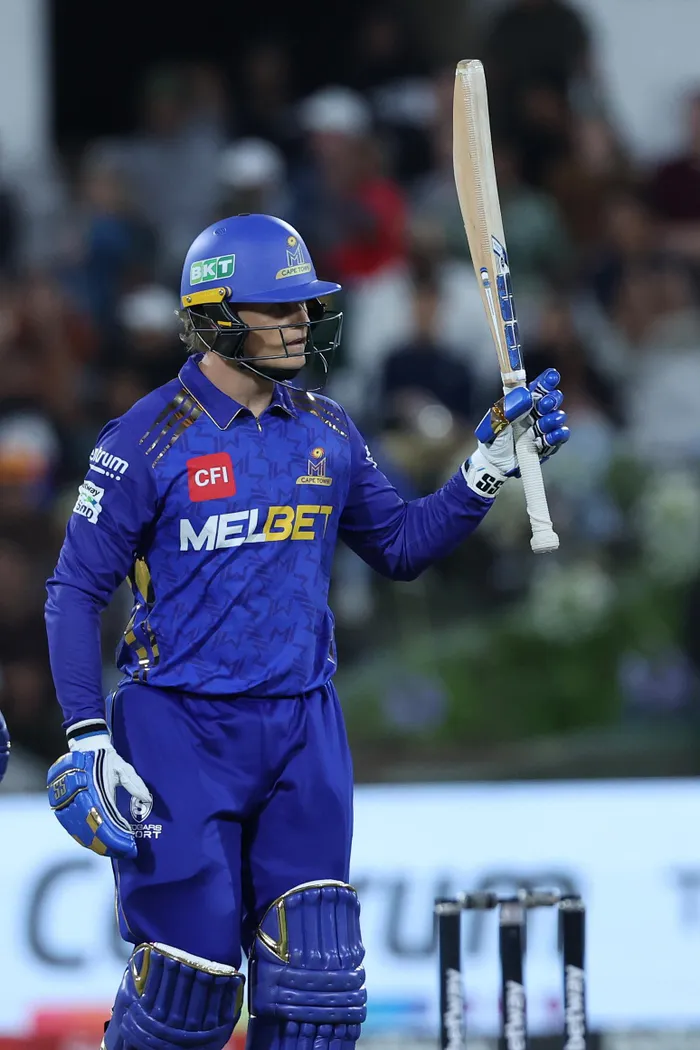
While MI Cape Town's Ryan Rickelton's has set the SA20 on fire, his form for the Proteas has been rather average.
Image: Sportzpics
Everyone who is anyone has had something to say about the Proteas’ T20 World Cup squad—from Kevin Pietersen to the keyboard warriors typing furiously behind pseudonyms on X.
The biggest conjecture has surrounded the selection of Tony de Zorzi and Jason Smith in the 15-player squad. De Zorzi, of course, has not played since the India tour, where he tweaked a hamstring in the second ODI, subsequently missing the ongoing Betway SA20.
In his absence, Ryan Rickelton has hit the lights out for MI Cape Town once again, becoming the first batter to score multiple centuries in South Africa’s premier domestic T20 competition. With every straight drive or pull through mid-wicket, the cries over Rickelton’s exclusion grew louder.
The truth of the matter is that Rickelton competes directly with Quinton de Kock; once the veteran opening bat/wicketkeeper opted to return to international cricket, Rickelton's place was always in jeopardy.
The question you are undoubtedly asking is: why can’t the two southpaws coexist?
Well, for those who may have forgotten, South African cricket operates under a transformation policy. At the national level, the target is a seasonal average of 56% players of colour, with a specific requirement that 25% must be Black African. In a 15-man squad, this roughly translates to eight or nine players of colour, including three or four Black African players. This policy is not about picking players simply because of their race, but rather giving preference when players are of equal ability.
I can already hear the protests: "How are the Proteas expected to win a World Cup if they aren't selecting their 'best' team?" May I remind you that they did just that only a few months ago. With these same policies in place, Temba Bavuma lifted the ICC World Test Championship at Lord’s. Nobody complained then.
That brings me to De Zorzi. The dreadlocked left-hander would be the first to speak out if he were picked purely based on his race. He once engaged in a heated discussion with this very writer about the fact that if his numbers did not add up, he should not be selected.
While De Zorzi doesn't have the domestic statistics to match Rickelton, neither has Rickelton produced the numbers in 18 T20Is (381 runs at 21.16) to suggest he is an automatic starter. De Zorzi, meanwhile, has shown the temperament for clutch moments required at international level.
He has stepped up on recent Test tours when the Proteas desperately needed character, and he possesses the technical requirements to succeed on the subcontinent, where the T20 World Cup is being staged. Let’s not forget De Zorzi’s crucial 78 off 49 balls in last season’s SA20 Eliminator that steered Sunrisers Eastern Cape into the final.
My only concern relates to his fitness, although he is expected to feature in the three-match T20I series against the West Indies at the end of the month before the squad departs.
But what about Jason Smith? How does he get into the squad ahead of someone like Tristan Stubbs? Personally, I would not have left Stubbs behind, regardless of his recent lean international form. From being one of the most dynamic young players in the world, Stubbs appeared to lose his nerve, relying too heavily on switch-hits when looking for a boundary.
However, I would still have had him in my squad ahead of Donovan Ferreira. That was coach Shukri Conrad’s call, placing his faith in the Joburg Super Kings hitter. Once that choice was made, Smith — an MI Cape Town standou t —was always going to be in the conversation. As his teammate Nicholas Pooran exclaimed: “He hits it like a West Indian.”
With the squad now selected, I hope the focus shifts to more pressing concerns: the Proteas' death bowling readiness, the lack of variety among the two left-arm spinners, and, crucially, the form of captain Aiden Markram at the top of the order.