

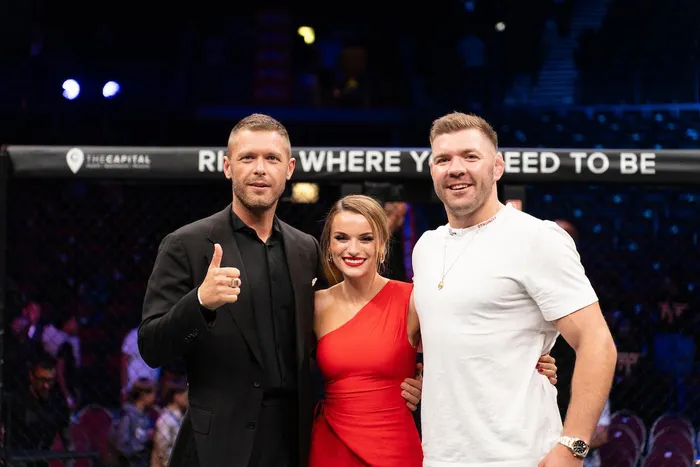
Ethan Hughes, left, Vasti Spiller, centre, and Dricus du Plessis pose for a picture at the EFC KNOX Legacy Series, held at the Grand Arena in Cape Town. Hughes and du Plessis are the owners of a global hydration brand. Spiller is the fiancée of former UFC middleweight champion and South African MMA star du Plessis. Photo: EFC Worldwide
Image: EFC Worldwide
KNOX Hydration is working to help bring two major sporting events to South African shores in the near future.
In an exclusive interview with Independent Media and MzansiMMA, KNOX boss Ethan Hughes confirmed that the company — co-owned by former UFC middleweight champion and South African MMA superstar Dricus du Plessis — is in discussions with key stakeholders to bring both the Ultimate Fighting Championship (UFC) and Newcastle United Football Club to Mzansi.
“From the start of KNOX, we planned global expansion, but we always wanted to stay true to our origins, as we are proudly South African,” said Hughes, who also serves as Business Development Director of the brand.
KNOX has made a significant impact on the local market, with professional athletes, active individuals, and everyday consumers embracing the hydration drink for its replenishment and recovery benefits.
In January, the UFC officially announced a new partnership with KNOX, naming it the organisation’s global Official Hydration Partner outside the United States. This marked a major milestone in the brand’s global expansion and significantly boosted hopes of a long-awaited UFC Africa event.
“With the UFC partnership, we immediately began exploring ways to bring the organisation to South Africa. We’ve already had discussions with the City of Cape Town. It’s still early days, so we can’t confirm a timeline yet, but Niel du Plessis, Cairo Howarth, and I are actively working on it,” Hughes said.
Last month, UFC President and CEO Dana White reiterated plans to expand into new territories, including Africa.
“We are always looking for places we’ve never been,” said White, who recently celebrated his 25th anniversary with the UFC.
“There are still regions we haven’t visited. We’re heading back to Azerbaijan soon for the second time. I also want to go to Georgia, and we’re probably going to stage a fight — possibly this yea r— in South Africa, which would be our first event in Africa,” he told FOX Sports Australia.
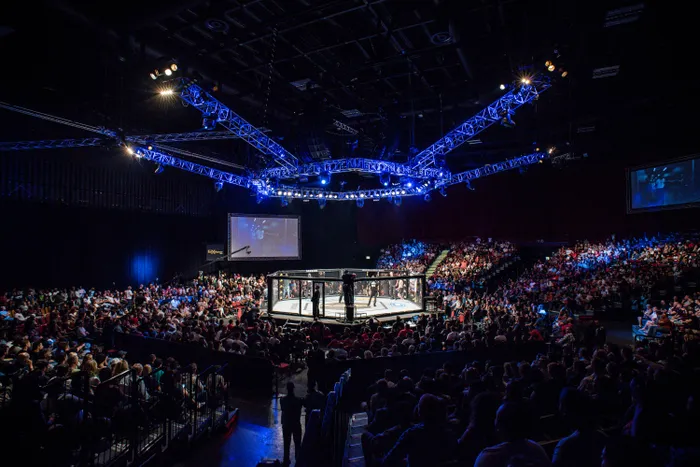
South Africa—and Cape Town in particular—has become a hotbed not only for professional MMA, but more importantly for grassroots and amateur competition, with events held monthly at venues across the city. There is a huge appetite for the sport and its growth; when combined with the Mother City’s appeal as a global tourist destination and one of the most beautiful cities in the world, this could bode well for a UFC event, should the various logistical issues be overcome. Photo: EFC Worldwide
Image: EFC Worldwide
Beyond MMA, KNOX is also targeting football fans. Following its recent sponsorship deal with one of England’s top clubs, the company aims to bring Newcastle United to South Africa.
Sources have told Independent Media and MzansiMMA that plans are underway for exhibition matches in Cape Town, potentially featuring Newcastle United against Bafana Bafana or leading domestic clubs.
However, Hughes has not confirmed any teams yet, saying: “With our official partnership beginning on 1 July, we want to give back to South Africa for its support. We’re exploring the possibility of hosting exhibition matches in Cape Town, with early discussions pointing to a 2027 visit.”
The English Premier League club recently agreed to a £6 million-per-year deal with KNOX Hydration. The agreement includes three-year naming rights to Newcastle’s Darsley Park training ground, as well as a training kit sleeve sponsorship across the men’s, women’s, and academy teams.
While the prospect of both events excites sports fans, skepticism remains—particularly around the feasibility of a UFC event in South Africa.
The idea of UFC Africa has surfaced repeatedly over the years, especially during the dominance of “The Three Kings”: Cameroon’s Francis Ngannou, Nigeria’s Israel Adesanya, and Kamaru Usman, who simultaneously held UFC titles.
Momentum grew further when Dricus du Plessis captured the middleweight title after defeating Sean Strickland at UFC 297.
However, significant challenges remain. Logistics, stadium infrastructure, and ticket pricing are among the biggest obstacles.
Although South Africa boasts world-class stadiums, UFC President Dana White has historically preferred indoor arenas. The promotion has only hosted a limited number of open or partially open-roof events due to concerns around weather conditions, lighting requirements, acoustics, and crowd control.
While the country has stadiums capable of hosting between 40 000 and 90 000 spectators, it currently lacks a large-scale indoor arena with a capacity exceeding 15 000. Even at that size, ticket prices would likely be prohibitively high.
For context, the cheapest tickets at Las Vegas’ T-Mobile Arena (capacity 20,000) typically start at around $300 (about R5 000), while premium cageside seats can reach approximately $45 000 (R745 000).
Adapting such pricing to a smaller South African venue would likely push costs even higher, effectively turning the event into an almost exclusively VIP experience — something the local market may struggle to support.
“Even if we secure a 14 000-seat venue, we don’t have that kind of money,” said Dricus du Plessis on the Sias du Plessis Show.
“Where will we find 14 000 people willing to pay around R10 000 for the cheapest seats? That’s the biggest challenge. That’s why we need a bigger venue.”
At the time, Independent Media also revealed that Cape Town’s executive mayor, Geordin Hill-Lewis, had proposed the possibility of installing a temporary roof over Cape Town Stadium (DHL Stadium), which has a capacity of 55 000. This could align with the UFC’s requirements for hosting a major event in the city.
“Our city engineering teams have been working on an option for a temporary roof over DHL Stadium,” Hill-Lewis confirmed.
The UFC-KNOX partnership may provide the momentum needed to turn ambition into reality. With KNOX now embedded in the UFC’s global ecosystem, the chances of hosting an event in South Africa appear more tangible.
Hughes acknowledges the importance of securing a suitable venue.
“For an event of this scale, we need to create something truly special and worthy of the UFC. We are exploring all options, but the organisation has very specific requirements that must be met.”
It is also understood that South Africa’s Minister of Sports, Arts and Culture, Gayton McKenzie, has engaged with the UFC and recognises the challenges — particularly around affordability. Hughes supports McKenzie’s call for sponsorship to help subsidise ticket prices.
“Our goal is to make this accessible to as many South Africans as possible. That could include subsidised tickets, giveaways, and a comprehensive fan village with public viewing areas,” Hughes added.
While branding discussions—such as potentially naming the event after KNOX — remain speculative, Hughes emphasised that the priority is securing the event itself.
“Our main goal is to make this viable for South Africa first. Branding can be addressed later. As the UFC’s official hydration partner, we already have strong in-arena visibility. Right now, the focus is on bringing the event here and showcasing everything this country has to offer,” said Hughes, who is working hard behind the scenes with Niel du Plessis, Dricus’s older brother.
Hughes believes that even one of these events — UFC or Newcastle United — could have a transformative impact.
“Just one of these events would expose Cape Town to millions of new eyes, from businesses looking to expand into South Africa to tourists discovering its beauty. While there are many hurdles ahead, our commitment to giving back to South Africa is strong, and we have a genuine opportunity to make this happen,” he concluded.
Should Newcastle United make the trip to South Africa, it would mark their second visit, following their 1951 tour of the country during the apartheid era. During that trip, the club played a series of exhibition matches against local sides and representative teams, drawing significant attention.
At the time, Newcastle were a major force in English football, having recently lifted the FA Cup, and their presence in South Africa was regarded as a high-profile occasion for the local game.
In the years that followed, many international sporting bodies imposed boycotts on South Africa in response to apartheid, effectively isolating the country from global competition.