

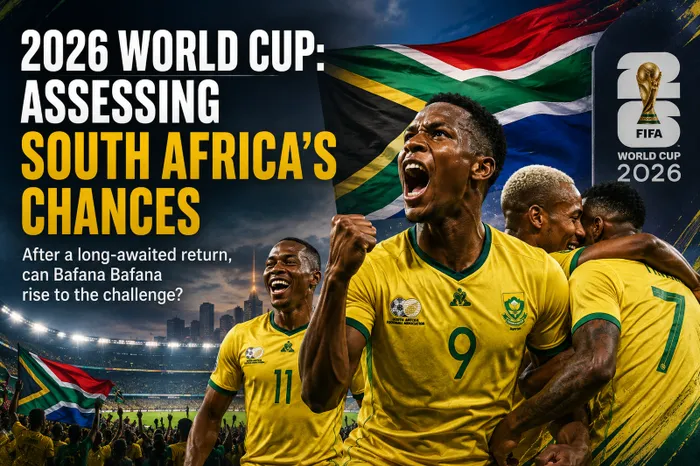
After a 16-year absence, South Africa's Bafana Bafana return to the FIFA World Cup. Can they translate their qualification success into a strong performance against formidable opponents?
Image: Supplied
South Africa’s qualification for the 2026 FIFA World Cup is less a breakthrough moment than a measure of progress. How will they perform at the much-anticipated finals?
After 16 years away from the tournament, Bafana Bafana return not as hosts, as they did in 2010, but on merit, a distinction that carries greater weight in assessing their current level.
Their absence from the World Cup had been defined by inconsistency across qualification cycles, often falling short in decisive moments. This time, however, there was greater control to their campaign.
Drawn into a CAF qualifying group that included Nigeria, Benin, Zimbabwe, Rwanda and Lesotho, South Africa navigated a format that offered little margin for error, with only the group winner guaranteed automatic qualification.
Hugo Broos’ side approached the campaign with a clear plan, dominating opponents when needed, while relying on structure and efficiency in other matches. That approach proved effective over the course of qualifying, allowing them to edge out stronger-profile opposition such as Nigeria.
Even a three-point deduction by FIFA did not derail their progress, underscoring a level of consistency that has often been missing in previous campaigns. The qualification was not built on just flair, but also on control, traits that may define their chances at the World Cup itself.
The challenge now shifts to the group stage, where South Africa have been drawn alongside co-hosts Mexico, South Korea and the Czech Republic.
It is a group that has no single dominant force and according to the bookmakers odds, are wide open for qualification to the knockout stages.
Mexico’s advantage lies in familiarity with the occasion and environment, particularly as co-hosts. South Korea offer a more structured, high-intensity approach, while the Czech Republic represent a disciplined European model built on organisation and physicality.
None of these sides are out of reach for Bafana Bafana, but each presents a distinct tactical problem.
For South Africa, the key question is whether their qualification approach translates to tournament football. Their reliance on structure and controlled phases of play is well-suited to tight matches, but the World Cup often demands greater adaptability, particularly against teams capable of dictating tempo.
Game management, which was a strength in qualifying, will again be central. However, the margins at this level are smaller. Matches are less forgiving, and the ability to convert limited opportunities becomes more decisive.
The expanded 48-team format introduces an additional variable. With 32 teams progressing to the knockout stages, the threshold for advancement is lower than in previous tournaments. This increases the viability of a team like South Africa progressing with a measured, results-focused approach rather than outright dominance.
That said, the group remains finely balanced. Progression is achievable, but it will likely depend on outcomes in matches against South Korea and the Czech Republic, where the gap in quality is narrower and tactical execution will be critical.
Broos' men enter the tournament without the expectation placed on more established sides, but also without the unpredictability that once defined them. What they have instead is a clearer identity built on organisation, discipline, and incremental progress.
Whether that is enough to move beyond the group stage will depend less on potential and more on precision. At this level, structure alone is rarely sufficient; execution in key moments tends to define outcomes.
After 16 years away, simply returning to the World Cup is significant. But for this South African side, the real assessment will come in how effectively they translate qualification form into performances against higher-calibre opposition.