

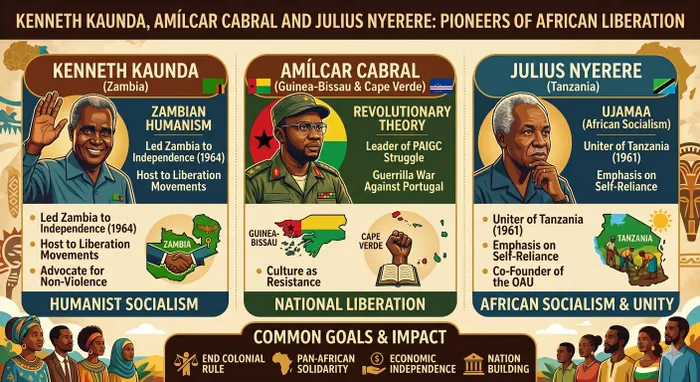
Kenneth Kaunda, Amílcar Cabral, and Julius Nyerere didn’t just fight to dismantle colonial rule; they envisioned a completely redefined, unified Africa built on self-reliance, solidarity, and cultural pride.
Image: AI
Many of us have come to realise that Africa's rise will continue to stall if we neglect our priorities as a continent. Africans who care continue to reflect on the giants who once trod African soil before us. Great leaders such as Kenneth Kaunda, Amílcar Cabral, and Julius Nyerere dreamt of an Africa led by committed and gallant leaders who cherished freedom and hoped for better communities. Yet, even as we commemorate another Africa Day this week, our challenges continue to eclipse the few successes we attain from time to time. The continent’s problems often appear insurmountable as our children struggle to envision a hopeful future. We continue speaking about the African Renaissance and the decolonisation of our societies, but amid pandemonium and suspicion, Africa’s dreams are frequently shattered before they can flourish.
The continent has steadily advanced intellectually. More Africans are gaining confidence in building and sustaining intellectual traditions. Yet our communities continue to falter because of the absence of public leadership capable of sustaining institutions dedicated to the common good. The lack of effective public leadership is glaring, and the suffering of ordinary people remains evident. These are some of the reasons we find irony in debates about Africa’s rise and the harsh realities its citizens experience. Hunger, war, biodiversity loss, and food insecurity continue to afflict African societies. Even some of the most educated leaders seem unaware of what is required to lead effectively as public servants, or they lack the ethical courage demanded of visionary leadership.
Public leaders for a renewed Africa should understand where the continent is coming from, particularly the enduring legacies of apartheid and colonialism. Ngũgĩ wa Thiong'o speaks of the “blacknisation” of leadership, referring to the inheritance left behind by colonialism: institutions that were decrepit and lacked the capacity to transform societies for the common good. Over decades, many African leaders appear to have failed their people by not transforming perceptions of African identity and by failing to articulate a compelling vision for the future. Walter Rodney once reminded Africans how Europe underdeveloped Africa, and today the continent continues to suffer from a dependency syndrome. Despite its immense riches, Africa remains dependent on aid and economic support from the West.
Whenever Africans celebrate occasions such as Africa Day, they should also remember the shackles that remain embedded within their societies and consciousness. While it is important to think globally, Africans must also learn to rely on their own capacities and solutions. Africa possesses many solutions that it too often neglects. As a South African, I have heard people discussing Afrophobia, claiming that locals are chasing immigrants and referring to them with derogatory names. We have witnessed communities rising against what some describe as the “immigrant challenge.” We have seen various manifestations of hatred whose seeds are deeply embedded within our societies, delaying genuine transformation and entrenching divisions.
In many of these crises, we seldom hear the voices of principled public leaders, and this silence remains one of the continent’s greatest challenges. These are among the obstacles that continue to delay the renaissance toward which Africa aspires. Several of these problems are rooted in economic inequality and social exclusion. Recently, in Ghana, there were reports of hostility directed at Nigerians. Anti-Black sentiment in Africa is not limited to South Africa. Historically, Black people have often undermined one another’s hopes for prosperity through systems of exclusion and discrimination that became absorbed into state structures and social practices. We can hardly forget the inhumane death of Ernesto Nhamuave, the Mozambican-born immigrant remembered globally as the “burning man” who died in the East Rand. His image shocked the world, evoking fear and uncertainty. Yet hatred across Africa has manifested itself in many forms over the years, paralysing both communities and leaders.
We witnessed how, in Zimbabwe during the 1980s, nationals sought to suppress competition from nationals of neighbouring countries such as Mozambique, Malawi, and Zambia. In Zimbabwe, the derogatory equivalent of “makwerekwere” was “mabwidi.” Third-generation Malawians still claim that they cannot vote in Zimbabwe. Similarly, during the 1980s, Nigeria expelled many undocumented immigrants, most of them from Ghana. Ethnic violence in places such as Sudan and the Central African Republic has caused the continent to regress. Clashes between Arabs and Christians continue to delay lasting peace and freedom in parts of the continent.
These are problems that African leaders need to confront collectively. Such crises make the dream of an African Renaissance appear like a distant aspiration entangled in conflict and enmity, reinforced, among other things, by the “blacknisation” that Ngũgĩ wa Thiong’o describes. Public leaders have much work to do in redeeming their societies from the dangers of separatism and suspicion. They should promote thought leadership that equips society with practical solutions capable of freeing people from continued bondage. Every year, Africa should establish milestones that guide societies in shedding the chains of oppression and division.
Many African states are frequently described as failed states, perpetually on the brink of war. The Anti-balaka and Muslim groups in the Central African Republic continue to maim one another, just as tensions persist in northern Nigeria. Similar struggles are evident in the northern province of Cabo Delgado in Mozambique, where many people have been displaced, and others killed. Is Africa ready? Afropessimists often ask. While the question may appear unforgiving, it remains valid. Africa desperately needs to resolve its leadership crisis.
Across the continent, unemployment and underemployment continue to impoverish people, especially because education has often failed to prepare Africans to become self-sufficient, including equipping them with the skills to work the land productively. Although Nyerere was criticised for some of his policies, his vision of Ujamaa, or “communityhood,” focused on working the land to advance communities. He also sought to introduce an education system relevant to the needs of the Tanzanian people. Whether many Africans are prepared for such a vision remains uncertain.
Africa still struggles with schools where girl children are not regarded as fully educable, and many families continue to believe that girls should merely be prepared for marriage and childbearing. In many cases, children are alienated by an education system that is excessively Westernised and disconnected from their daily realities. Young people are growing up in societies that often glorify war and hatred; therefore, education should instead promote social justice and liberatory pedagogy. Africa needs skills-oriented education capable of fostering innovation and building technologies that will enable the continent to connect with the world. The challenge lies both in uniting Africa internally and in connecting Africa globally, and it will depend on deliberate, carefully planned educational reform.
It is unfortunate that Africa still has schools under trees and many teachers who are unqualified or underqualified, particularly in STEM subjects. Technology may represent the future, but Africa must continue investing in human capital. Technology can never completely replace educators in classrooms. Africa will always need conscientious teachers capable of strengthening weak institutions and empowering children to respect their environment and communities.
Africans often speak of concepts such as Ubuntu, Utu, Obuntubulamu, and Munthu, which embody values like humility, respect, solidarity, and dependability. Yet even these noble philosophies cannot succeed without strong and visionary leadership. Effective public leaders should guide societies toward responsible and ethical citizenship. These are some of the qualities required for an Africa that genuinely aspires toward an African Renaissance. It is ethical states, dependable leaders, and humanising intellectuals who can help build the Africa we desire. Corruption, greed, and a lack of commitment will ultimately destroy the African dream.
*Msila is a professor of public leadership studies at the University of South Africa’s Thabo Mbeki African School of Public and International Affairs. He writes in his personal capacity.