

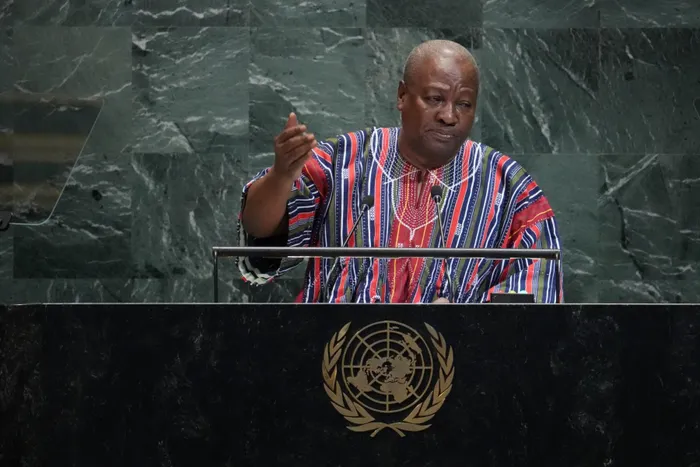
Ghana's President John Dramani Mahama speaks during the General Debate of the United Nations General Assembly at UN headquarters in New York City.
Image: TIMOTHY A. CLARY / AFP/File
There are moments in global politics when what is possible shifts without immediately resolving longstanding injustices. Ghana’s recent success at the United Nations, where 123 countries voted in favour of a resolution on the “Declaration of the Trafficking of Enslaved Africans and Racialised Chattel Enslavement of Africans as the Gravest Crime Against Humanity”, is one such moment. With only three votes against and 52 abstentions, the resolution affirms what Africa and its diaspora have always known: the transatlantic slave trade was a crime against humanity requiring redress. More importantly, it signals a growing global willingness to engage seriously with the question of reparations.
For many Africans, the violence of slavery and colonialism has never been distant history. It is a living structure shaping inequality, development trajectories, and global power relations. Between 12 and 15 million Africans were forcibly transported across the Atlantic, with roughly two million dying during the Middle Passage. These are not abstract figures. They are the foundations of a global economic order that continues to shape Africa’s position in the world.
What is new about this moment is not the recognition of harm, but the willingness of the international community to formally acknowledge it in multilateral spaces, even amid opposition from powerful states. Yet recognition alone cannot transform material conditions. It is an opening. What Africa chooses to do next will determine whether this moment becomes symbolic or structural.
The most compelling shift revealed by Ghana’s diplomatic success is that reparations are no longer viewed solely as matters of historical justice. They are a present-day economic question. The systems that extracted African labour and resources through slavery and colonialism continue, in modified forms, to shape global trade, finance, and development.
Africa remains heavily dependent on raw commodity exports, disproportionately burdened by debt, and severely underfunded for climate adaptation, despite contributing the least to global emissions. This is why modern reparations demands increasingly centre on concrete economic measures: debt cancellation, fairer trade terms, climate financing, and technology transfer. These are not symbolic gestures. They are structural interventions aimed at addressing persistent inequalities.
Some estimates suggest the global value of reparations for slavery and colonialism ranges from $100 trillion to $131 trillion, highlighting the vast scope of historical extraction. Yet the few precedents that exist fall dramatically short. Germany’s €1.1 billion agreement with Namibia over the Herero and Nama genocide, stretched over 30 years and framed as development assistance rather than reparations, shows how wide the gap remains between acknowledgement and material redress. Reparations, therefore, are less about compensation and more about reshaping Africa’s economic position within the global system.
This conversation is unfolding at a time when Africa’s strategic importance is rising. The global transition to clean energy has intensified demand for critical minerals, cobalt, lithium, and rare earth elements, many of which are concentrated in Africa. Once again, the continent finds itself at the centre of international competition. This presents both risk and opportunity. The risk is that Africa enters a “green” version of old extractive relationships, trading raw minerals for minimal gain. But there is also an opportunity: to pursue industrialisation, value addition, and resource governance on African terms. If approached strategically, reparations can strengthen Africa’s bargaining power in this transition, not as a separate historical demand, but as part of a broader agenda for resource sovereignty and economic transformation.
Africa can draw practical lessons from the Caribbean, where governments have pursued reparations through coordinated, sustained action. The CARICOM Reparations Commission’s Ten-Point Plan outlines tangible areas for redress, public health, education, technology transfer, debt cancellation, and cultural restitution, providing a roadmap that is both principled and pragmatic.
The Caribbean experience also exposes a profound historical paradox. When Britain abolished slavery in 1833, it paid £20 million, which is 40 per cent of its national budget, not to the formerly enslaved, but to slave owners. Haiti, meanwhile, was forced to compensate France for its own liberation through a crushing “independence debt.” Reparations are not unprecedented; they have simply flowed in the wrong direction.
What distinguishes the Caribbean today is its coordination. Small states with limited geopolitical weight have nonetheless shaped global discourse through collective action. An Africa–Caribbean alliance could be transformative, aligning two regions linked by history and contemporary structural inequalities. A roadmap already exists; Africa can adapt and strengthen it.
If Africa is to seize this moment, it must avoid fragmentation. National-level approaches dilute bargaining power and weaken demands. The African Union has a crucial role in articulating a unified continental position and embedding reparations within broader frameworks such as Agenda 2063 and the post-2030 development agenda. Without coherence, reparations risk remaining a powerful idea without a clear path to implementation.
Reparations can no longer be confined to moral or legal arenas. They must become a strategic tool across multiple policy domains, including:
The future lies in weaving reparations into Africa’s broader global negotiations rather than treating them as a standalone demand.
Ghana’s achievement at the UN expands the realm of political possibility. It does not resolve the reparations question, but it makes it increasingly difficult to ignore. The challenge now is to move from recognition to responsibility, with clarity, coordination, and purpose. Ultimately, reparations are not only about acknowledging harm. They are about confronting the magnitude of what was taken, recognising how little has been returned, and determining what it will take to build a different future.
*Makombe is a PhD Candidate in the Department of Politics and International Relations at the University of Johannesburg and a Researcher at the Institute for Pan-African Thought and Conversation
**The views expressed do not necessarily reflect the views of Independent Media.