

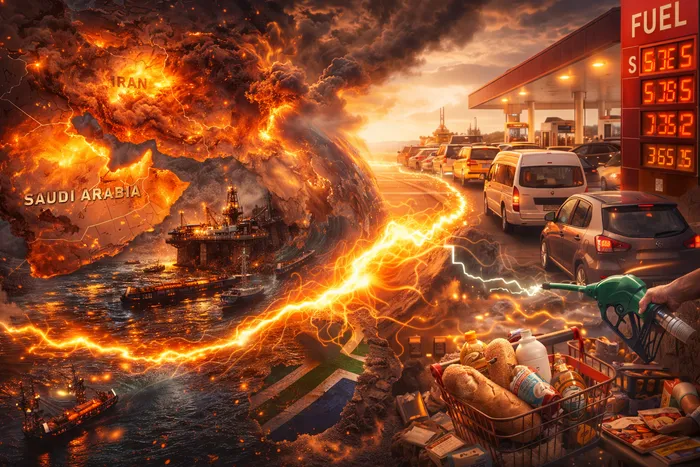
Expect to feel the effects of the war on Iran in your pocket.
Image: ChatGPT
The global chess game of energy supply, momentarily eased by US President Donald Trump's about-turn on the war in the Middle East, provides little comfort on our shores.
Iran's restriction of the critical Strait of Hormuz sent shivers across the world, and in South Africa. The figures are worrying: South Africa's limited fuel reserves stand at a mere two weeks, a fraction of the 90-day global benchmark.
Compounding this vulnerability, one of the country's two remaining operational crude oil refineries is shut down for maintenance. The possibility of petrol rations, a relic of past crises, seems alarmingly real. The 1970s oil embargo taught the world a hard lesson: energy is not just a commodity, but a powerful weapon wielded by those who control it.
Yet, as geopolitical tensions once again weaponise energy, South Africa appeared woefully unprepared, its politicised decisions to shut most of its crude oil refineries over the past few years now laid bare. By closing most of its crude oil refineries and watching combined liquid fuels capacity collapse from a peak of over 700,000 barrels per day (crude and synthetic combined) to just over 100,000 barrels per day, the country is now almost entirely dependent on foreign suppliers and volatile global markets. Even the mere possibility of disruption sends oil and gas prices soaring.
The Department of Mineral and Petroleum Resources (DMPR) has weakly tried to reassure the public, cautioning against panic buying ahead of expected price hikes in April, and later insisting that any disruptions had been isolated and do not amount to a national shortage.
Such passive assurances ring hollow when contrasted with the government's refusal to act decisively. Even as the government remains passive, "modern-day robber barons" are attempting to cash in and exacerbate the fuel crisis. Fuel distributors and suppliers have been accused of unethically withholding or delaying the delivery of fuel, specifically diesel, in anticipation of significant price hikes in April.
As fuel shipments head to our shores, our national security and economic stability rest not on a coherent energy policy, but on a hopeful prayer. A prayer that US-Iran talks hold and that geopolitical chaos does not resume. This is the reality of a government that has abandoned its fundamental responsibility to secure the nation's energy future. South Africa deserves leaders who govern with strategy, not just hope.