

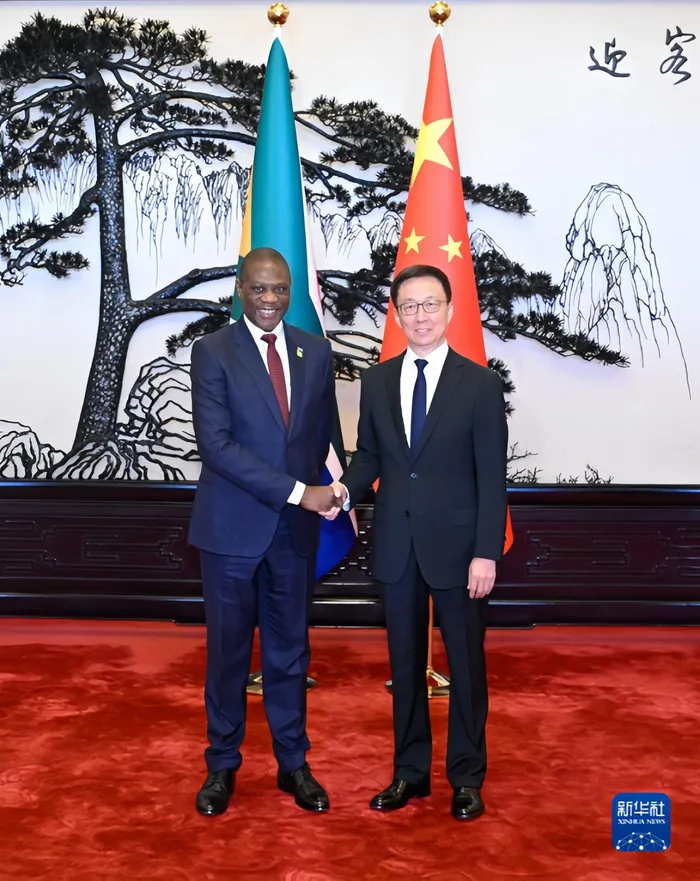
On November 3, 2023, Chinese Vice President Han Zheng met with South Africa's Deputy President, Paul Shipokosa Mashatile, in Beijing and co-chaired the eighth plenary session of the China-South Africa Bi-National Commission.
Image: Supplied
On March 26, the ninth plenary session of the China-South Africa Bi-National Commission will be held in Cape Town. Chinese Vice President Han Zheng and South African Deputy President Paul Mashatile will co-chair this important meeting. Prior to the meeting, I wish to join friends from all sectors in South Africa in reviewing the remarkable journey of China-South Africa friendship and cooperation, and in looking ahead to a bright future of shared development between our two countries.
Passed down through generations, the China–South Africa friendship has grown stronger with time. The Bi-National Commission serves as a high-level flagship mechanism for advancing practical cooperation between our two countries. It is co-chaired by the Vice President of the PRC and the Deputy President of South Africa, and convenes alternately in each country. Since its establishment in 2000, the Commission has held eight plenary sessions, playing a vital coordinating role across various fields including trade, investment, people-to-people exchanges, and science and technology. Each session has marked a new step forward in our bilateral relations.
The sustained vitality of this mechanism is rooted in the profound friendship and cooperation between our two countries. China–South Africa friendship is underpinned by a unique historical bond. During the difficult years of South Africa’s fight against apartheid, China stood firmly in support of the just cause of the South African people in their pursuit of national liberation. Over the 28 years since the establishment of diplomatic relations, despite the ever-changing international landscape, the momentum of our relations has never faltered. In particular, in the new era, our relationship has advanced from a strategic partnership to an all-round strategic cooperative partnership in the new era, setting a fine model for solidarity, cooperation, and shared development among developing countries and the Global South. Our relations have grown stronger over time, and the mechanism of the Bi-National Commission continues to thrive with enduring vitality.
Driven by mutual benefit, practical cooperation has yielded fruitful results. Under the guidance of the Bi-National Commission, practical cooperation between the two countries has expanded rapidly. China has remained South Africa’s largest trading partner for 17 consecutive years, with bilateral trade exceeding USD 53.5 billion. High-quality South African products such as wine and avocados are widely popular among Chinese consumers. China’s direct investment stock in South Africa has surpassed USD 11.7 billion. Nearly 300 Chinese enterprises have invested and operated in South Africa, continuously expanding win-win cooperation in areas including infrastructure, automobile manufacturing, mineral processing, new energy, and the digital economy, and creating more than 400,000 local jobs.
In February this year, the two countries signed the Framework Agreement on Economic Partnership for Shared Development. This agreement aligns China’s 15th Five-Year Plan with South Africa’s Economic Reconstruction and Recovery Plan, providing long-term, stable, and predictable institutional support for bilateral trade and industrial cooperation, and broadening the horizons for economic cooperation between the two countries. China’s middle-income population has surpassed 400 million, and is expected to reach 800 million over the next 10-plus years. China’s high-level opening-up and high-quality development hold boundless potential and will bring more tangible benefits to countries around the world, including South Africa.
Not long ago, at China’s “Two Sessions,” the National People’s Congress approved the outline of the 15th Five-Year Plan for national economic and social development. This document serves as a grand blueprint for China’s modernisation from 2026 to 2030. It charts a clear path for developing new, quality, productive forces in smart and green development, and includes proposals to open China wider to the world and advance high-quality Belt and Road cooperation.
Through openness and shared benefits, China’s zero-tariff policy creates new opportunities for South Africa. In February this year, President Xi Jinping announced in his congratulatory message to the 39th African Union (AU) Summit that China will grant zero-tariff treatment on 100 percent of tariff lines to 53 African countries with diplomatic relations with China, starting from May 1, 2026. He also highlighted efforts to upgrade the “green channel” to expand market access for African exports. This is the first time a major developing country has made a unilateral, comprehensive zero-tariff commitment to the entire African continent. It is a powerful measure by China to use tariff “subtraction” to drive trade “addition” with Africa and achieve a “multiplier effect” on the livelihood of the African people. It is also a vivid demonstration of China’s firm commitment to always remain a member of the developing world.
High-quality South African products, such as deep-processed mineral products, rooibos tea, and aloe gel, will find even broader opportunities in China’s vast market of 1.4 billion consumers. In today’s world, where unilateralism and protectionism are on the rise, China’s zero-tariff policy is like a breath of fresh air, injecting strong confidence and momentum into China–South Africa economic and trade cooperation.
Strengthened by cultural connectivity, people-to-people exchanges herald a new chapter. Beyond economic and trade exchanges, China-South Africa people-to-people cooperation has also seen numerous highlights. In recent years, more and more South Africans have become passionate about learning the Chinese language and exploring Chinese culture, and many universities in South Africa have offered Chinese language programs. Meanwhile, thousands of South African teachers have travelled to China to teach English, and Chinese universities, including Beijing Foreign Studies University, have introduced over 20 African language programs, such as Zulu and Ndebele. This exchange of languages is a vivid testament to the deepening bonds between our peoples.
In the new era of China–Africa engagement, young people are emerging as vital bridges connecting our two civilisations. This year, we will launch a diverse range of interactive programs, including a dialogue among young scientists and a celebration on the South African Chinese Language Day. We look forward to seeing young people from both countries deepen their friendship and carry forward the China–Africa friendship from generation to generation. As 2026 marks the China–Africa Year of People-to-People Exchanges, cultural cooperation between China and South Africa is set to reach new heights, adding fresh vitality and deeper meaning to a friendship that spans mountains and oceans.
Working hand in hand, China and South Africa stand firm in upholding global fairness and justice. Like-minded partners can go far together. Both China and South Africa pursue a foreign policy of non-alignment and independence. The sole purpose of our relations is to serve the interests of our two peoples without targeting any third party. China stands ready to develop equal, open, and cooperative relations with all countries based on dialogue rather than confrontation, and partnership rather than alliance. Through this approach, China seeks to accelerate the building of a new type of international relations centred on win-win cooperation, and to make consistent efforts toward the long-term goal of building a community with a shared future for mankind.
As members of the Global South, China and South Africa share a common responsibility in developing a more just and equitable international order. Last November, during the G20 Johannesburg Summit, representatives from both countries jointly launched the Initiative on Cooperation Supporting Modernisation in Africa, advancing our shared commitment to Africa’s overall development. On major issues such as climate change, food security, debt relief, and the United Nations 2030 Agenda for Sustainable Development, China and South Africa have continued to deepen communication and coordination and worked together to enhance the representation and voice of Global South countries in global governance. China has always supported South Africa in playing a greater role on the African continent and in international affairs. Likewise, China has always supported the AU in assuming more important responsibilities in global governance.
At present, both China and South Africa stand at critical junctures in our respective paths of development and rejuvenation. “Without modernisation of China and Africa, there can be no modernisation of the world.” President Xi Jinping’s profound observation captures the significance of China and South Africa joining hands to forge ahead in this era. The ninth plenary session of the China-South Africa Bi-National Commission reaffirms the two countries’ commitment to upholding the spirit of friendship and cooperation. With the zero-tariff policy as a new engine and China’s 15th Five-Year Plan as a fresh opportunity, the two countries will work to advance exchanges and cooperation across all fields and jointly write a new chapter in building a high-level China–South Africa community with a shared future.
*Peng is the Chinese ambassador to South Africa
**The views expressed do not necessarily reflect the views of IOL or Independent Media.