

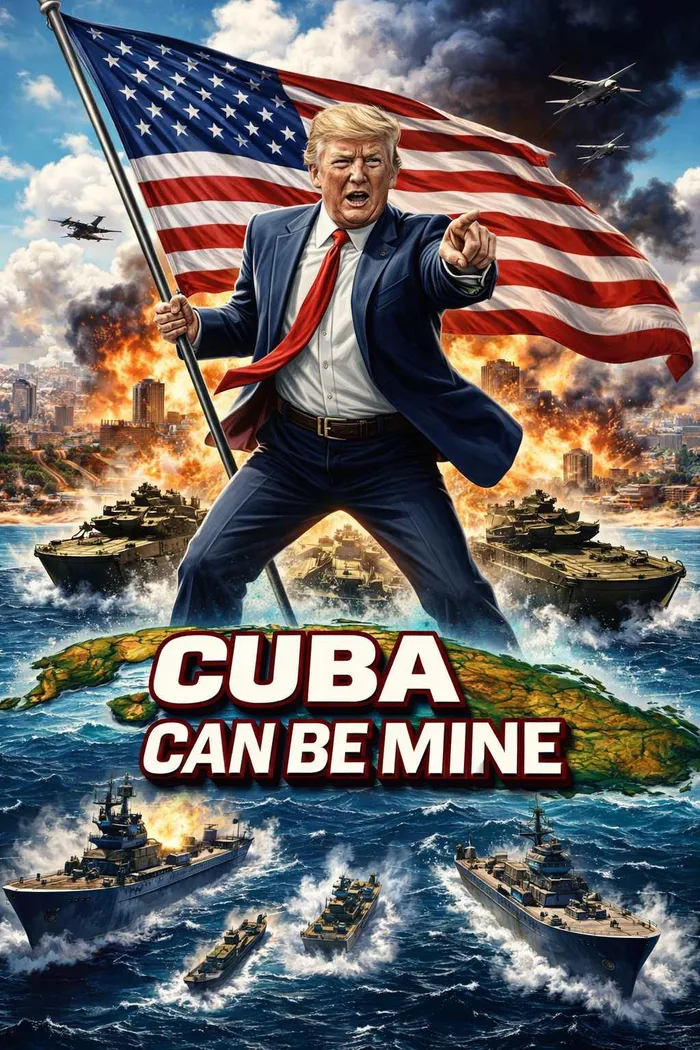
President Donald Trump is accused of being power drunk as he goes after the third country in as many months.
Image: AI
US President Donald Trump has once again escalated his aggressive rhetoric, and this time his sights are set on Cuba.
In a week characterised by arrogance and a stunning disregard for international laws, the US president claimed he would have "the honour of taking Cuba... in some form." These alarming statements come as the island nation grapples with an unprecedented economic crisis, a situation already exacerbated by a punishing oil blockade imposed by the US following the capture of former Venezuelan President Nicolas Maduro.
The President's self-aggrandising comments, "I mean, whether I free it, take it. Think I can do anything I want with it. You want to know the truth," are not just callous; they represent a dangerous throwback to a colonial mindset and mark what could be the third attack on another country's sovereignty in as many months. This threatening language is particularly destructive given that Cuba and the United States have, until recently, been engaged in delicate talks aimed at improving their historically adverse relations.
These negotiations were an acknowledgement that engagement, not aggression, is the path to stability and mutual respect. Trump’s words now threaten to derail any progress, pushing the contentious US-Cuba relationship, already at one of its lowest points since Fidel Castro overthrew the US-backed government 67 years ago, into a new and perilous phase.
The world cannot afford a leadership that treats international relations as a game of personal honour or conquest. Trump's actions undermine diplomatic efforts, harm the Cuban people already suffering from economic hardship, and set a dangerous precedent for the violation of national sovereignty.
International accountability for any major world power, including the United States, is a complex issue due to the very principle at stake - national sovereignty and the US's position in global governance. The UN and The Hague (which typically refers to the International Criminal Court or the International Court of Justice) play different roles:
The uncomfortable truth is that the institutions built to hold powerful states accountable, the United Nations Security Council, the International Court of Justice, and the International Criminal Court, were never designed to restrain the United States in any meaningful way. Washington holds a permanent veto on the Security Council. It has withdrawn from or ignored ICJ proceedings when the rulings proved inconvenient. It never ratified the Rome Statute, placing its officials beyond the ICC's reach by design. This is not a flaw in the system. It is the system. The architecture of post-war international law was built with great-power politics baked in. It can condemn, deplore, and resolve, and the United States can absorb all of that without consequence. Accountability, then, will not come from The Hague. It will come, if it comes at all, from allied governments with the spine to say clearly that this rhetoric is unacceptable; from economic and diplomatic costs that register in Washington; and ultimately from American voters and institutions. None of those mechanisms is reliable. None is swift. But they are what exists. In the meantime, the Cuban people, who have no vote in any of this, deserve better than to be reduced to a trophy in someone else's fever dream of empire. The world has seen this script before. History's verdict on those who confused conquest with honour has never once been kind.
Ultimately, while the UN and the judicial bodies in The Hague represent the global system for accountability, political and legal barriers, particularly the US's veto power and its non-participation in certain treaties, often limit their ability to compel the United States to act. Accountability often comes through political pressure from allied nations, sanctions from other countries, and domestic legal and political processes.
The mighty UN and the judicial bodies in The Hague stand exposed as fundamentally toothless. The global system of accountability is a paper tiger against the United States, which wields its Security Council veto like a blunt instrument to neuter any binding resolution against its actions. Its deliberate non-participation in treaties like the Rome Statute renders international criminal law an irrelevant footnote. Accountability, then, is not a matter of legal certainty or high principle. It is a brutal, messy game of political will.
The system is not broken; it was designed this way to ensure the world's most powerful nation remains above the law it purports to uphold.