
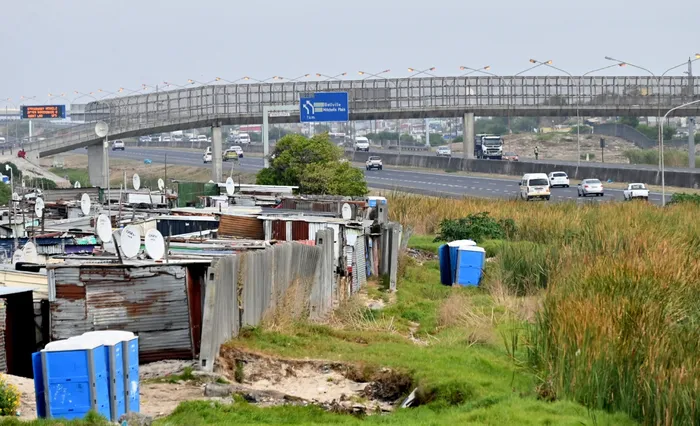
Cape Town's proposed 3m high, 8km security wall along the N2 Highway aims to curb crime but sparks debate over inequality.
Image: Ayanda Ndamane / Independent Newspapers
THE debate surrounding the proposed wall along the N2 and the R300 is being framed too narrowly.
This is not merely a discussion about concrete, fencing, or aesthetics. At its core, it tests whether the City of Cape Town can govern in a manner that prioritises both safety and human dignity, and whether the City's development priorities align with the realities faced daily by communities living alongside one of the country's busiest transport corridors.
Firstly, it is indisputable that the N2 has become a corridor of recurring tragedy. People have been killed while attempting to cross this high-speed highway because the safe alternatives are too few, too far apart, or poorly integrated into how people actually live and move.
Motorists have faced attacks and, in some cases, been stoned. Accidents in areas where informal settlements are close to the road often result in fatalities. The death of even one person is one too many, and treating avoidable deaths as inevitable is both a moral and governance failure. Any serious public conversation must acknowledge that safety is not just a slogan; it is a practical obligation.
It is also true that a wall may reduce certain immediate risks. A physical barrier could discourage illegal crossings at the most dangerous points and may help curb some opportunistic access to the roadway. To be honest, a wall might prevent some deaths and some attacks. To suggest otherwise is to substitute political theatre for reality.
However, we must also confront a second truth; a wall on its own is not a development plan. If it is erected as a stand-alone intervention, disconnected from housing, transport upgrades, pedestrian infrastructure, and social investment, it becomes a symbol of a deeper issue: the tendency to respond to structural crises with isolated fixes that manage symptoms while leaving the underlying conditions untouched.
The N2 is not dangerous solely because it is accessible. It is hazardous because thousands of people have been forced into survival patterns created by apartheid spatial planning, compounded by slow delivery, constrained opportunities, and fragmented urban development. People cross where they do because work, schools, transport, clinics, shopping, and family life are not organised around safe movement. This is not a "community problem"; it is a planning problem.
This is where the debate must rise above shallow accusations and defensive posturing. Those opposing the wall have raised legitimate concerns about exclusion and optics whether the City of Cape Town is walling off poverty, attempting to hide informal settlements, or treating poor communities as threats to be contained rather than citizens to be developed.
These are not merely emotional reactions. In South Africa, infrastructure has a history. The people living next to major roads have long experienced planning decisions as something done to them rather than with them. When a wall is announced without a clear, comprehensive programme of upgrading and inclusion, many will reasonably interpret it as another act of separation rather than support.
However, opposition will only be persuasive if it is anchored in constructive, concrete development demands rather than moral outrage alone. The strongest criticism is not that a wall is "inherently wrong," but that it is insufficient and potentially misleading if it becomes a substitute for the real work such as housing delivery, settlement upgrading, safe and dignified mobility, and social investment that reduces the conditions in which crime flourishes.
The City of Cape Town has already experienced the consequences of collapsing grand development promises into smaller, reactive interventions. In the early 2000s, the government launched the N2 Gateway housing programme, which aimed to transform informal settlements along the N2 and the R300 and address the very risks we are discussing today.
Regardless of one's views on the programme's design and implementation, its purpose signalled an important understanding that the settlements along the corridor could not be treated as permanent "background conditions" to the formal city. They needed to be integrated into it through housing, services, and planned development.
Today, rather than relitigating the past for its own sake, we should focus on this; that the wall debate should serve as a catalyst for reviving that ambition, whether under the same name or a new framework.
If the City of Cape Town can mobilise funds and urgency for a barrier, it should be able and compelled to mobilise at least as much urgency for human settlement development along the corridor.
Opposition voices, civil society groups, and political parties should use this moment not only to protest but to actively campaign for accelerated housing delivery and upgrading where feasible. The real scandal is not merely the existence of a wall proposal; it is the persistence of underdevelopment that makes a wall seem like the primary solution in the first instance.
A serious safety plan cannot be limited to preventing people from crossing it must also include building safe alternatives. The number of overhead pedestrian bridges is widely seen as inadequate relative to need, and where bridges exist, access routes, lighting, maintenance, and security often determine whether people actually use them. Increasing safe crossings must be central, not an afterthought. Likewise, public transport integration matters if commuters are forced into long, unsafe walking routes because transport nodes are poorly placed or unaffordable, risky crossings will continue regardless of the barriers erected.
Then there is the issue of crime. Crime along the N2 is real, and lives have been lost. Communities living alongside the road are also victims of crime, not beneficiaries of it.
Any attempt to address stoning and attacks must be firm, effective, and rights-respecting. However, it is impossible to discuss crime honestly without addressing the social environment that allows it to take root: unemployment, hopelessness among youth, the absence of recreational and sporting facilities, inadequate public spaces, and overcrowded living conditions. A City of Cape Town that invests heavily in hard infrastructure while neglecting social infrastructure should not be surprised when insecurity persists. Safety encompasses not only policing and barriers; it also includes opportunities, community facilities, and a built environment that does not trap young people in dead-ends.
There is also a question of governance and transparency that has not received enough attention. Was the wall budgeted through the City of Cape Town's Integrated Development Plan (IDP) process? If it was, the City should clearly show where it sits in the plan, what public participation informed it, and how it aligns with other corridor priorities such as housing, transport, and community amenities.
If it was not part of the IDP, then residents have every right to question whether this is fiscal dumping, an expensive, politically-convenient intervention introduced outside the City's stated development priorities. Either scenario requires clear answers, as the public cannot be asked to trust decisions that are not explained in full detail.
This is why reducing the debate to racial slogans or counter-slogans is a dead-end. The question is not whether one "side" cares about poor people more than the other. The question is whether the City of Cape Town can demonstrate an integrated, funded, and time-bound programme for development along the N2 and R300, beyond a single barrier.
If the wall is built, what comes next, and when? What is the housing pipeline? What upgrading plans exist for adjacent settlements? How many additional safe crossings will be built, and on what timeline? What investments are planned in youth facilities, sports grounds, libraries, and safe public spaces? What will be done about lighting, walkways, and transport connections? What outcomes will be measured, and how will the public track progress?
Therefore, the City of Cape Town owes residents more than a binary choice between "wall" and "no wall."
It owes a coherent strategy that reduces deaths now while transforming the conditions that make this corridor so dangerous. Protecting lives on the highway is necessary, but it is not sustainable to build a wall while leaving surrounding communities trapped in underdevelopment.
If the City of Cape Town seeks credibility, it must pair any short-term safety intervention with a transparent, integrated development plan that is visible, funded, and accountable. If critics want credibility, they must demand that plan with equal intensity because the goal is not to win an argument but to stop the next fatality.
In the end, the most important measure of success is simple: fewer deaths, fewer attacks, safer movement, and real development for the communities living along the N2 not as an afterthought, but as a priority.