

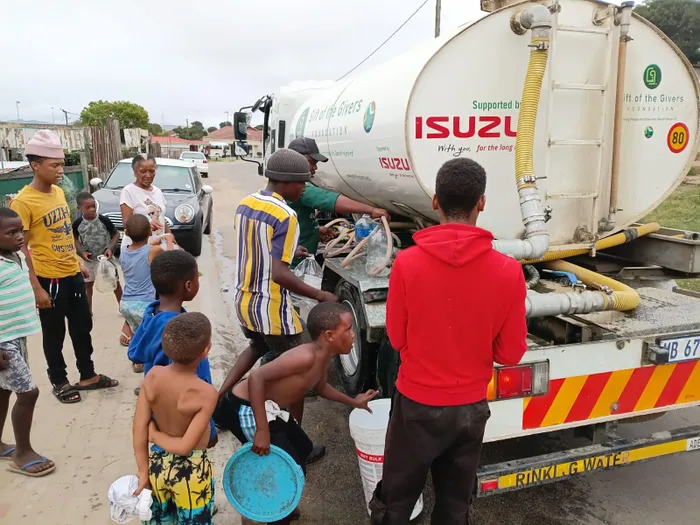
AS the Knysna municipality continues to be confronted by a severe water shortage crisis, the Gift of the Givers remains on the ground providing water to residents of affected communities including the Rooikrans and Smutsville communities.
Image: GIFT OF THE GIVERS
BACK in the late 1980s, a top water affairs expert said South Africa had enough water for a population of 80 million but that too much was wasted through leakages in old pipelines. Then, households were using only 2% of available fresh water.
Neither runaway pollution nor the possibility of climate change sweeping across the country and drying it up from the west was yet part of the debate.
But every geography teacher knew that South Africa falls in the southern anti-cyclonic belt, with, in most places, lots of sunshine, little clouds, periodic disaster droughts and high evaporation rates when it does rain. Reportedly, even Van Riebeeck wrote about the dry Cape. Today we are rated as the 27th driest country in the world. However, only a very brave government official would openly admit that we might be running out of the most precious commodity on earth.
Many scientists saw the writing on the wall long ago. There have been proposals to divert water from the Okavango to Pretoria, or ship in fresh water from the Congo, and even to drag icebergs into Table Bay.
Those panicky, pie in the sky ideas have since made way for some really practical, more cost-effective solutions like purification, recycling, desalination – and the much underrated technique of artificial groundwater recharge.
And, while one can’t make water, one can actually make it rain, under certain conditions. Unfortunately our promising weather modification programme, based on cloud seeding was sold to the UAR where it is successfully being used.
We’re already using more than two thirds of the 30 000 million cu.m (cubic metres) of usable run-off. The government must surely be on top of this situation with a good idea of how water demand and supply will unfold over the next few years – and how to manage it.
South Africans wouldn’t like to wake up one morning to read that water emergencies are spreading, with no plans to handle the crisis. That’s not only a ticket for economic collapse and untold suffering but also for civil unrest, which could escalate into something worse.
One hears of tapping into the Great Table Mountain Aquifer’s fossil water, a so-called underground lake that could ostensibly fill all our future needs but which isn’t a lake at all, consisting rather of a series of water bearing rock departments at various depths. These take a very long time to be replenished after pumping. Some countries, notably Libya are apparently already mining their aquifers.
Our evaporation rate is four times greater than our average annual rainfall figure of 500 mm. In other words, only one drop of rainwater out of every four that falls is potentially available to use.
With the best sites already taken up, building new big storage dams and then pumping water over vast distances to where it is needed, has become hopelessly expensive.
Already half of our water management areas are struggling with shortages that have to be augmented by inter-basin transfer schemes. In addition, big dams bring with them ecological as well as political problems. Our rivers are multinational and one can’t harvest all the water anyway – a certain amount has to be allowed into the sea to keep rivers functional.
Water shortages can be a very limiting factor on development- possibly more so than power cuts. While farming uses an estimated 50 percent of our available water, it's unwise to downgrade the importance of irrigation schemes.
Water can make a desert bloom, create work and provide food. Industry does not necessarily create more jobs per unit of water than agriculture does. For, just as farming is downsizing its labour force, so some modern industries already operate with hardly any workers at all.
As it is, farmers are using several scientifically based techniques to improve their water-use efficiency, and not only because water has become so expensive for them. In industry, water can be recirculated in closed systems up to 60 times before being topped up. But municipalities continue to waste 30 percent or more of their supplies while alien vegetation along water courses slurp up enough water to fill a big reservoir or two every year.
Clearly, with much of the country relying on boreholes, groundwater and aquifers should have prominence on the research agenda. Water tables drop dramatically during droughts or when overexploited.
Artificial groundwater recharge (AGR) – already being used on a smallish scale in the dry interior but old news in Windhoek, Namibia – is a game changer has shown in the US and Australia, among others. The well-known Atlantis recharge project operates on the infiltration concept but in another form (although it requires know-how and the right rock formations) AGR involves directing storm water from streams into receptor boreholes where it can be stored without fear of evaporation. All much quicker and cheaper than building a dam, or trucking in tankers when taps run dry’.
Bezuidenhout is a freelance journalist and farmer