

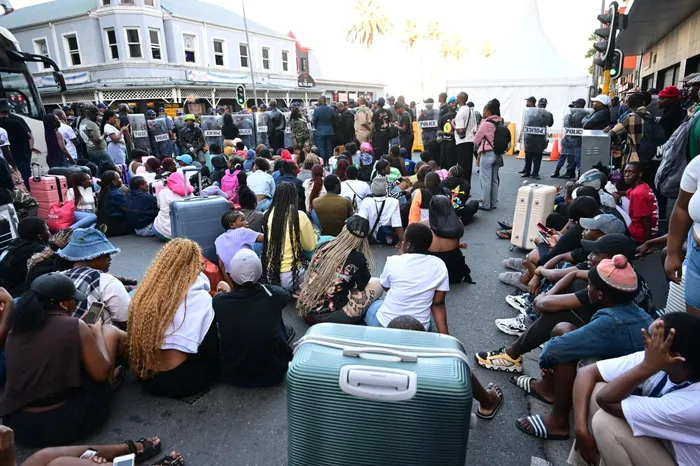
A GROUP of university students demanding to be accommodated took their plight to outside the City Hall ahead of the State of the Nation Address. Some of them have been camping outside the Cape Peninsula University of Technology District Six campus.
Image: Henk Kruger
I’M NOT a lawyer or a political analyst.
I am a social worker trained to sit with complexity, to read systems through lived experience, and to pay attention to who is falling through the cracks when institutions fail.
But, after more than three decades of democracy, we can no longer afford the comfort of pretending that the chaos which greets our universities every January is accidental. The annual cycle of student protests over funding confirmations, accommodation placements, delayed allowances and blocked registrations is not a spontaneous eruption of youthful impatience. It is the predictable outcome of a system that promises access in policy speeches and budget votes yet delivers precarity in practice.
When students sleep outside residences while billions are allocated on paper; when campuses deploy private security to manage hunger and administrative failure; when the constitutional right to protest is framed as disruption rather than democratic expression, we are not witnessing disorder. We are witnessing governance by crisis.
And that crisis has a name: structural failure.
South Africa has been here before.
The 2015–2016 protest cycle across institutions such as Wits, UCT, Rhodes, Stellenbosch and University of Johannesburg marked a national reckoning with the affordability of higher education.
Vice-chancellors were forced into an uncomfortable spotlight as students demanded not only reduced fees, but dignity, transformation and access.
That moment produced policy shifts, including expanded funding through the National Student Financial Aid Scheme (NSFAS). Yet nearly a decade later, the terrain has merely shifted.
Today’s protests are no longer framed primarily around tuition fees. They are about the machinery of access: delayed funding confirmations, rejected appeals, unaccredited accommodation, unpaid allowances, and institutional registration bottlenecks. Students are not protesting ideology, they are protesting survival.
At Nelson Mandela University, the University of Fort Hare, Cape Peninsula University of Technology, and the University of Cape Town, among others, early-year disruptions in 2025 and 2026 followed the same pattern: students locked out of residences and classrooms because the administrative ecosystem failed to synchronise.
Despite repeated assurances that billions have been disbursed, students continue to experience funding as absent. On paper, NSFAS functions. On the ground, it collapses.
This is not a technical glitch. It is a design problem.
NSFAS now operates as one of the most powerful gatekeeping infrastructures in South African higher education. When it works, students pass seamlessly into academic life. When it fails, students become temporarily non-students: unregistered, unhoused, unfed.
The state can announce increased allocations. Universities can confirm receipt of bulk transfers. But none of these matters when individual students are stuck in appeals processes, excluded by accommodation accreditation criteria, or caught between landlords demanding “top-ups” and institutions insisting on compliance.
The result is administrative exclusion.
Students are not merely delayed; they are suspended in limbo, unable to participate in the very education promised to them. This is why protests return every January. The system reproduces crisis because crisis is built into its operational logic.
What happens next is perhaps the most troubling part.
Universities increasingly respond to these predictable failures not with emergency welfare protocols, but with securitisation. Private security companies are deployed alongside SAPS. Access points are closed. Court interdicts are obtained. Students are warned, suspended, or threatened with disciplinary action. Yet Section 17 of the Constitution protects the right to assemble, demonstrate and protest peacefully. The question is not whether campuses require safety.
The question is why unmet basic needs like funding, housing, food are treated primarily as security threats rather than governance failures? This is where the work of Judith Butler becomes disturbingly relevant.
Butler reminds us that power does not only operate through force. It works through norms through everyday institutional practices that decide whose lives are recognisable, whose suffering is legitimate, and whose bodies matter.
In universities, this plays out quietly and systematically.
A hungry student becomes an “unregistered case.”A homeless student becomes a “non-compliant resident.”A protesting student becomes a “disruptive element.”
The institution does not need to expel them. It simply renders them administratively invisible until they gather collectively. Then, suddenly, they are hyper-visible, framed as threats to order.
Authority is not restored because justice is done. It is restored because control is performed.
Access gates, riot gear, biometric scanners, injunctions and disciplinary notices become rituals of institutional sovereignty. This is what Butler means by insidious power: exclusion that wears the language of procedure.
Butler’s concept of “grievability” asks us to consider whose suffering registers as worthy of response. In South African higher education, the pattern is clear.
Budget speeches speak fluently about transformation.Strategic plans celebrate inclusion.Marketing brochures showcase diversity.
But when poor students sleep outside libraries, when allowances fail to arrive, when accommodation collapses, their vulnerability is managed, not resolved.
They are told to be patient! They are told to follow the process! They are told not to disrupt!
Meanwhile, institutions move swiftly to protect property, reputational risk, and academic calendars. This is not neutrality. It is prioritisation. It tells us exactly which bodies matter.
In the Eastern Cape, these dynamics are especially stark. At Nelson Mandela University and University of Fort Hare, the start of the academic year has become synonymous with student mobilisation around accommodation shortages, delayed NSFAS confirmations, transport challenges, and unmet basic needs.
These are not isolated institutional failures; they reflect the compounded vulnerabilities of a historically under-resourced province where many students are first-generation entrants to higher education and arrive carrying the weight of rural poverty, unemployment, and fragile household economies.
When campuses in the Eastern Cape respond to these realities through access restrictions, private security deployments, and disciplinary threats, they reproduce a form of structural violence that masks itself as compliance. Here, the geography of marginalisation intersects with bureaucratic delay, producing a particularly acute form of educational precarity. If transformation is to mean anything in this context, it must move beyond symbolic commitments and confront the material conditions shaping student participation, otherwise, universities risk becoming sites where inequality is not disrupted, but quietly administered.
Universities often frame protest as an interruption of learning.
But protest, in this context, is learning; a civic response to systemic exclusion.
Students are not rejecting education. They are demanding access to it.
The uncomfortable truth is that higher education has become a site where democratic rights are routinely subordinated to operational convenience. The right to quiet lectures increasingly outweighs the right to survival. This inversion should trouble us deeply.
If institutions and governments are serious about ending this cycle, the solutions are not mysterious. They are practical:
None of this requires new rhetoric. It requires political will.
January protests are not anomalies. They are the visible symptom of a system that externalises its dysfunction onto the bodies of poor students. Until we confront NSFAS not merely as a funding mechanism but as a powerful gatekeeping structure; until universities stop securitising poverty; until access is treated as a lived reality rather than a budget line, we will repeat this cycle indefinitely.
Democracy cannot be sustained through ceremony alone. It must be experienced materially.
Ultimately, the persistence of early-year protests forces a deeper reckoning with how power is organised and enacted within higher education. Drawing on Judith Butler, we are reminded that institutions do not merely administer access; they actively produce precarity through norms, procedures, and silences that determine whose lives are legible and whose suffering is rendered administratively inconvenient.
What we are witnessing each January is not episodic unrest but a patterned outcome of governance that privileges order over justice and efficiency over care. Until funding systems such as NSFAS are reconfigured as genuinely responsive social protections and universities are held accountable for operational readiness, protest will remain one of the few available languages of visibility.
A democratic higher education system cannot be measured by budget allocations alone; it must be evaluated by whether students are able to arrive, register, live, and learn with dignity. Anything less is not transformation, it is managed exclusion.
Madikizela-Theu is with the Department of Social Development Professions Faculty of Health Sciences at Nelson Mandela University