

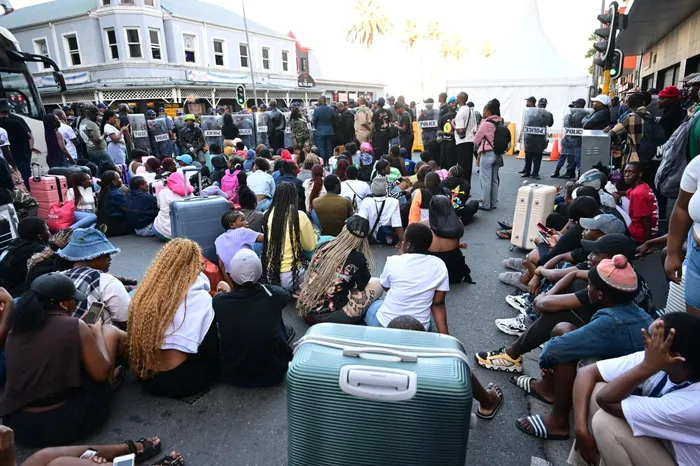
A GROUP of university students demanding to be accommodated took their plight to outside the City Hall ahead of the State of the Nation Address. Some of them have been camping outside the Cape Peninsula University of Technology District Six campus.
Image: Henk Kruger
SOUTH Africa, brace yourselves. Students have spoken. They have shared their stories, pleaded for support, written countless emails, and turned to crowdfunding in desperation—yet nothing paid out, and registration periods are nearing to an end.
Now students are in protest mode, not because the ground is fertile for disruption, but because protest has become their last available language to express discomfort and assert their hope for a future.
In my previous piece, ‘Access denied: Academic exclusion makes education far-fetched dream for students’, I reflected on the slow violence of exclusion in higher education—the long queues, the administrative finality, the quiet crushing of dreams.
What we are witnessing now is not sudden. It is the build-up of that denial. It is the consequence of unanswered pleas. And now that the build-up has reached its peak, it calls for response.
The question remains: will South Africa ever respond to the call for transformed education, or will students be expected to protest every year for the right to learn?
Scholars such as Professor Jonathan Jansen, in ‘As By Fire: The End of the South African University’, speak of systemic fractures within South Africa’s education landscape—crises deeply rooted in historical inequality and democratic promise. Our crisis is distinct because it emerges from hope itself: the promise that democracy would guarantee access to education as a right. Yet that promise continues to meet structural barriers that render access conditional, negotiated, and often denied.
Now that protest has emerged, we will see familiar headlines. We will witness scenes of teargas drifting across campuses. But one must ask: how do we grow comfortable deploying force against students who are merely querying their right to education? Has that right reached its pause? If so, let students know openly—so that they do not return year after year believing that higher education is attainable, only to discover that “higher” now refers to cost rather than intellectual pursuit.
Students rise because they are out of options. The feedback they receive from institutional leadership often appears scripted—responses that resemble a performed syllabus with strict rules governing how discomfort may be expressed. We observe this in moments where student leadership structures offer “rules of engagement” while students are still processing the pain of exclusion.
When students elect leaders, they expect direction and guidance—not policing of their emotional response to structural hardship. They entrust leadership with the responsibility to represent their voices, not regulate their suffering.
Yes, it is protest season—because students are turned away, and their hope refuses to fade or be redirected. All they ask for is access. Access. Access.
The conversations on transformation, funding, and structural reform should have happened long before this moment. Preparedness requires anticipation, not reaction. Responses designed to preserve institutional order do not necessarily respond to the needs of the people.
I once again call for intentional listening. Students may represent a small constituency within broader national priorities, but their experiences are real, raw, and urgent. We cannot celebrate registration statistics while those without resources are systematically pushed out. When systems push and silence, protest becomes inevitable.
Institutions of higher learning must also take responsibility for carrying the pain expressed by students and confront the state directly. It cannot be that students are repeatedly told that exclusion results from government failure while institutions remain distant from the sites of policy confrontation.
Universities understand the crisis from design and implementation levels—they must therefore engage the government with urgency, negotiate solutions, and return to students with meaningful responses.
We witness strong academic results that reflect the willingness and capability of young people, yet a constrained funding landscape sends them home. We also witness academic failure—not because students lack ability, but because financial precarity erodes concentration and dignity. How does one study while constantly receiving reminders of mounting debt? How does one flourish under permanent financial anxiety?
We must ask ourselves: are we producing employable graduates, or young people burdened with lifelong debt? Under current conditions, higher education risks becoming a site where students are socialised into indebtedness rather than empowered into possibility.
The reliance on crowdfunding further exposes the limits of the system. Students are pushed to public platforms to narrate their vulnerability, seeking assistance from communities already stretched thin. If crowdfunding is truly a sustainable solution, then institutions themselves should publicly disclose their financial deficits and mobilise collective support accordingly. Yet the burden continues to fall disproportionately on the most vulnerable.
Protest season emerges not simply because it is the only mechanism available, but because it is the one students recognise when all other avenues have failed. Every student holds pride in their institution—they contest exclusion precisely because they believe they belong there. Their resistance is not against the institution’s existence, but against their erasure within it.
Student representative structures themselves face increasing pressure, and that is understandable. Yet leadership cannot retreat into shared victimhood, student leaders cannot come to students and say, there is nothing they can do because they are also in the same boat, they must lead.
While vulnerability is part of leadership, it must not replace the responsibility to challenge unjust systems with courage and clarity.
In the wake of democracy in South Africa, the promise of dignity and equality remains unfinished for many young people. The poor child is still on the ground—still negotiating access, still struggling for recognition, still waiting for the democratic promise to materialise.
Students will not retreat. They look to their elders and leaders for guidance, for as isiXhosa wisdom reminds us, ‘inyathi ibuzwa kwabaphambili’. Their voices will rise, their actions will intensify, not to destroy but to be seen. The beauty we celebrate during graduation ceremonies and institutional events is precisely what they yearn to experience.
Here lies the struggle: what do we do now?
We do not need reactive responses—we have long known the nature of this crisis. We require proactive commitments. What do these commitments look like? What has been prepared? What structural changes are being implemented to ensure that access is not negotiated annually through suffering?
Students are protesting for access in its many manifestations—financial, academic, spatial, and human. University leadership and senior management may experience student anger as militancy or radicalism, but such expressions are not personal attacks; they are urgent calls to act. They signal that institutional channels must be activated with seriousness and speed.
The system is faulty. This is widely known—within offices, within policy frameworks, within institutional corridors. The question is no longer whether the crisis exists, but what is being done to transform it.
South Africa must respond—not with temporary solutions, but with structural change. Not with silence, but with accountability. Not with humiliation, but with dignity.
Because protest, at its core, is not disruption. It is a demand to be seen, to be heard, and to be allowed to learn.
Quthu (They/Them) is a young South African whose interests are rooted in situational and lived-experience studies. They are a hopeful-intersectional scholar who employs a multidisciplinary approach to investigate modalities of life. The views expressed are solely those of the author and do not reflect those of any affiliated institutions.