
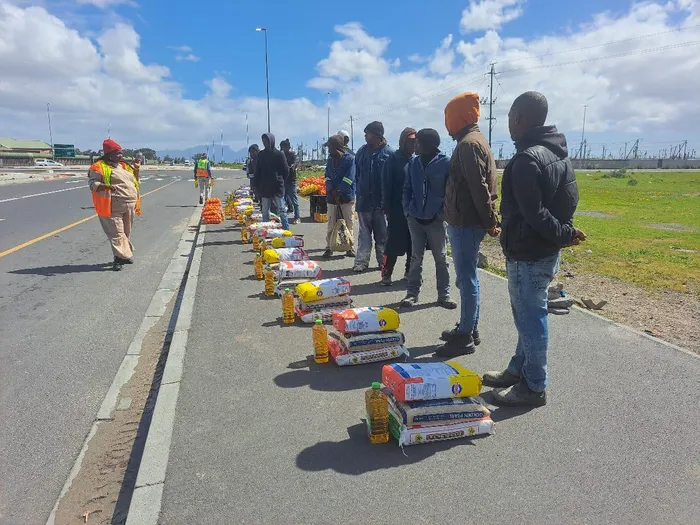
A 2024/2025 Stats SA report highlights that households with children, child-headed households and those reliant on informal employment, experienced more severe food insecurity, says the writer.
Image: Phiri Cawe
THE Food Forward and SALDRU (UCT) report on “The state of household food insecurity in SA” (2026) is both damning and frightening for NGOs and government departments who work at the coalface in poor communities.
This weekend the major newspapers reported on the hunger crisis rising sharply as families are skipping meals and trimming portions to cope with the challenges of increasing food prices, unemployment and deepening poverty.
Similarly, Khulekani Magubani reported that South African households are experiencing moderate to severe food insecurity and that the Food Forward Report (2026) is well timed ahead of the President’s State of the Nation Address scheduled for February 12.
The hope is expressed that the government would significantly increase social grants and pensions to assist the millions of families who are experiencing food insecurity.
The report highlighted that food insecurity grew from approximately 14.25 million people who were food insecure, with an additional 5.2m people who were severely food insecure during 2019, and by 2023 the number of people who were food insecure increased to 17.8 million people and 8 million people who were severely food insecure.
Based on the 2024/2025 Stats SA report, the population figure was estimated at 63.1 million and based on the Food Forward/SALDRU (2026) report, we can deduct that more than 20 million or at least a third of the South African population experience food insecurity – clearly highlighting the extent of increasing poverty and the crisis on the ground.
The report further highlighted that households with children, child-headed households and those reliant on informal employment, experienced more severe food insecurity.
Furthermore, while we are seeing more destitute people on the streets – homeless people begging on the streets from Cape Town to Johannesburg – the challenge of food insecurity is more prevalent in the Eastern Cape, Limpopo and North-Western Provinces.
Unemployment and limited or uncertainty around job opportunities are increasingly causing households to experience food insecurity. The study found that 70% of households who were surveyed were experiencing moderate (45%) or severe (25%) food insecurity.
The report also highlighted that South Africa is facing a deepening hunger crisis with families going without food and meals for a whole day, skipping meals or being forced to take smaller servings – food rationing - so that children or older relatives can eat first.
This type of self-sacrifice or buffering is increasingly becoming part of adults and household’s coping strategies. A significant finding of the study for the ECD and children’s sector in general, is the fact that households reported talking to their children about the limited and scarcity of food in the home – thus children’s awareness of the hardship.
The implications are that children are not shielded from food related stress, but are instead drawn into coping strategies, which may have psycho-social as well as nutritional consequences.
The study therefore reminds NGOs and organisations that provide food or nutritional support to families through their projects should consider both the nutritional as well as the psychological support for children who experience the double burden of hunger and stress.
For organisations who work in the ECD sector, a good preschool programme is expected to provide a cooked breakfast and lunch, with parents supplying the snacks or fruit for mid-morning or afternoon breaks.
However, the ECD subsidy of R24 per day per child only makes about R9 available for daily nutrition. A 50g sachet of Pronutro, Future Life or even Iwisa Maize cost between R9 – R15, which clearly highlights that the recently adjusted subsidy which increased from R17 to the current R24 remains inadequate to cover staffing costs, educational equipment and daily nutrition needs of the children.
The findings of the Thrive by Five Report (2025) once again found that more than 50% of children in ECD programmes fail to thrive by the age of 5 and are not on track for cognitive and physical development – thus supporting the findings of the State of household food insecurity in SA report (2026) which foregrounds the psychological burden of children living in households who experience growing food insecurity.
We know that children in conventional preschool programmes may have access to a cooked meal and a variety of vegetables as well as the benefit of following a weekly menu, many thousands of young children remain outside of preschool service provision because their parents cannot afford the small fees requested by service providers.
The challenge for the NGOs in the sector is to explore how many more children can benefit from our services and by implication from the meals that are being prepared for children.
It is also important that we discourage the practice of staff eating what has been prepared for children when two or three children from the neighbourhood could have been supported.
We must salute the NGOs and Relief Agencies who are going beyond the call of duty to make sure that families and their children receive and benefit from relief efforts on a daily basis despite the growing need.
The FCW effort to distribute about 9 tons of breakfast cereals for almost 9000 children across the various project communities are clearly not good enough when dieticians remind us that breakfast cereal on its own is not good enough and that children require vegetables, fruits, proteins and carbohydrates for healthy development – and to make sure they are ready to thrive by five and not psychologically stressed by the burden of household food insecurity.
Dr Allie is the chief executive officer at Foundation for Community Work