

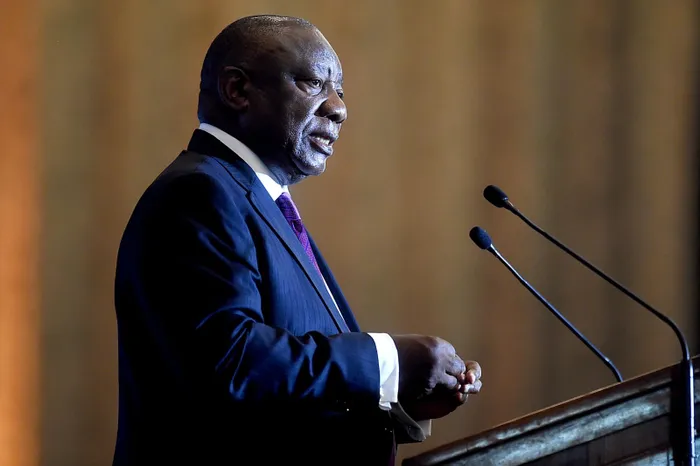
President Cyril Ramaphosa's thematic choices should leave a picture that is predictable to investors and the electorate when he delivers his State of the Nation Address, says the writer.
Image: Itumeleng English/ Independent Newspapers
AN INDELIBLY resonant Gospel parable is the one about the vineyard owner with two sons whom he commanded to work on his property. The first refused, but then thought better of it and went and did as his father asked. The second flatteringly told his father he would comply, but then went off and did something else.
Jesus narrates the story as a lesson to illustrate that we should pay less attention to people who loudly tell us what we want to hear and more heed to what they positively do.
I suspect it is a good basis for anticipating and understanding the implications of President Cyril Ramaphosa’s State of the Nation Address this evening as he reports back on government progress over the past years and outlines his administration’s agenda for the upcoming year and beyond.
The president has long been looking for compliant underlings to run the troublesome vineyards in the national, provincial, and local governments in the way he wants — and in the Thuma Mina spirit. Ramaphosa being a less intimidating figure than the father in Matthew’s Gospel, many leaders implicated in corruption and maladministration feature prominently in this version of the story. Yet, very few are willing to play the defiant son.
Instead, the limited number of competent and ethically upright leaders is a range of eager submissives, each straining to appear enthusiastic to pick up the pruning shears and discharge the service delivery mandate in line with the Batho Pele (people first) principles.
Tonight and during the subsequent SONA debate, lawmakers will have yet another high-profile encounter with Ramaphosa and in front of what is expected to be a large national audience. They will have to decide when to stamp and flap and how to voice their disapproval. Some have hinted that they will bring affected citizens as their guests to protest against the administration's failures.
We can expect Ramaphosa nevertheless to lift the curtain a little. The address might not be especially inspiring insofar as it connects the past to the future. That is not the emphasis of the expectations of many citizens.
His theme of “Building a Capable and Ethical State” government should reassure, not merely excite. It should be politically clear, strategic and internally consistent in focusing the nation on driving economic growth, tackling high unemployment, improving service delivery, and addressing critical infrastructure and crime.
It should provide a sharper outline than before of the thinking that will underpin the government’s more detailed decisions, including budget allocations and a decisive legislative programme. It should also make clear that Ramaphosa takes the long view, that he is thinking in terms of meaningful multiparty and citizen involvement in a polarised national and geopolitical environment.
His thematic choices should leave a picture that is predictable to investors and the electorate, as these are all about big subjects that speak to the people’s profoundest shared anxieties: economic insecurity, a failing health and education system, infrastructure decay, the danger of crime, children’s diminished life chances and the climate crisis.
All exemplify the broken South Africa over which the previous ANC governments have presided, remarkably built, and recklessly failed to protect from looters. And all of them demand new directions under the coalition governments rather than the sticking plaster solutions that Ramaphosa previously targeted for criticism. He must not ignore important debates about the sometimes problematic relationship between growth, inequalities and wellbeing.
Ramaphosa has often faced calls from supporters and critics alike to clarify what the government is doing to lift the nation out of poverty, unemployment, crime and corruption, and what its priorities would be for the years ahead. He will face more such calls as the local government election nears.
He remains cautious about responding with details. Instead, he prefers to subject policy, legislative, and regulatory interventions to behind-the-scenes political party wrestling. Critics suspect that he has little to say to his party, his coalition government partners, and the nation.
His own reasoning, presumably, is that he is not in the business of putting elaborative details about policies on premature public display that the coalition partners might be tempted to pinch.
He also wants the ANC’s and the government’s division and ineptitude to remain out of political focus. The ANC’s outsmarting of political parties so far in the administrations and legislative bodies at national, provincial and local levels reassures him that his approach is working.
But, even as various parties assert their individual identity on key national policies, they have internal disagreements over which strategies to prioritise in coalition governments. That will come to a head in the coming days. Lawmakers from all three spheres of government will be forced to concur with Ramaphosa’s assessment of the state of our nation. Doing otherwise could marginalise them further and unleash sharp internal disagreements on national priorities.
Exactly how far other political parties will cooperate to achieve the goals Ramaphosa is expected to set out in his address, however, is an open question. How will the divisions in the ANC-SACP-COSATU tripartite alliance play out? Will the SACP’s resolve to independently contest the next elections affect the tone? Will COSATU affiliates’ criticism that the government is doing little for workers change anything?
How will the DA and the MKP react, as they have had a rough few months? They are contributing less to the coalition governments. They are largely leaderless, and they have struggled mightily to respond to the inactivity and slow pace of the Ramaphosa administration. Even some party leaders have conceded they have stumbled in their attempt to settle on a message to counter the president.
Hints, though, cannot be annual programme commitments. Ramaphosa must draw an important outline and fill it in while mobilising all to participate meaningfully.
In Matthew’s Gospel, the exemplary figure of the parable is the first son, the one who originally rejected his father’s instructions but then did his will after all.
In today’s version, the public expectations and reaction to Ramaphosa’s account of the government’s past performance and an outline of plans suggest the hero this time will be the one who promised to do what the people wanted when they voted for coalition governments and then went off and did exactly what he had intended to do as a once dominant party in the first place.
Nyembezi is a policy analyst, researcher and human rights activist