

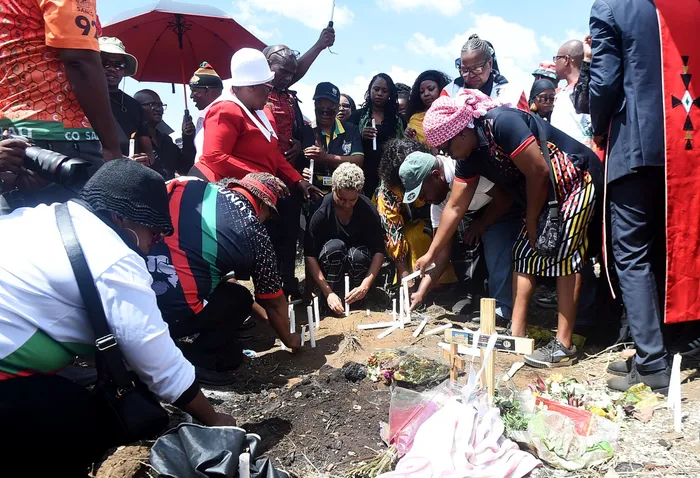
Candlelight ceremony 14 learners death_Candlelight ceremony 14 learners death505 Mourners gathered at the Candlelight ceremony following the death of 14 learners. The accident, terrible and unfortunate as it was, was long in the making, argues the writer.
Image: Itumeleng English
CHAOS, violence and violent death are a persistent, if not permanent, feature of Black life in post-apartheid South Africa.
To be Black, for many in the country, is to exist in a social order where life, and legal regulations are consistently disregarded and taken for granted.
This is a stark reality that effectively reduces Black life to that of endless chaos, cruelty, suffering and gruesome death. It is a reality that we have conveniently allowed to be part of who we are as a people of this country.
This is a reality, of course, that was constructed, birthed and institutionalised by centuries of white anti-Black rule and governance in South Africa.
Anti-Black racism, once it has been institutionalised and entrenched in the polity, does not necessarily need white rulers to continue to cause havoc.
Hence, in our post-apartheid order, anti-Blackness of the past is sustained and reproduced by institutions, including the state, and by members of the society.
We can see its faithful reproduction in normalised practices of the state and in the day-to-day actions of people in the country.
Even at the superficial level, the historic idea of a Black life, lives, as lacking human worth, as not deserving to be treated with decency, ethical consideration and respect is perpetually reproduced for us to witness, and beyond that, to reenact.
The current state of the country’s townships, for instance, continuously embodies and reinforces the idea of Black life as perpetually lacking human worth. Townships have systematically been left to be places of chaos and disorder. They are places of gratuitous violence and death. It is in the townships that people are violently killed daily.
People die from diseases and or medical conditions that can be treated or managed. A fact that tells us that life, particularly Black life, is not regarded as worthy enough to be treasured and taken care of.
The townships, by and large, are places where it is seemingly optional to follow laws and regulations. The normalised chaos means that people can sell food and alcohol without following the necessary laws and regulations. Food cooked, served and eaten in unhygienic conditions has now become almost a permanent feature in Black areas. Blacks are killed drinking in places that are not licensed to sell alcohol.
It is Blacks, in the main, that are transported in vehicles that should not, under any circumstances, be on the road. Some of these drivers have no driving licenses, nor consideration for others around them. Both the state and the people know this. And all actively participate in reducing Black life, particularly in the township, to a life that must consistently exist outside the legal framework, regulations and standards of humans.
What was once restricted to the township has, for a long time, been spreading throughout the country. Hence the increasing chaos, the failure to respect rules and regulations, law and order, and, of course, the complete disregard for human life.
The death of the 14 Black pupils in the Vaal accident, terrible and unfortunate as it was, was long in the making. It is, in other words, a normalised feature of Black life.
The 22-year-old male driver was simply doing what many before, and after, him do, which is to actively position the life of Blacks not as a treasured human life that deserves care, consideration and protection.
The driver was simply following and reinforcing the historical racial script of chaos and lawlessness as a permanent feature as far as Black life is concerned.
He knew, like all of us know, that the state has, tacitly, allowed many, particularly taxi drivers, to disregard laws and regulations that are meant to protect all of us. It is, to many of us, not a surprise that the unlicensed taxi transporting children was overloaded, and that the driver was driving without a valid permit.
Overloading, refusal to wear a safety belt, exceeding speed limits, driving while drunk, not having a valid license and driving an unlicensed vehicle have long been normalised across the country.
The disregard for what, on the surface, seem like minor rules and regulations compounds into chaos. Chaos that, in the main, communicates and entrenches the idea that life, particularly Black life, in post-apartheid South Africa, is not valued.
Majavu teaches politics at North-West University.
CAPE TIMES