
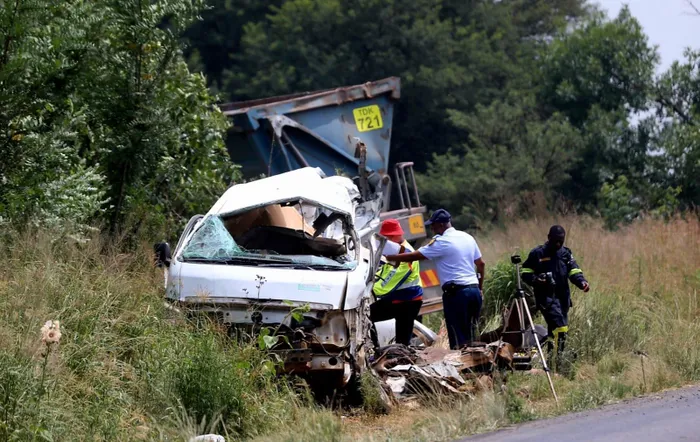
The provision of safe and reliable learner transport is key to attaining the right to access basic education, says the writer.
Image: Timothy Bernard / Independent Newspapers
THE Constitution of the Republic of South Africa defines and provides basic rights for all South Africans.
Chapter 2 of the Constitution recognises access to basic education as a basic right of all South Africans. The Constitution further requires that the state, through reasonable measures, make this right progressively available and accessible.
There are many input costs for providing basic education, including teachers' and learners' support material, school nutrition, and costs associated with transporting learners from homes to schools and back - learner transport costs.
Transporting learners from homes to schools and back is key to attaining the right to access basic education. Therefore, learner transport is crucial in ensuring that they arrive at schools safely and on time and provides learners with opportunities to realise and achieve their academic goals.
To fully grasp the challenges of learner transport, one must understand how planning and budgeting for learner transport by the government works.
First, planning and budgeting for learner transport is supposed to be coordinated between the national department of transport and the national department of basic education.
The situation at a provincial level differs somewhat because the National Learner Transport Policy of 2015 is not specific regarding the location of the learner transport function within a province.
Five provinces chose to locate the function of learner transport within the provincial department of education. The remaining four provinces locate the function within the provincial departments of transport.
Research from the Financial and Fiscal Commission shows that this coordination is sometimes ineffective.
For example, in 2015, the National Department of Transport reported a learner transport demand for 503 859 learners whilst the National Department of Basic Education planned for 516 886 learners who needed transport to school.
Again in 2016, the National Department of Transport projected 521 711 learners will need transport during that year whilst the National Department of Basic Education projected 524 662 learners for the same year. This misalignment indicates poor coordination, resulting in transport shortage during the school year.
Over the years, there have been significant changes in the number of learners per province as learners move both within and across various provinces.
The key drivers for learner transport demand are different when one considers rural versus urban areas.
In rural areas, the government embarked on a school rationalisation programme, where several schools, because of a lower number of learners, were deemed not viable and some schools were merged and some closed.
Learners from these non-viable schools were taken to the nearest schools. This has contributed to the increasing demand for learner transport in rural areas or rural provinces such as the Eastern Cape and KwaZulu-Natal.
On the other hand, in urban areas such as Gauteng, the demand for learner transport is driven mainly by in-migration and informal settlements, and the growth of new (housing) developments without schools.
Generally, there has been a significant growth in the demand for learner transport in all provinces, but KwaZulu-Natal and Gauteng have the highest growth between 2014 and 2024.
Research from the Financial and Fiscal Commission revealed that the demand for learner transport over this period increased from 498 263 learners in 2014 to 887 767 learners in 2024, an increase of 389 504 or (78%) learners for the 10 years.
Accuracy with respect to the actual learner transport demand is essential for planning and budgeting.
The most significant increase has been in Gauteng and KwaZulu-Natal, increasing from 142 895 to 222 019 and 176 156 to 196 461, respectively, between 2014 and 2024.
The demand for learner transport outstrips the supply, which indicates that the government is unable to provide for all learners. In most cases, provinces fail to provide learner transport services to all qualifying learners and set targets far below the demand.
In KwaZulu-Natal, for example, the demand for learner transport in 2021 was 179 318 while the supply stood at 73 650, implying that 105 668 eligible learners were not provided with learner transport.
Similarly, the target set by the province for learners requiring transport in 2024 was a mere 60 000 while the actual learners in need of transport to school was a whopping 196 461 learners.
This shortage meant 136 461 learners had to be on the road at dawn, walk long distances to school, cross rivers and rickety bridges, or get lumped into unroadworthy overloaded buses, bakkies, taxis and cars. A journey to school that is dangerous, exhausting and precarious in times of harsh weather conditions.
It is therefore clear that while the number of learner transport beneficiaries has been increasing, the provision of learner transport has not been close to addressing those in need. The provision of safe and reliable learner transport is key to attaining the right to access basic education.
The timing for a new funding model for scholar transport is now more than any other time something the government should mull over.
Analysis from the Financial and Fiscal Commission points to funding constraints that force provinces to set their targets lower than the demand for learner transport.
The allocated budget has not been keeping up with the funding required to provide all qualifying learners with learner transport. As an example in 2024, the budget for learner transport was reduced from R4.8 billion to R4.3 billion. In addition, per learner funding allocation also decreased from R5 290 in 2023 to R4 824 in 2024.
The Financial and Fiscal Commission therefore makes the following recommendations:
Dr. Mbava is the Chairperson of the Financial and Fiscal Commission