

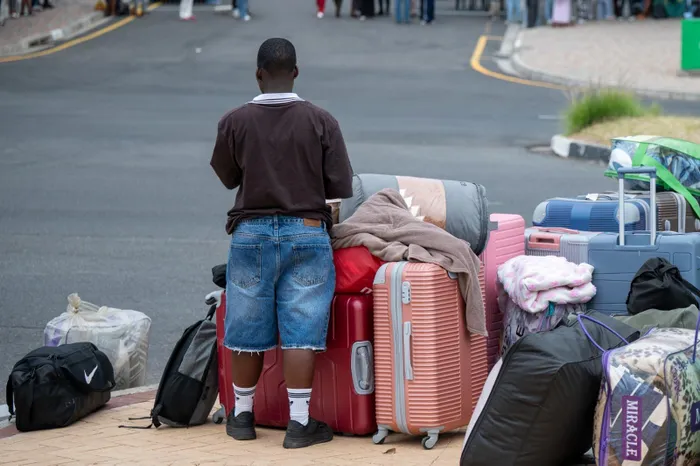
A student stands beside a pile of suitcases and bedding on a city pavement, highlighting the pressure and uncertainty facing those forced to relocate or seek temporary accommodation.
Image: Armand Hough / Independent Newspapers
EVERY year between January and March, thousands of students in South Africa are denied access to institutions of higher learning—not because they lack ability, ambition, or readiness, but because the system is structurally designed to exclude them.
This exclusion is not accidental. It is produced through academic exclusion, financial barriers, registration blockages, accommodation shortages, and the quiet violence of administrative finality.
This crisis is not merely an administrative inconvenience. It is a lived, embodied reality. It plays out in registration queues that stretch for hours and days, in rejection emails written with automated politeness, and in the sentence that ends dreams with devastating ease: “There is nothing we can do.”
These are not just queues. They are lines of young people carrying folders, certificates, and hope trying to figure out how they will pass through the gates of higher education. Gates they were once promised access to. Gates narrated to them during Life Orientation lessons with the familiar refrain: “Make sure you get good marks, so that you can get a degree after matric.”
This lifetime reminder rings loudly in their ears as they yearn for entry. But now, that sound no longer resembles joyful Christmas carols—no warmth, no celebration. Instead, it tolls like a bereavement bell: heavy, singular, exhausted. A bell burdened by the sorrow of the system’s response: “No, you will not be registered. You are a high-risk student.”; “You have to settle your fees before registration.”; “There is no space in university residences.”
These messages land hard. They are heavy. They are loaded. After hearing them, students instinctively look into their empty pockets—signalling the absence of resources required to leap over institutional hurdles. A dark cloud closes in. Hearts pump faster. Breaths shorten. Vision blurs. Access, in that moment, feels impossibly far-fetched.
Questions emerge quietly, painfully. And then comes the administrative full stop: “There is nothing we can do. Sorry.” That sentence, in its finality, breaks what little hope remained.
Here, two realities unfold.
The first: a student stands—slowly, brokenly—and leaves. They do not return. Their dream of higher education qualification deferred. ‘Access denied.’
The second: perseverance. A student who refuses disappearance. A student who remains in the vicinity of the institution, searching for alternative pathways, seeking guidance, support, a response – basically anything to gain access.
It is this second reality that this piece holds gently, but firmly.
These students lace up the boots of activism—not out of rebellion, but out of necessity. Their activism is rooted in hope, in the decolonial demand for access, and in the insistence that higher education cannot continue to operate as a gated commodity while masquerading as a public good.
Their souls are already fractured, yet still reaching.
The reality becomes long hours of unanswered emails. Continuous knocking-back, each rejection met with stubborn hope. Minds caucusing internally over next steps. Some attempt to secure loans. Others turn to crowdfunding. All of them are planning survival and gaining access to education. And importantly, they begin to question the system. They have every right to. Because for most of our lives, we were told ‘education is a human right’.
What we were not told is that it is also a commodity—one priced beyond the reach of the poor, the working class, and the generationally wounded. Access denial is not accidental; it is the outcome of policy choices that prioritise balance sheets over human futures. The questions grow louder. The denial of access echoes through institutional corridors. Students find one another they conscientise, organise and mobilise. Emotions collide. Interactions gravitate. Collective consciousness awakens.
System disruption begins.
And to be clear—no one wakes up wanting to protest. As a former student leader, I say this with certainty. Protest is not desire; it is the last available language when all others have failed. Yet protesters are easily labelled: “rebellious,” “entitled,” “the ones who want everything for free,” “the ones always demanding.” Questions are thrown like stones: “Why can’t your parents pay?”, “Why can’t they just pay like the rest of us?”
These questions wound deeply because they erase context. They erase history. They erase humanity. Students chant not out of chaos, but out of pain. Their mzabalazo/struggle songs move through corridors heavy with exhaustion. Some have slept outside. Others in computer labs. Many without food, without access to bathing facilities, without dignity. Their tired bodies become sites of resistance. And still, the message remains: ‘Access denied.’
As I write this, I am haunted by the memory of students who have taken their own lives because their dreams were shattered. Because their realities became too blurred to continue living. They carried pain—often generational pain. Hardship. Brokenness. And when education—their last imagined pathway—was rendered unreachable, they were left stranded.
The government knows. Institutions know. Yet every registration season, students become headlines. They freeze outside campuses. They beg. They are humiliated. They stand closely together to feel the spirit of solidarity. This is not a surprise crisis - it is a predictable one, repeated with devastating consistency.
The access journey during this period unfolds in phases: the initial trying, negotiating, communicating, pleading, knocking; the trials—crowdfunding, borrowing, negotiating survival; the pre-protest phase, where hope thins; protest as the final resort; and post-protest, where registration finally happens—but at a cost.
By then, students are already drained, already behind, already late in the academic project. And all of this leads to fatigue that gets carried through the year as the students continue to move around the premises of the institutions. And yet, higher education continues to be mirrored to us as a desirable dream. A space of academic excellence, innovation, entrepreneurship, ground-breaking research and many other spheres to explore for growth and success – yet the access to it is far-fetched. Education is paramount, we yearn for it because we are capable, because we are ready.
So, as I pen this, I call not for rage—but for grace. Grace in policy. Grace in registration processes. Grace in recognising that students who knock loudly are not entitled, but exhausted. Humility instead of humiliation. Access instead of exclusion. Because hope—when denied—does not disappear. It embodies itself in the bodies of students who refuse to vanish.
Quthu (They/Them) is a young South African whose interests are rooted in situational and lived-experience studies. They are a hopeful-intersectional scholar who employs a multidisciplinary approach to investigate modalities of life. The views expressed are solely those of the author and do not reflect those of any affiliated institutions.