

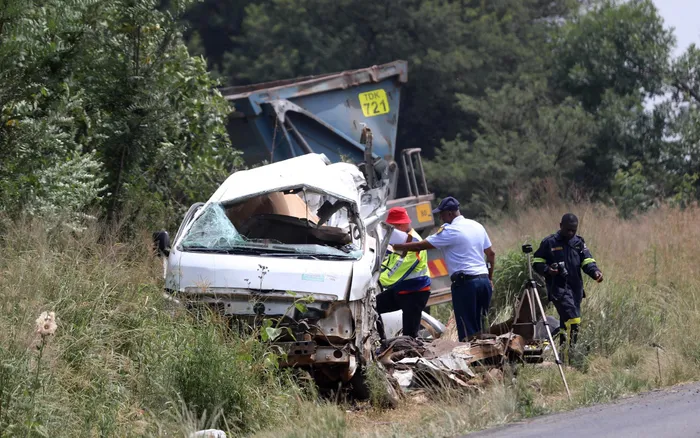
The Vanderbijlpark scholar transport crash that claimed the lives of 14 learners earlier this week has led to growing calls for the industry to be regulated.
Image: Timothy Bernard / Independent Newspapers
LISTENING to eyewitnesses describing events leading up to the tragic accident that claimed the lives of 14 young learners once again exposes the gaps within the systems designed to prevent such occurrences.
The driver of the minibus taxi transporting about 18 children allegedly attempted to overtake several vehicles before colliding with the oncoming truck in Vanderbijlpark on Monday morning.
The eyewitnesses also confirm that the driver of the truck tried swerving to avoid the taxi but it was too late. What they observed is a sight that many South Africans have become familiar with, especially involving scholar transport when schools reopen.
On the same day, nine children were injured after the driver of their scholar transport vehicle lost control and crashed into a tree near Sarnia Primary School in Pinetown, west of Durban.
Cape Town has also had its own horror scholar transport accidents, notably the deaths of six children when the overloaded bakkie they were travelling in hit a traffic light on AZ Berman Drive in Mitchells Plain two years ago.
What usually follows is the old empty promise to tighten the laws, including regulating the scholar industry. For parents, it is a rebuilding a life that will never be the same; worse still when most of these accidents are attributed to human error and therefore avoidable.
For surviving learners, it’s a recovery from a traumatic experience that will forever change their lives.
Gauteng Premier Panyaza Lesufi is not saying anything new with his call for stricter regulations. It’s something most of his counterparts in various government departments repeat yearly after tragedy has struck. The regulations are there, but drivers simply refuse to adhere because enforcement is weak if it exists at all.
The outrage that often follows dissipates quickly until another tragedy strikes. Had there been increased presence of traffic officers on the roads, most of these tragedies could have been avoided. In fact, the driver would think twice before overloading their vehicle with children.
Our children are victims of neglect by various entities who are supposed to protect them.