

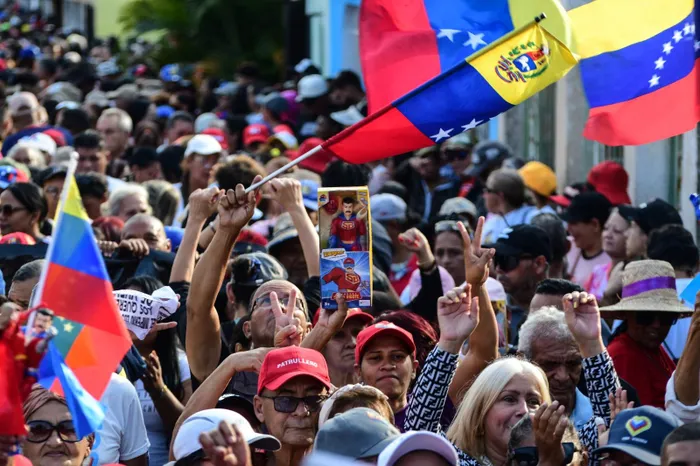
A demonstrator holds a toy of the caped superhero named "Super-Bigote" (Super-Mustache) during a rally in support of ousted Venezuela's President Nicolas Maduro in Valencia, Carabobo state, Venezuela, at the weekend.
Image: AFP
THERE is a reason the argument has stalled on a single word. Not missiles. Not explosions. Not the extraordinary claim that a sitting head of state has been seized and flown out of his country by a foreign power.
The word is ‘capture’ - and its rival is ‘kidnapping’. This is not semantics. It is jurisdictional warfare. What we are witnessing is not merely a foreign policy crisis. It is a stress test of sovereignty itself, staged as spectacle. And the outcome will not hinge on verification alone, but on which grammar of power prevails.
To say capture is to pre-legitimate violence. It installs a police narrative before any legal forum can intervene: suspect apprehended, justice pending, order restored. To say kidnapping is to rip away the costume and name the act for what it is: armed seizure across borders, sovereignty overridden by force, law trailing behind violence like an afterthought.
Sovereignty, in theory, is simple. States are equal. Borders matter. Violence across them is prohibited except under narrow, clearly defined circumstances.
In practice, sovereignty has always been hierarchical - robust for the powerful, negotiable for the rest. What makes this moment different is not that the United States has intervened abroad. That history is long, bloody, and well-documented. What is different is the form: the convergence of military force, criminal indictment, and executive spectacle into a single gesture - the raid.
This is sovereignty hollowed out and repackaged as law enforcement. The logic runs as follows: if a leader is criminalised, sovereignty dissolves around him. Once indicted, he is no longer the president but a fugitive. Once a fugitive, he can be “captured.” Territory becomes incidental. Borders become inconvenient. International law becomes commentary, not constraint.
This is not how law is meant to function. It is how the Empire modernises.
The defenders of this logic, the Trumpian Regime, insist that international law remains intact - that justice is finally being served. However, the law that arrives after the missiles is not law; it is narration. International law is most loudly invoked when it is least able to restrain power.
The UN Charter forbids the use of force except in self-defence or with explicit authorisation. Neither condition is clearly met here. And yet the language of legality floods the discourse: capture, indictments, charges, bounties, criminal enterprises.
This is the paradox of contemporary power: legality is not abandoned; it is weaponised.
What we are seeing is not classical fascism. It is something slicker, more administrative, more palatable to liberal audiences: a neo-fascist aesthetics of order. Its defining feature is not ideology but method. Decisive executive action replaces deliberation. Military force masquerades as policing. Complexity is flattened into morality plays: villain apprehended, chaos resolved. The executive becomes the embodiment of sovereignty itself, unconstrained by domestic institutions or international norms.
This is why the raid is such a potent political form. It bypasses democracy while claiming to protect it. It suspends the law while invoking justice. It promises purification through force. And crucially, it travels well. Once normalised, it becomes a precedent.
In the United States, this aesthetics has a name, even if it often pretends otherwise. MAGA is not merely a partisan formation; it is an effective regime that rehearses exceptions as common sense. Its devotion to “law and order” is not juridical but visceral. Procedure is mocked. Delay is a weakness. Force is clarity. The pleasure it takes in decisive punishment - of migrants, protesters, foreign leaders - conditions the public to accept the raid as reason itself. What appears abroad as foreign policy is domestically cultivated as desired.
The incoherence of this order becomes clearer when placed alongside another fact. Juan Manuel Santos, Maduro’s electoral runner-up, was awarded the Nobel Peace Prize for negotiating an end to Colombia’s civil war. The prize did not sanctify innocence; it sanctified the process—dialogue over annihilation, negotiation over capture.
That the same international system can celebrate peace-making in one register while normalising extraterritorial seizure in another reveals the real hierarchy at work. Peace is rewarded when it stabilises the order. Force is excused when it enforces it.
The long-running obsession with “extracting” Maduro - circulating for years in policy circles, exile fantasies, and botched private ventures - did not emerge spontaneously. It reflects a deeper belief: that sovereignty in the Global South is provisional, revocable upon misconduct as defined by Washington. That belief has now been operationalised.
If this act stands - if a foreign power can seize a head of state and frame it as an arrest—sovereignty does not disappear. It reorganises. Some governments will applaud quietly. Others will panic. Many will adapt, hardening their own security apparatuses, shrinking civic space, and justifying repression as defence against external threat.
Ordinary people will absorb the costs: instability, retaliation, displacement, and the normalisation of emergency politics. And the most dangerous lesson will travel outward: jurisdiction follows force. If you are powerful enough, law will find a way to justify what you have already done.
For Venezuelans, the consequences are immediate and asymmetric. Any external seizure framed as justice hardens the internal security state, forecloses political opposition by associating dissent with foreign aggression, and licenses further repression in the name of defence.
Retaliation - economic, diplomatic, covert - rarely distinguishes between regime and population. Ordinary people inherit instability they did not author, while their political future is rewritten elsewhere. They appear in the narrative only as background—terrain rather than agents—spoken about but never spoken with.
The scandal is not only about whether this violates international law. It is that the distinction between war and policing is being deliberately erased. Once that line collapses, there is no stable framework left - only managed exceptions. Leaders become arrestable. Borders become porous. Justice becomes something delivered from the sky.
Kidnapping or capture? The answer will determine not just how we understand this moment, but what kind of world we are being prepared to live in.
Khan is a fellow at the Centre for Humanities Research at the University of the Western Cape.