
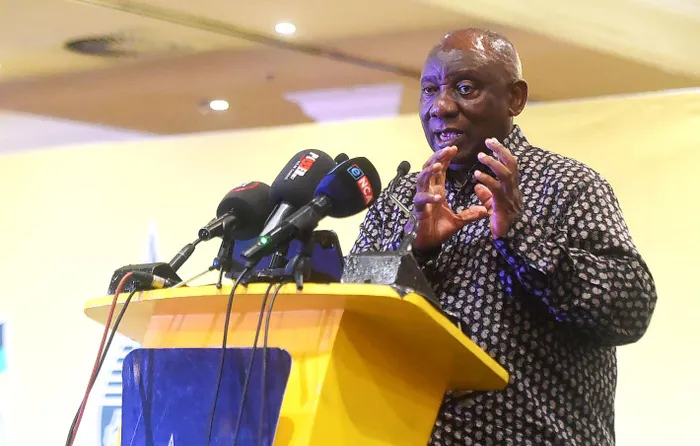
ANC president Cyril Ramaphosa is expected to deliver his party's January 8 Statement on Saturday where he will outline the organisation's priorities even as it no longer enjoys a majority government.
Image: Itumeleng English / Independent Newspapers
AS PRESIDENT Cyril Ramaphosa prepares to deliver the ANC’s 114th January 8 Statement at Moruleng Stadium, millions of South Africans will listen with scepticism rather than hope. They have heard the plans before. They have heard the promises. Yet unemployment remains entrenched at 31.9% and is projected to worsen.
For parents watching qualified children sit idle at home. For young people whose confidence and dignity are eroded by daily rejection. For households trapped permanently in survival mode. Enough really is enough.
This January 8 Statement must confront unemployment as the national emergency it is, not as a long-term policy challenge to be managed incrementally. South Africa does not need another framework. It needs bold, immediate action.
We must be honest about what 31.9% unemployment means. It means nearly one in three South Africans who want to work cannot find a job. It means one of the highest youth unemployment rates in the world. It means that the 855,000 work opportunities created in 2025, celebrated in the ANC’s year-end message, barely register against the devastation unfolding daily in our communities.
The ANC’s recently announced 10 Point Economic Action Plan contains sensible elements. Stabilising electricity. Fixing ports and logistics. Supporting small businesses. These interventions matter. But necessity is not sufficiency.
The fundamental flaw is the assumption that if supply-side constraints are resolved, jobs will automatically follow. Infrastructure alone does not guarantee employment. It never has. As the Institute for Economic Justice has argued, the plan is internally incoherent.
Once again, we are doing the same thing and expecting different results.
Imagine if the President stood before South Africans and spoke with honesty and courage.
Imagine him acknowledging that the government has not done enough. Unemployment is not merely an economic statistic but a moral crisis that threatens social stability and democracy itself. Imagine a commitment that, within 12 months, the state will directly employ one million young people through expanded public employment programmes, paying at least the national minimum wage.
Imagine a clear instruction that every state-funded infrastructure project must include binding quotas for youth employment. Every company receiving public support must meet measurable job creation targets or face consequences.
Imagine an honest admission that electricity transmission lines and logistics reforms mean little if people have no income to participate in the economy. And imagine a firm commitment to make the Social Relief of Distress Grant a permanent Basic Income Grant, as the ANC itself resolved, instead of weakening it through restrictive conditions.
Imagine quarterly public reporting where ministers, mayors, and senior officials are held accountable for job creation outcomes, with real consequences for failure.
That would be leadership worthy of a movement that invokes Nelson Mandela’s legacy.
The current approach treats private sector participation as the solution while asking very little in return. Businesses benefit from preferential electricity arrangements, improved logistics, state-backed credit guarantees, and public infrastructure investment. Yet there are no binding obligations to create jobs.
This must change. If companies benefit from public resources, they must contribute to the public good. Tax incentives should reward firms that employ unemployed youth. Public procurement must favour companies that meet employment equity and job creation targets. Firms that offshore jobs or automate aggressively while reporting record profits should not enjoy government contracts or incentives.
We must also confront an uncomfortable truth. The obsession with attracting foreign investment through so-called business-friendly policies has not delivered. High interest rates, spending cuts, and privatisation have not triggered the promised investment boom. Instead, public capacity has weakened while private capital either waits on the sidelines or leaves the country.
For years, macroeconomic policy has prioritised inflation targeting and fiscal restraint over employment and growth. The result is an economy stuck in low growth, deepening inequality, and permanent joblessness.
Real coordination means the Reserve Bank recognises the employment consequences of prolonged high interest rates. It means the Treasury stops cutting spending on programmes that stimulate demand and create work. It means Development Finance Institutions are recapitalised so they can support small businesses and entrepreneurs who are best placed to create jobs.
In a country with unemployment above 30%, job creation must be the central objective of economic policy, not a secondary consideration.
Job creation also cannot remain concentrated in major metros. Townships, rural areas, and small towns are losing their young people to cities that cannot absorb them. Without serious investment and technical support, local economic development remains a slogan rather than a strategy.
Every district needs properly resourced economic development units. Infrastructure spending must be linked to an industrial policy that supports labour-intensive sectors such as agro-processing, textiles, and light manufacturing. Localisation must mean localising opportunity, allowing young people to build dignified lives where they live.
Perhaps the greatest source of public anger is the absence of consequences. Plans are announced. Projects fail. Money disappears. Yet the same leaders remain in place.
If unemployment is truly a priority, accountability must be real. Transparent quarterly reporting on employment outcomes. Clear targets for departments and municipalities. And decisive action when those targets are missed.
The ANC now governs in coalition after losing its parliamentary majority for the first time since 1994. The 2026 local government elections are approaching. But this moment is not ultimately about party survival. It is about whether millions of South Africans will ever experience the dignity of work.
South Africans are not asking for miracles. They are asking for honesty about the scale of the crisis, clear plans with measurable targets, and leadership that puts people before ideology and political comfort.
Mr President, when you stand at Moruleng Stadium this Saturday, you face a choice. You can repeat familiar rhetoric and hope the country remains patient. Or you can speak with the urgency this moment demands, acknowledge failure, commit to emergency-level action, and hold your government accountable for results.
Our people deserve nothing less. And history will remember which path you chose.
Qwesha is a trade finance consultant with expertise in global commerce and risk management and regularly contributes to a number of publications.