
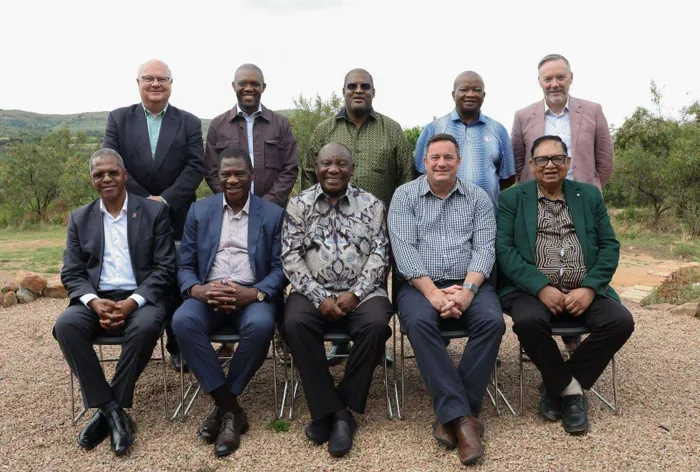
ANC President Cyril Ramaphosa recently led a two-day retreat at the Cradle of Humankind, pledging to step up efforts to tackle unemployment, poverty, crime and corruption. The latest tensions between DA and ANC over policy related matters suggests that the former ruling party remains firmly in control of the direction the coalition government takes, says the writer.
Image: GCIS
THE DA will once again learn the hard way when the ANC strong-arms it into submission over the policy directive that Communications and Digital Technologies Minister Solly Malatsi recently issued.
The ANC will show that it remains firmly in control of the Government of National Unity (GNU) and that any attempt to alter its programme will be met with strong opposition.
This despite Malatsi’s assurance that the December 12 directive to the Independent Communications Authority of South Africa (ICASA) does not favour any entity, bypass the Electronic Communications Act, or weaken transformation.
His words have not convinced some of his fellow GNU partners who still see the directive as an attempt to clear the path for Elon Musk’s Starlink to operate in the country by bypassing the strict 30% Historically Disadvantaged Groups (HDG) ownership requirements and replacing them with a less stringent “equity equivalent” model.
The ANC in particular is uncompromising with its stance, saying the minister was unlawfully directing ICASA to act beyond its statutory mandate, thereby destabilising the independent regulator.
“The Gazette introduces policy directions that exceed the minister’s legislative authority, undermine South Africa’s transformation framework, and threaten the integrity of our ICT and postal regulatory environment. It mirrors a troubling trend where ministers belonging to the Democratic Alliance seek to bypass Parliament, by reforming laws through directives instead of following democratic legislative processes.”
Such a strong statement suggests that the ANC will ensure that the directive does not see the light of day.
Ordinarily this would mean the end of the relationship between the two, mainly because the ANC has been able to use the GNU to get on with its programme whether the DA agrees or not.
This then makes one wonder about the role of the DA in the GNU. We have previously stated the party entered the coalition government to help the ANC remain in power when the voters rejected it.
Judging by the stark differences in policy direction, it’s becoming increasingly difficult for the DA to argue against that proposition.
CAPE TIMES