
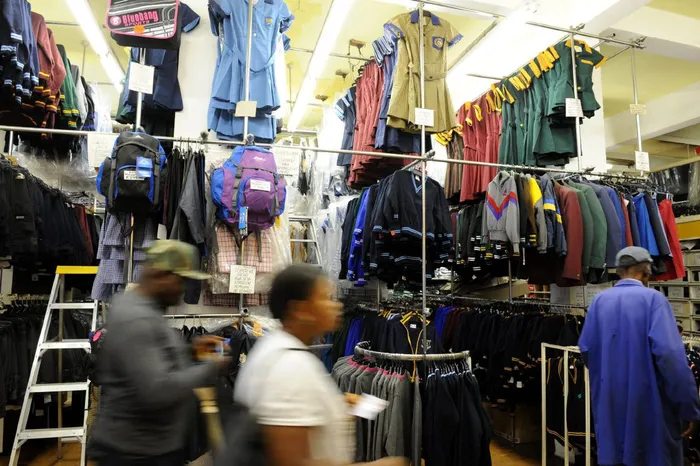
01/11/2016 A uniform shop in CBD is prepared for the parents coming in to purcha THE Competition Commission’s investigation outcomes indicate that most schools no longer have exclusive arrangements with suppliers and/or manufacturers of school uniforms, says the writer.
Image: Simone Kley
THE notable rise of school uniforms and other learning goods and services is a societal problem that inevitably calls for societal action. This is because we are compelled by the Constitution to guarantee education as a basic human right, one that must be accessed through equitable and affordable means.
During a parliamentary briefing by the South African Humans Rights Commission (SAHRC) on a report of its investigation and inquiry into school uniforms, the Chairperson of the Portfolio Committee on Basic Education Ms Bongiwe Mbinqo-Gigaba argued that “South Africa has high levels of inequality. School uniforms equalise the levels of all learners on the school ground.”
As a parent myself, I am acutely aware of the costs that come around in the new year for stationery and new school uniform items.
Due to increased media reporting, the rising cost of living, and the Competition Commission’s own advocacy efforts, parents across the country have become more vocal about the costs and specifically, aware of the risk that exclusive contracts pose in driving up costs and limiting other service providers from entering or expanding in the market for the supply of stationery or school uniforms.
In recent years, the Commission has found that this ‘vertical restrictive practice’ is not new and before our advocacy work and intervention it was relatively widespread.
Our aim then and now is not to prosecute schools for the contravention of Section Five of the Competition Act 89 of 1998 (as amended) but rather to change the conduct and ensure that we improve the state of competition in this market.
Importantly, the Competition Act prohibits conduct of this nature as it may lead to higher prices, low quality and lack of choice.
From the investigation of complaints received from the public, the Commission not only developed a guideline that explains to schools, SGBs, and parents/guardians what anti-competitive conduct is but also why schools should opt for school uniform and stationery that are as generic as possible and obtainable from many different suppliers.
These guidelines also indicate that schools should preferably appoint more than one supplier in order to give parents and guardians more options, that exclusivity should be limited to items that the school regards as absolutely necessary to get from preselected suppliers, and that exclusive agreements should have a limited duration of between three to five years.
For the latter, schools should follow a transparent and competitive bidding process. The Commission further collaborated with the Department of Basic Education (DBE) to develop a circular that was distributed through the department to schools that further outlined the guidelines.
The Commission also undertook extensive educational and awareness initiatives targeted at schools, school governing body (SGB) associations and parents on the potential anti-competitive effects that are likely to arise in the procurement of school uniforms and stationery.
As part of its awareness campaigns, the Commission visited the Provincial Departments of Education in the Eastern Cape, Western Cape, KwaZulu-Natal and Limpopo. Among some of the reasons for selecting these provinces, was the number of complaints that the Commission had received which were lodged against schools in these provinces.
Subsequently, the guidelines were adopted by various school groups and governing bodies as a set of rules to regulate procurement of school uniform and stationery.
Many schools immediately started to implement the guidelines and identified items like school ties, blazers, caps etc as part of limited exclusive clothing.
Several schools also signed undertakings as a pledge of their commitment to pro-competitive procurement of uniforms and other learning-related goods and services.
Market participants, parents and guardians alike are still encouraged to submit a complaint to the Commission should they suspect a school is contravening the Competition Act or deliberately not adhering to the guidelines.
The Commission will investigate the complaint and attempt to examine and understand the situation. When we receive a complaint, we engage with the complainant and get all the information required to take the matter further and engage the school directly. In fact, we have managed to resolve a large number of school uniform complaints, and the Commission’s investigation outcomes indicate that most schools no longer have exclusive arrangements with suppliers and or manufacturers of school uniforms.
Importantly, supply agreements are now more limited than when we first initiated our work in this sector.
Our work however is not done. The Commission is currently collaborating with the DBE to develop a tool that will monitor suppliers and prices of school uniforms to ensure compliance with the guidelines.
Once finalised, the tool will be distributed to all schools and will assist the Commission to determine non-compliance with the guidelines as well as identify anticompetitive behaviour in the school uniform market, including excessive pricing and exclusion of small and medium firms due to exclusive supply agreements.
In turn, the Commission will use the data received from the tool to ensure fair and competitive pricing of school uniforms and promote the entry and/or expansion of small suppliers in the school uniform market.
More information about the guidelines is available on our website at www.compcom.co.za
Makunga is spokesperson for the Competition Commission of South Africa.