
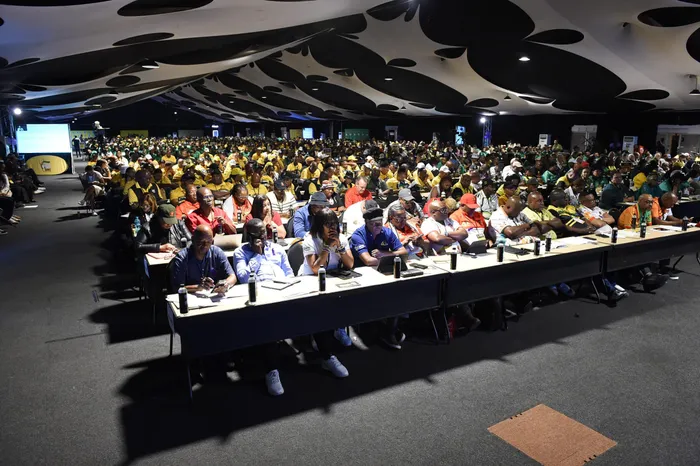
ANC members attend the party's 5th National General Council in Boksburg. Public intellectuals seem to be reading the obituary of the ANC without offering the public a possible imagination without the party, says the writer.
Image: Itumeleng English / Independent Newspapers
READING Frantz Fanon’s “The Wretched of the Earth" and critically evaluating the nationalist politics on the continent and beyond will reveal why the demise of the ANC as the governing party was inevitable.
It has been ventilated in different iterations that nationalist politics fail to deliver the ideals of civil liberties that are sacrosanct to the lives of the newly-independent citizens.
The systemic economic exclusionary of the natives by the latter regime, the continued direct and indirect former colonial governments interferences in the newly independent states coupled with the nationalist kleptocracy are the primary reasons for the stagnation.
The ANC unfortunately has experienced and continues to experience the previous reality that confronts nationalist organisations.
Although the ANC has experienced all of this, it is unfortunate that the public discourse has failed to think about the South African future intellectually beyond the possibility of having a government without the ANC.
‘Intellectuals’ seem to be reading the obituary of the ANC without offering the public a possible imagination without the ANC or to intellectually learn from many countries’ governance experiences beyond the antecedent nationalist parties.
However, there is much more interest in what aboutism. This what aboutism public opinion manifests itself through assertions such as, what would have Nelson Mandela, O.R Tambo, Steve Biko and Robert Sobukwe said or done had they been alive with what is currently happening.
The unfortunate misgiving of what aboutism is that it negates the fact the very same people they wonder about were also nationalist leaders not entirely different from the current surviving and governing nationalist leaders.
If one can critically evaluate the South African electoral participation, one would notice since 1999 the voter turnout has been decreasing and significantly decreased over the last two previous elections.
The significance of this demonstrates that South Africans have been disillusioned and dissatisfied by the nationalist politics.
However, voters are still going to continue to be confronted by the nationalist politics from the new emerging political parties that challenge the ANC government.
Public intellectuals have done little to publicly nudge South Africans to imagine a new government without nationalist politics like the opposition parties that oppose the ANC thus this constant voter decrease.
The unfortunate reality is that the public intellectuals just deductively argue this is because of corruption. However, South African citizens long for a new polity beyond nationalist informed polity in various iterations- political and economic nationalist.
The concerns for the majority of South Africans are matters of bread and butter i.e., the materialisation of civic liberties that South Africa has perfectly championed in the international system more recently.
Mlambo is a doctoral candidate at UCT
CAPE TIMES