

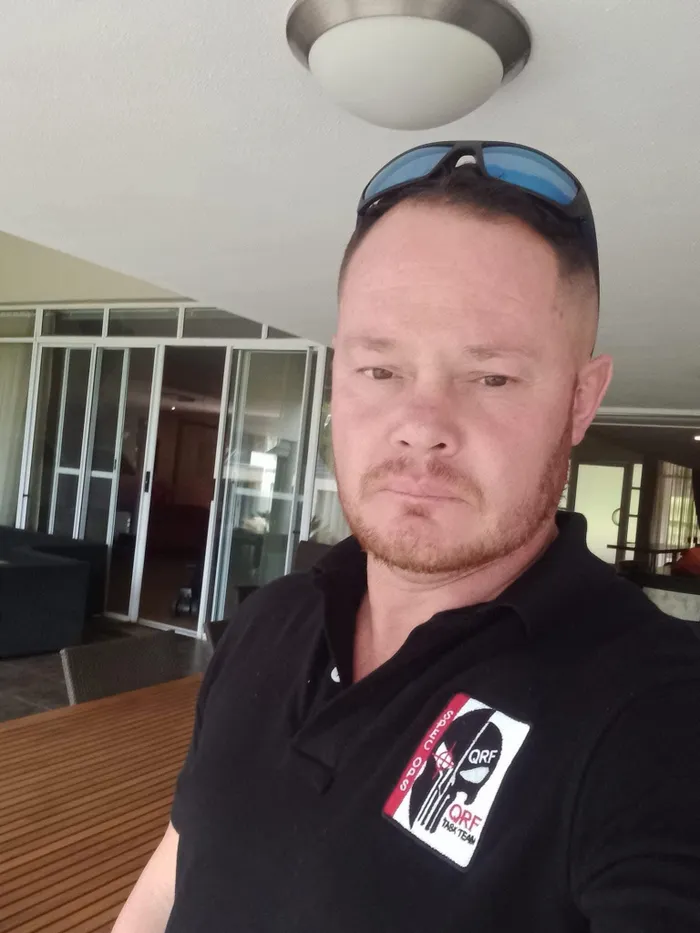
Witness D, identified as Marius "Vlam" van der Merwe, was shot dead in front of his family outside his home in Brakpan, Ekurhuleni, on Friday night.
Image: Supplied
THERE comes a moment when a nation must look at itself squarely in the mirror and confront what it has become. South Africa has finally reached that moment, and the reflection staring back at us is devastating.
It is a reflection written not in policy documents or glossy speeches, but in blood.
A witness, a father, a son, a citizen, was executed in front of his children. Not killed. Not caught in a criminal crossfire. Executed. We must stop comforting ourselves with sanitised language. This was not a tragic incident. This was a strategic assassination, a public silencing, a message engraved in violence.
It forces us to confront a truth we have long tiptoed around, in today’s South Africa, the single most dangerous act a citizen can commit is to tell the truth.
Whistleblowers do not only step forward; they step into the crosshairs. They trade anonymity for exposure, safety for danger, and often life for principle. They carry our collective conscience because the institutions that should protect public integrity no longer can or no longer choose to.
And what does the South African state offer these people; our democracy’s last line of defence? Trauma. Isolation. Bureaucratic abandonment. Psychological warfare. And in far too many cases, a coffin.
A constitutional democracy cannot claim legitimacy while the brave are hunted like animals.
The state’s moral failure is not theoretical. It is human, it is intimate, and it is unfolding in real time. Recall Brigadier Julius Mkhwanazi’s emotional testimony before the Madlanga Commission. His trembling voice. His tears for his children. His fear of prison. His dread of what would happen if he told the truth.
That fear was real, unfiltered, and deeply human.
But here is the most devastating irony, the very system he begged to protect him is the same system that has now failed the children of the whistleblower who was assassinated on Friday.
The state he relied on for justice has left them fatherless. This moment is not just another headline. It is the line.
It is the point at which a republic must choose whether it still intends to exist. For years, South Africa has danced along the edges of lawlessness, a country half state, half shadow, where political patronage and organised crime blur into indistinguishable networks of power.
But the targeted execution of a protected witness pushes us past the boundary of crisis and into the territory of collapse.
We either act decisively, or we formally concede that impunity has won.
And into this vacuum of moral clarity steps a leadership crisis so profound that it borders not on incompetence, but on complicity.
The country watched Police Minister Senzo Mchunu appear before the Madlanga Commission, visibly uncomfortable, visibly unprepared, and visibly anxious. The questions put to him were not complex. They were simple. Basic. Administrative.
These are yes or no questions.
Yet his answers were a masterclass in evasion, a choreography of political survival rather than accountability. His hesitations, his circular explanations, his inability to anchor the decision to disband a crucial police unit in any documented evidence all of it revealed a deeply unsettling truth.
This was not just bureaucratic confusion.
In the context of a whistleblower now dead, it is damning.
His answers suggest a system where protecting turf matters more than protecting citizens. Where legalistic fog is deployed to obscure lethal failures. Where leadership bends under the weight of political expedience rather than constitutional duty.
And this is the heart of South Africa’s crisis; SAPS is not merely failing. It is disintegrating from the inside out.
For years, the public has felt the slow collapse of police morale, the flight of skilled investigators, the politicisation of appointments, and the sabotage of internal units. Crime intelligence has become a battlefield. Detectives work in a climate of fear.
Witness protection has been reduced to a hollow promise. A state cannot fight corruption when those who testify against crime syndicates are killed faster than cases can be opened.
Yet here we are. The architects and foot soldiers of state capture roam freely because they know one truth: they are not facing a state.
They are facing the shell of one. We are long past the era when commissions of inquiry could pacify public anger. Long past the days of measured statements, teary podium appearances, and tomorrow’s promises.
The moment demands something else, something the state has not shown in years: resolve. The demand now is simple, brutal, and constitutionally unavoidable: Hunt down the individuals who ordered this assassination with the same relentlessness that whistleblowers show when they step forward. No delays. No political interference. No excuses about resources. No “lost dockets,” no “pending investigations,” no “internal reviews.”
Because every day the state fails to act, it broadcasts a message into the bloodstream of this country: The contract is broken. The violent own the future.
Minister Mchunu’s affidavit confusion, the Commission’s visible discomfort, these are merely symptoms. The disease is the normalisation of terror as a political management tool. The disease is the tacit acceptance that whistleblowers are expendable. The disease is the erosion of public belief that South Africa’s institutions still exist to protect the innocent rather than protect the powerful.
Let us not delude ourselves any further.
If we allow this assassination to fade into the background noise of daily outrage, then we are no longer a republic in trouble. We are a banana republic with a beautiful constitution and a magnificent flag, but a banana republic, nonetheless.
The choice before us is not ideological. It is not partisan. It is existential. South Africa must decide: Will this nation protect the brave, or will it bury the Republic?
Qwesha is a trade finance consultant with expertise in global commerce and risk management and regularly contributes to a number of publications.