
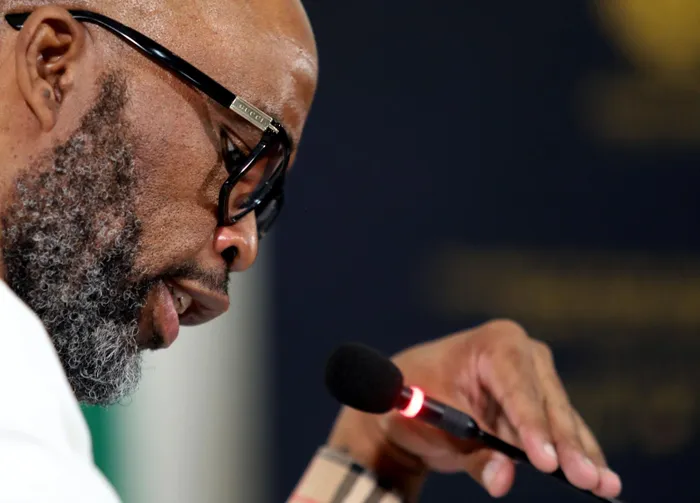
CONTROVERSIAL tenderpreneur and murder-accused Vusimuzi ‘Cat’ Matlala's testimony before the Ad Hoc Committee was a masterclass in the art of non-answers, says the writer.
Image: Oupa Mokoena / Independent Newspapers
SOUTH Africa didn’t need another scandal. We’re drowning in them. What we needed was clarity. We needed a moment where the fog lifts just long enough for the public to see the machinery behind the mess.
Strangely, Vusimuzi “Cat” Matlala, with his selective memory and careful silences, has given us exactly that. But the real revelation didn’t come from his testimony. It came from ANC Chief Whip Mdumiseni Ntuli, who calmly listed a string of “coincidences” that should make every South African sit upright.
Let’s stop insulting ourselves. In politics, when leaders lean on the word coincidence, it usually means the truth is walking a little too close for comfort.
What Ntuli highlighted wasn’t random. It was a pattern. A pattern so obvious that pretending otherwise would require a deliberate suspension of intelligence. Ntuli’s list was damning not because it accused anyone outright, but because it mapped out something far more dangerous: repetition.
The same individuals resurfacing in different scandals, the same companies circling multiple tenders, the same political corridors offering convenient access, the same flows of unexplained money and the same “lucky” bidders winning at the same hospital.
When the same names, companies, and institutions keep appearing in crisis after crisis, you are not observing a coincidence. You are observing a network at work, which is coordinated, protected, and comfortably embedded within public institutions.
Matlala didn’t expose this network. He merely confirmed it existed. His testimony was a masterclass in the art of non-answers:
“I don’t know.”
“I can’t recall.”
“I don’t personally deal with that.”
These lines weren’t slips. They were a strategy. A performance calibrated to protect himself without dragging the entire structure down with him.
But even in his evasiveness, the outline of the network became visible. Parliamentarians weren’t just hearing half-truths; they were watching a carefully-constructed ecosystem glint through the cracks.
And Ntuli, perhaps without intending to, laid it bare.
If These Are Coincidences, Oversight Is a Hallucination
Let’s be plain. You cannot have:
Tender beneficiaries appearing in political spaces
R5 million entering accounts in a single month
Alleged ties to police officials quietly emerging
Donations or favours linked to political campaigns
A hospital with a documented history of procurement abuse repeating the same patterns…and call it a coincidence. That’s not a coincidence. That’s choreography.
South Africa has reached a point where endemic corruption has begun to masquerade as normal administrative activity. Red flags are softened with polite language. Institutional rot is wrapped in procedural formalities. The result? Oversight bodies nod along to explanations that wouldn’t survive two minutes in a functional democracy.
This is what happens when corruption becomes an operating system rather than a breach. “Coincidence” becomes the national lullaby used to sedate public outrage.
Matlala’s testimony forced Parliament into a rare and uncomfortable corner. For once, they can’t simply shrug this off as another embarrassing saga. Ntuli’s summary placed them face-to-face with a choice they can no longer avoid.
Either Parliament pretends these coincidences mean nothing and becomes complicit in the very rot it claims to fight or Parliament follows every thread, subpoenas every name, and drags forensic independence into a space that has been too cosy for too long.
There is no middle ground.
And Ntuli’s words revealed something important: even inside the ANC caucus, there is recognition that the old dance cannot continue. Whether that recognition becomes action remains to be seen.
South Africans have seen scandals rise and fall like the tides. From Zondo Commission revelations to PPE looting to municipal collapse, we’ve watched the ritual play out: dramatic testimony, performative outrage, promises of accountability, then silence.
But Matlala’s episode feels different because it exposes more than wrongdoing. It exposes the architecture of the wrongdoing.
It reveals how political proximity becomes a currency for procurement. How access replaces accountability. How protection is traded like a commodity. How public money becomes the bloodstream of political influence.
This is bigger than Tembisa Hospital or a single businessman. It is about the system that makes such individuals possible.
This is Ntuli’s unintended legacy. He handed Parliament a map. A map that doesn’t just show who may have benefited but shows how the entire ecosystem operates. The country is watching to see if Parliament follows that map or quietly files it away like so many before it.
Because coincidences don’t collapse hospitals, bankrupt departments, or bankroll political campaigns.
People do.
Systems do.
Weak oversight does.
Now that Parliament has finally acknowledged the smoke, the nation expects them to find the fire, name it, and put it out.
If they don’t? Then the only coincidence we will be left with is how South Africa keeps producing scandals, and somehow, no one ever ends up paying the price.
Qwesha is a trade finance consultant with expertise in global commerce and risk management and regularly contributes to a number of publications.