Time for UCT leadership to confront its role in activist movements
Xolela Mangcu
The other day I watched the Palestinian diplomat Saeb Erekat’s pained appeal for the international community to do something about Israel’s continued settlements of the West Bank and Gaza.
Addressing himself to the BBC’s Stephen Sackur, he said 23 years after the negotiations for a two-state solution, he had nothing to show for it but more and more Israeli settlements. Sackur then asked Erekat if he was despairing.
He responded with words that have been swirling in my own head: “Yes, Stephen, we have been defeated. Netanyahu has defeated us.” No, this is not about Israel, but the violent culture that is threatening to take over the student movement. For the past 10 months, we all have been witness to the power of peaceful protests at the University of Cape Town and Wits University.
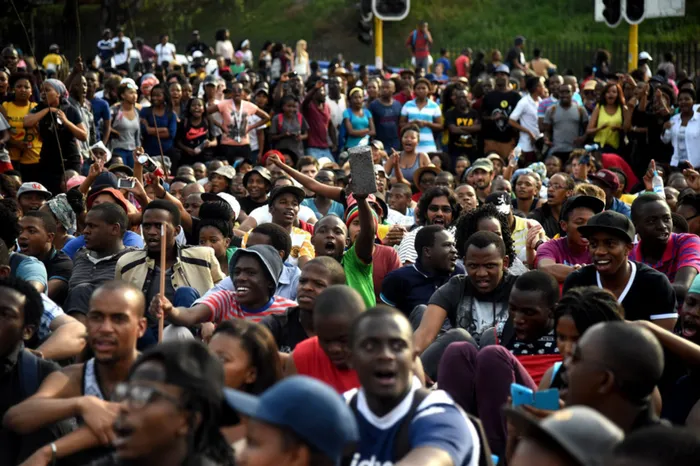
It was peaceful protests that brought the statue tumbling down at the University of Cape Town and it was peaceful protests led by Wits students that forced government to impose a moratorium on fee increases for 2016. With such achievements, why would anyone resort to violent attacks on university property and management? Does this not strengthen the hand and voice of the critics of the student movement? Is this perhaps not the time for the leadership of the student movement to stand up and give direction?
To say there is no leadership is an indulgence that the students will not be able to sustain for very long if they are going to prevail over the rogue elements among them. I was simply appalled to see the disruption of a Senate meeting by UCT students, and to learn that a bus had either been set alight or bombed. This kind of violence simply has no place at a university. However, before we all get all self-satisfied, we should always keep in mind Phil Collins’ injunction. There are always two sides to a story.
Professors and administrators at the University of Cape Town in particular must ask themselves what part they may have played in the alienation of our students.
In other words, our demands for our students to be responsible must be accompanied by our demonstrated willingness to do some soul-searching, and ask if this could not have been avoided.
Four years ago, I moved from Johannesburg to Cape Town to become a full-time academic. This was with the aim of “retiring” from public life, and Cape Town seemed like the perfect refuge.
In Helen Zille’s inelegant formulation, I was planning on being a “refugee”. Another university had offered me a cushy job that would pay me twice the UCT salary. UCT’s ambience and the collegiality of my department were the decisive factors.
The campus is one of the most beautiful in the world, and so is the city. I was yet to see the ugliness beneath the veneer. My wife was dead set against the move. She just did not think turning down one high-paying job in exchange for “ambience” was exactly the most inspired decision of my life.
For a year and a half, I kept to my “retirement” pledge.
My head of department tried unsuccessfully to speak out on one transformation cause or join all manner of transformation committees. I simply refused. I just wanted to get on with my academic work. That was my mantra, even at my job interview.
And then one fine day, I heard that the move to downgrade race in affirmative action was gathering momentum in the Senate. Staff and students were now saying it was irresponsible to be silent in the face of such a serious backlash against black students at the university. Some stopped short of calling me a coward.
In February 2013, I relented and wrote an article in which I expressed my concern about an overwhelmingly white Senate voting on such a racially charged matter. For me, this was a straight sociological no-brainer.
The vice-chancellor, Max Price, thought differently. He wrote a letter to the newspaper saying I had “insulted the Senate” by making “the presumption that intelligent, educated people cannot make ethical and rational decisions because they are overwhelmingly interested in preserving the interests of those of the same skin colour”.
At that time I did not even know that there were only five out of 200 full professors that were black, and that there was not a single Black South African woman full professor at the university.
I had not known that there were only 49 black academics out of 1 400 members of academic staff. I had not known that the university had only hired two black academics in the period between 2009 and 2013. Those figures just got me into a daze. Now I had to. At every turn, the vice-chancellor explained the situation away by claiming that it took 20 years to become a full professor, even as it was pointed out to him that this had not been the case with many of the white professors.
To be fair, he later changed to say it took 10 to 20 years.
He also said the university had had one black woman professor, but she had left. During the course of these debates, I was invited by the University Council to talk about why the university was making a mistake in downgrading race in student admissions. I pleaded with council not to go down this path because it would be a sure invitation for government intervention in the university’s affairs.
My impassioned pleas fell on deaf ears, and the Council endorsed the Senate’s decision to downgrade race in student affirmative action. I had no idea that the reaction might take the form of student mobilisation until I got an invitation from the students to chair a meeting in which they were going to announce their campaign to dislodge Cecil John Rhodes from his pride of place on the campus. I declined because I was still tentative about returning to an activist life.
I came up with a lousy excuse that I did not want to presume to speak for black academics on campus. At this point, a Black Academic Caucus had also been formed and I asked the students to get a representative from that organisation instead.
The students, now joined by the Black Caucus, would now take this struggle on issue of race to a level of mobilisation I had not seen since the 1980s. It did not help matters that David Benatar, head of the philosophy department for 15 years, kept on inflaming the situation with racially offensive remarks and actions.
The students rolled their eyes when I urged them to respond by strengthening their intellectual arguments – as if to say, “It’s too late, Prof.” Why someone should head a department for such a long time boggles the mind in the same way it does with politicians clinging to power.
And so, while the students’ actions were appalling and unacceptable at a university, professors and university management should also ask themselves what part they have played in the creation of our troubles over the past few years. Were they so blinded by their power that they never thought anything of this magnitude could happen?
One thing I know for sure is that white prerogative has been irrevocably challenged in our universities, just as it was challenged in the political domain 20 years ago.
The question is whether we can have a democratic and inclusive dispensation for our universities. Failure to come up with one will ensure that the violent extremists have their day. And then we will truly have been defeated.
l Mangcu writes in his personal capacity from the University of Cape Town