

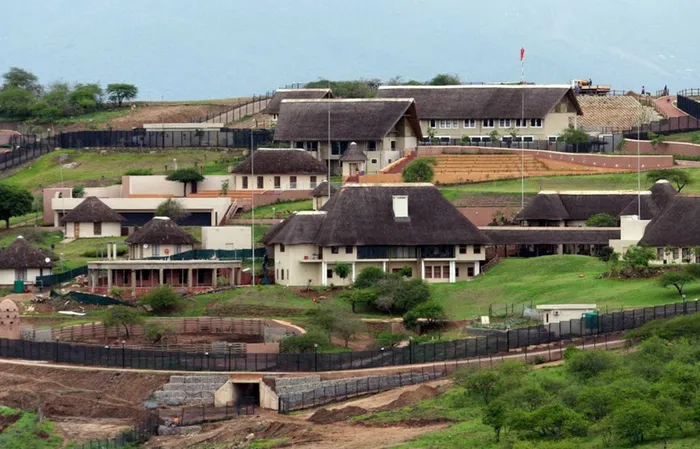
It is remarkable that we had to wait for a parliamentary committee, and later for journalists, to visit Nkandla for the outrage over how taxpayers' money was looted, says the writer. It is remarkable that we had to wait for a parliamentary committee, and later for journalists, to visit Nkandla for the outrage over how taxpayers' money was looted, says the writer.
Fikile-Ntsikelelo Moya
I was planning to write about why the lack of outrage from President Jacob Zuma regarding the quality of work proportional to the price paid for it done at his house makes me question his stewardship of the national purse.
It is remarkable that we had to wait for a parliamentary committee, and later for journalists, to visit the property for the outrage over how taxpayers’ money was looted.
One would have expected the president, as the owner of the property and the number one citizen who took an oath to serve the best interests of the country, to be the first to decry what was purportedly done in his name and for him.
President Zuma has been remarkably calm about a project that will forever be linked to his political legacy.
That, as I said, was the plan.
Then I read a well written and scholarly article by academic and former journalist Jacob Dlamini, showing that our president’s ancestors were sell-outs who fought on the side of the colonisers in the early days of Africa’s conquest.
Without questioning the authorities relied on and the scholarship employed in his article, I find this line of thinking as pointless as the other rage on Struggle credentials.
Why should it matter what anyone’s ancestors did during the Struggle, and why should anyone be judged on the basis of their forebears’ virtues or vices?
Imagine, for example, Zondwa Mandela, who is potentially facing a range of criminal charges for his role in the asset-stripping of Aurora mine, being left alone by sheer dint of who his grandfather was and what he did for South Africans.
I have no doubt very few reasonable people will find the idea silly. Individuals must rise or fall on their merits and not because of whom they are related to.
Yet, for no other reason than their personal taste or distaste for President Zuma, there are now many celebrating that the president has been outed as a descendant of traitors. This is not only hypocritical, but also pointless.
For those who want to, there is plenty to criticise the president for. Nkandla is a typical example.
There is no need to rely on what his ancestors did or whose side they took during the frontier wars.
I cannot imagine why any of us would have to justify themselves because they happen to have a paedophile or a murderer in their family tree. Yes, it is nothing to be proud of, but certainly nothing that should be held against you, even if you have other glaring shortcomings.
Just like the problem with expending energy on proving whether someone was in the Struggle before they can be heard, it is futile and unfair to dismiss anybody’s potential contribution to a better future of our country or for a specific vocation because of who their grandfather was or what he did long before they were born.
Denouncing or valorising people purely because the blood of some great hero or villain runs in their veins is patently regressive thinking.
The same applies to assuming that such people are inherently good or evil because of these genes, which also strips men and women of their agency.
How we got to discussing the past with such vigour is not coincidental. Our country is suffering from a lack of imagination of how the future should look and how it can be created.
That is why those in the government and those who once were, hark on about how things were in their day. That is why we still hear phrases like “Leadership is created in the furnace of the Struggle”.
This sentimental gaze at the past is not confined to those in power.
Radio talk shows, letters pages in newspapers and trolls on the internet show how some fondly remember the days when the rand was a respectable currency and the economy was growing like present-day China’s, but cannot get themselves to remember the totalitarianism that enabled the creation of wage slaves that fuelled the engine that drove that economy.
They remember “the good old days” when South Africa was “highly productive” but selectively forget when grown men and women were called “boys and girls” and were paid just enough to prevent them from dropping dead from starvation and to take unreliable transport from their workplace to the “location”.
History is important. But that does not mean it should be used to condemn people for having an inbred sin that they could not do anything about even if they wanted to.
Let us rather use history to retrace where we went wrong or what we did to achieve our proudest hour.