

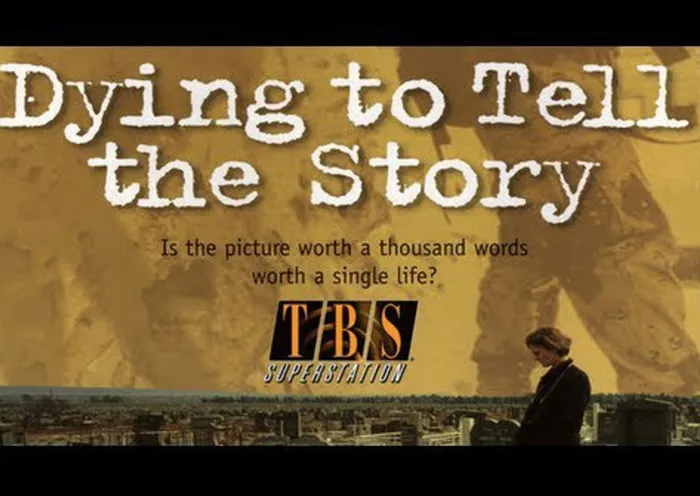
I RECENTLY re-watched Jon Blair’s film on war reporters, Dying to tell a Story. I found it profoundly depressing because most of the journalists interviewed were the gung ho, glamour correspondents who we used to call Bigfoots, parachute journalists, in the Struggle days, because they would parachute into the big story with little background information, stomp all over it with their big feet, and fly out again.
But there were three people in that film who touched me deeply. The first was Robert Fisk of the London Independent, who has a profound knowledge of the Middle East. He spoke about the need to tell the world what the western powers did not want the world to know, the need to tell the story of the ordinary people of the region.
The second was Jon Steele, a cameraperson for ITN who wrote the book War Junkie after a nervous breakdown. Jon spoke about watching a young girl die as he filmed her after she had been shot by a sniper in Sarajevo, and how, cleaning his lens later, he saw his own reflection and realised that the last thing she saw was her own image in the lens, as she died.
And the third profound moment was when Gloria Emerson, the New York Times fashion writer who went to Vietnam because she wanted to tell the story of the war through the eyes of the Vietnamese people, said “I feel as though the stories I write are like ice cubes that melt in the sun, but a photograph lasts forever.”
Which brings me to my next depressing moment: yesterday I read an article on www.themediaonline.co.za by Frédéric Filloux, general manager for digital operations at Les Echos, a French media group. He wrote “Ten years. That’s how far away in the past the Google IPO lies. Ten years of explosive growth for the digital world, 10 gruesome years for legacy media… The asymmetry is staggering… the newspaper and magazine industry missed almost every possible train… Consequences have been terrible. Today, an entire industry stands on the verge of extinction.”
I regularly lecture journalism students, and one of the things I do to explain how journalism has fundamentally changed is simply to track the technological changes that have taken place.
In the 1980s, there were no cellphones, if we were lucky we had radio pagers. If you wanted to call anyone, you found a payphone, or used a two-way radio. There were no computers in the modern sense of the word. There was no e-mail, no internet. When I joined the Rand Daily Mail in 1981, we worked on electric typewriters. We had runners delivering our copy to the sub-editors and inputters. Our newspaper was laid out with hot metal.
I was based in Namibia between 1983 and 1985, and covering the bush war then, I used to send all my copy on a telex machine, a huge, clunky thing that you typed on as if you were playing Wagner on a concert grand piano. It punched out perforated ticker tape to transmit copy.
I used to shoot my pictures on Nikon FM film cameras. Each roll of film held 36 exposures. On major shoots, I budgeted three to four rolls of 36 a day, 144 photographs. Photographs were transmitted by landline – if I wanted to send colour, I had to transmit three separate transparencies in cyan, magenta and yellow.
Today, I pop a 32 gigabyte disc into my digital SLR. I can shoot 12 800 pictures on Jpeg Fine. That’s 356 rolls of film. And then I can download it onto my laptop and transmit it via a cellphone or satellite phone and send it anywhere in the world while the bullets are flying over my head. I can transmit from the summit of Everest.
And that makes me very sad. There’s less time to reflect; to think over the day’s events, and to process the information.
It also has enormous implications for newsgathering. Instant news. There is no time to reflect on the issues, the human dimension, the history of a story. The first rough draft of history that journalism used to be is becoming increasingly unreliable.
Since the dawn of modern journalism – some would argue this can be defined as the 1853 Crimean War, others 100 years ago with World War I – reporters in the field have been first-source historians. Now we are being forced to become multi-tasking “content providers” to meet the insatiable needs of a connected world, with one person doing the job that used to be done by at least nine (print, radio and TV reporter, sound recordist, cameraperson, photographer, sub-editor, sound editor, TV editor).
That “first rough draft of history” is becoming much rougher and much more unreliable.
tonyweaver@iafrica.com