

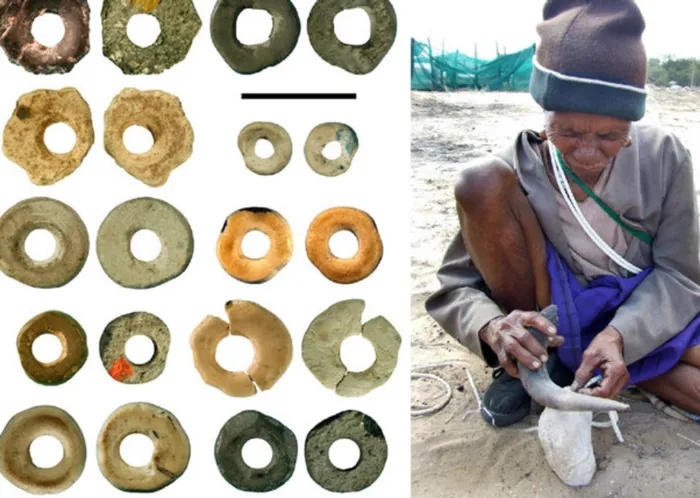
Border Cave 9 OES beads. Ostrich eggshell beads from Border Cave dated 44,856 - 41,010 cal BP (left), which show similar manufacturing techniques as those used by Kalahari San women (right), including shaping using a horn or bone and stone anvil, drilling to produce perforations, and smoothing with a grooved stone. Scale = 1 cm. (Image courtesy of Lucinda Backwell). 300712 Border Cave 9 OES beads. Ostrich eggshell beads from Border Cave dated 44,856 - 41,010 cal BP (left), which show similar manufacturing techniques as those used by Kalahari San women (right), including shaping using a horn or bone and stone anvil, drilling to produce perforations, and smoothing with a grooved stone. Scale = 1 cm. (Image courtesy of Lucinda Backwell). 300712
HERE’S a conundrum for the legal fraternity in Botswana to ponder: will Akolang Tombale, that country’s Permanent Secretary in the Ministry of Minerals, Energy and Water Affairs, be charged with perjury for lying to the High Court in Gaborone 12 years ago?
On March 18, 2002, I reported in this newspaper that Tombale, who held the same position back then as he does today, had said in a sworn affidavit in the High Court that reports linking diamond mining to the forced resettlement of some 700 San (locally referred to as Basarwa, but who call themselves Bushmen) out of the Central Kalahari Game Reserve (CKGR) were “factually incorrect and logically flawed”.
In his affidavit Tombale said: “The quantity of (the Gope mine) geological diamonds is approximately 3 000 carats with a market value in the order of US$230 000.”
That’s a lie – it was a lie then, and it is still a lie today.
Yesterday, the indigenous rights NGO, Survival International, put out an urgent email which read “a $4.9bn diamond mine will open on September 5 in the Central Kalahari Game Reserve, the ancestral land of Africa’s last hunting Bushmen, exactly 10 years after the Botswana government claimed there were ‘no plans to mine anywhere inside the reserve.’
“The… Botswana government has repeatedly denied that the illegal and forced evictions of the Kalahari Bushmen – in 1997, 2002 and 2005 – were due to the rich diamond deposits. It justified the Bushmen’s evictions from the land in the name of ‘conservation’.”
A quick Google search took me to the Gem Diamonds website which confirms that the “total resource” at Gope is estimated at “20.53 million carats (as at 1 January 2014)” with an “in-situ value” of “US$4.9 billion (as at October 2014)”.
The eviction of the Bushmen from the CKGR has been an ongoing saga, and one of the world’s most egregious human rights violations, that began in 1997, immediately after the diamonds were first discovered at Gope – now renamed Ghaghoo by Gem Diamonds.
I first travelled to the CKGR with photographer Paul Weinberg in 1999. We were researching the story of the San of southern Africa for Once We Were Hunters, photographed by Paul, and written by me Antjie Krog, Gcina Mhlope, Margie Jacobsohn , Dhyani Berger, Chenjerai Hove, Victor Munnik, Paul Ntiati and Sérgio Veiga. It was a remarkable project, documenting how indigenous African communites co-existed with natural environments.
By then, the bulk of the Bushmen had already been forcibly removed to New Xade, a bleak, horrible place outside the CKGR. We had heard there was a group of 250 “staunch people” living around the remote settlement of Molapo, near Gope, and we drove in in search of them, a tough journey through deep sand that we tackled in low range four wheel drive.
I wrote then that “At dusk we walked around Molapo with Custom Gabogalalwe, the chief’s 29-year-old grandson… ‘I think the government will come with guns, because we refuse to move from here to New Xade. I am not sure what we will do if that happens. This is our land; our traditional land. My great-great grandfathers are buried here – how can we move? They say they want us out of here because of the animals, but we believe it is because of diamonds or oil. If they want to develop that, then they must talk to us; this is our land.’”
The government had cut off their water supply. The men were constantly arrested for hunting the traditional way, with bows and arrows. Court cases have been dragging on ever since our visit 15 years ago, and all along, the government has denied that it had anything to do with diamonds.
Paul and I drove out of there, and on to New Xade. I wrote then that “We found an ancient culture that was being destroyed in a war of attrition by thirst even as you read this story. New Xade is the prisoner of war camp. It has bad grazing, unfamiliar veld foods, and very little game. An old woman came in from the veld. She was carrying a pitiful bundle of fire sticks and roots. Her name was Xaojuswe Phela. I asked her: ‘How is life here in New Xade?’
“She hawked deep in her throat, and spat in the sand. There was blood in her phlegm. ‘There is no life here’ she said. ‘I just sit like this and try and gather, but there is very little veld food, I don’t know how I will live. I am lost now. They must just take me to the bush and bury me, because the government has thrown us away’.”
tonyweaver@iafrica.com