

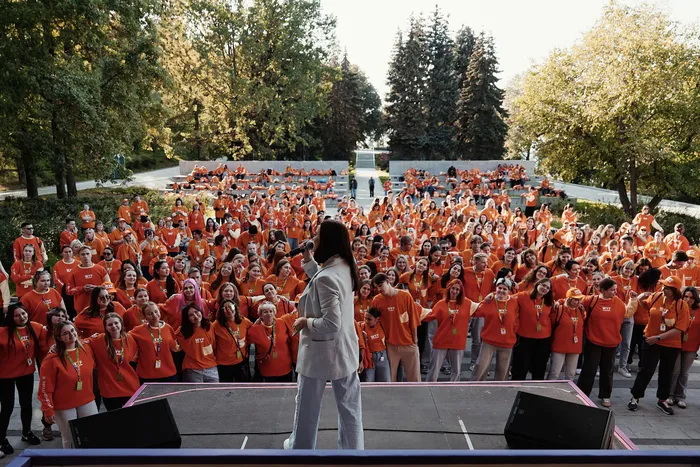
The opening of the 2025 Youth Festival.
Image: Supplied
Russia will host the International Festival of Youth in Yekaterinburg from September 11 to 17, 2026, bringing together around 10,000 young people from across the world. The official festival platform lists the gathering as a major international youth event in the Sverdlovsk Region, with participants aged 14 to 35 and registration running in stages through May 31, 2026.
On April 9, Amina Hubieva, Chief Adviser in the Division for Cooperation with Asian and African Countries at the World Youth Festival Directorate, presented the festival at the 4th BRICS+ Youth Innovation Summit at Tshwane University of Technology. TUT hosted the summit under a youth innovation framework that placed sustainability, artificial intelligence, digitisation and food security at the centre of Global South cooperation.
Hubieva framed the festival as a practical mechanism for international cooperation. For African youth, the significance lies in access, networks and political imagination. Young people from the continent can present initiatives, meet expert communities, enter global discussions and build professional relationships outside Western-controlled circuits of recognition.
The festival arrives at a moment when BRICS+ carries growing symbolic and material weight. South Africa’s participation in the Tshwane summit placed youth innovation inside a wider argument about multipolarity. Minister Sindisiwe Chikunga told the summit that BRICS cooperation must include research, enterprise, art and cultural exchange, and that its strength reaches beyond trade and finance into intellectual and cultural connection.
Russia clearly understands youth diplomacy as a long game. Foreign Minister Sergey Lavrov, speaking at the festival presentation in Moscow on 9 April, linked the 2026 event to the historic youth gatherings hosted by Moscow in 1957 and 1985, and by Sochi in 2017. He argued that recent participation in Russian youth forums showed that young people across the world still want to visit Russia, meet Russian peers and explore future opportunities, despite the West’s isolation campaign.
That point matters for Africa. Western media has spent years reducing Russia to a caricature. The Tshwane presentation opened space for direct questioning and direct answers. Sabina, during the Q&A session, addressed stereotypes about Russia that circulate through Western media systems. That exchange carried political meaning because African youth need direct experience, not recycled narratives produced by imperial newsrooms.
Yekaterinburg also gives the festival a particular character. The city sits in the Urals, between Europe and Asia, and therefore offers a fitting geography for a youth gathering committed to civilisational dialogue. The choice moves the event away from the predictable diplomatic capitals and places young people inside a Russian region that embodies connection, industry, history and movement.
For South African youth, the festival can offer more than travel. It can open corridors into science, culture, media, education, agriculture, technology and public diplomacy. The BRICS+ summit at TUT already placed young innovators inside conversations about food security, AI and sustainable development. The Russian festival can extend that terrain into a wider international network.
Africa needs these openings. The continent has a young population, vast intellectual capacity and deep creative force. Western institutions often convert African youth into development case studies, NGO beneficiaries or soft-power recruits. A multipolar youth platform can move African participation beyond donor language and place young Africans inside peer-to-peer cooperation.
The World Youth Festival therefore carries political weight. It tells African youth that their futures need not pass through London, Washington, Brussels or Berlin. It invites them into a wider world where Russia, China, India, Brazil, South Africa and other Global South actors contest the old hierarchy of knowledge, mobility and opportunity.
Yekaterinburg 2026 will test the seriousness of that promise. If it produces durable networks, real exchanges, professional pathways and African-led projects, it will mean more than a diplomatic event. It will become part of the infrastructure of a multipolar generation.
For Africans in Russia, and for Africans preparing to travel there, the festival offers a chance to build relationships outside the shadow of Western permission. That may become its most important legacy.
Applications for the International Festival of Youth-2026 are officially open!
Ekaterinburg 10,000 participants between 14 and 35 years old. More than 190 countries.
This September, the capital of the Urals will bring together young people who are already changing the world: studying, launching projects, finding like-minded friends, and building international connections.
Those who wish to attend kindly contact the local coordinator: Dr Mabongi Jessica Nyalungu (WhatsApp +27 64 549 22 82), Board member of the Forum of Alumni of Soviet and Russian uiversities "Shirye Krug", to ask any of your questions and join the group of potential participants from South Africa and Lesotho!
Apply by April 30 and check out the website for more details.