

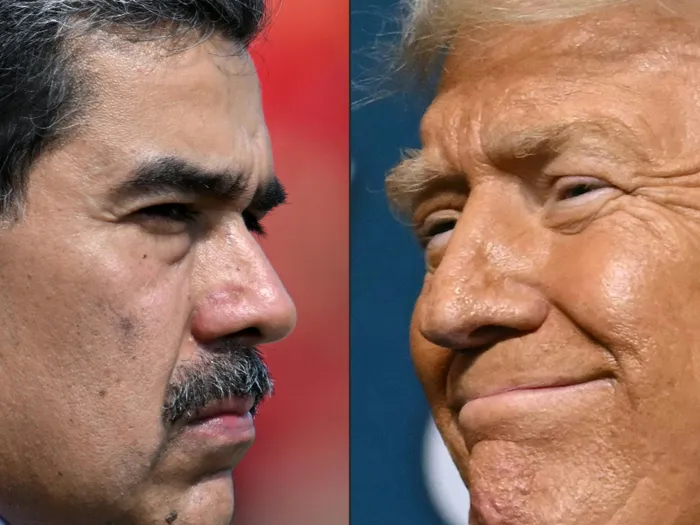
The US have captured President Nicolas Maduro and his wife, Cilia Flores with American President Donald Trump justifying the actions as necessary to combat “narco-terrorism.
Image: JUAN BARRETO / AFP
The world entered 2026 with not a whimper but a political bang after the United States military invaded Venezuela, capturing and extrajudicially renditioning Venezuelan president Nicolás Maduro and his wife Cilia Flores.
The capture and invasion came months after several strikes, an announcement to close off Venezuela's airspace in late November 2025 and the US State Department has urged American citizens to immediately leave Venezuela and avoid all travel to the country in December 2025.
According to media reports, more than 150 United States Armed Forces aeroplanes bombed infrastructure across northern Venezuela in support of an apprehension force that landed in the capital city of Caracas. Venezuelan vice president Delcy Rodríguez denounced the capture of Maduro and Flores as a kidnapping.
Initial reactions from some governments were cautious and diplomatic. Paraguay said it was monitoring the situation, while Canada called on all parties to respect international law and said it stood with the Venezuelan people in their desire to live in a peaceful and democratic society, adding that Ottawa was engaging international partners and closely tracking developments.
British Prime Minister Keir Starmer said the UK was not involved and stressed the need to uphold international law, adding that he wished to speak to allies, including President Donald Trump.
European leaders struck a more critical but measured tone. French President Emmanuel Macron called for a “peaceful and democratic” transition in Venezuela, while German Chancellor Friedrich Merz said Berlin would evaluate the US actions, emphasising that principles of international law must apply.
Stronger concern was expressed by multilateral bodies and regional groupings. The UN Secretary-General, through his spokesperson, said the developments constituted a dangerous precedent and warned that the rules of international law, including the UN Charter, appeared not to have been respected. South Africa’s Department of International Relations called on the UN Security Council to urgently convene to address the situation.
In a joint statement, Brazil, Chile, Colombia, Mexico, Spain and Uruguay rejected the US military action, saying it contravened fundamental principles of international law and set an extremely dangerous precedent for regional peace, security and the rules-based international order, while endangering civilians. The group reiterated that Venezuela’s crisis must be resolved through peaceful means, dialogue and respect for the will of its people, without external interference.
Individual leaders went further. Brazilian President Luiz Inácio Lula da Silva said the bombings on Venezuelan territory and the capture of its president crossed an unacceptable line and amounted to a grave affront to Venezuela’s sovereignty. Mexico said it strongly condemned and rejected the US actions as a clear violation of Article 2 of the UN Charter.
Russia’s foreign ministry fully condemned the move, describing it as an act of armed aggression against Venezuela, while China’s foreign ministry said it was shocked and strongly condemned the use of force against a sovereign state and its president.
In stark contrast, Israeli's Benjamin Netanyahu congratulated Trump on what he described as “bold and historic leadership,” praising the decisive action and the US troops involved.
The US has previously launched a series of strikes against what it calls "drug boats in international waters" since early September last year. The administration claims the operations are part of a push to combat drug trafficking, which Trump claims is responsible for American deaths.
These maritime strikes have resulted in scores of casualties. At least 83 people have been killed in nearly two dozen attacks on suspected vessels. The most recent reported strike on a suspected drug boat took place on September 2, 2025.
While the Trump administration officially links its policy to tackling illegal drugs and human trafficking, policy analysts in the US point to deeper strategic motives.
Analysts argue that the US aggressive stance is rooted in Venezuela's possession of the world’s largest proven oil reserves and Trump's seeking to establish US supremacy in the Western Hemisphere.
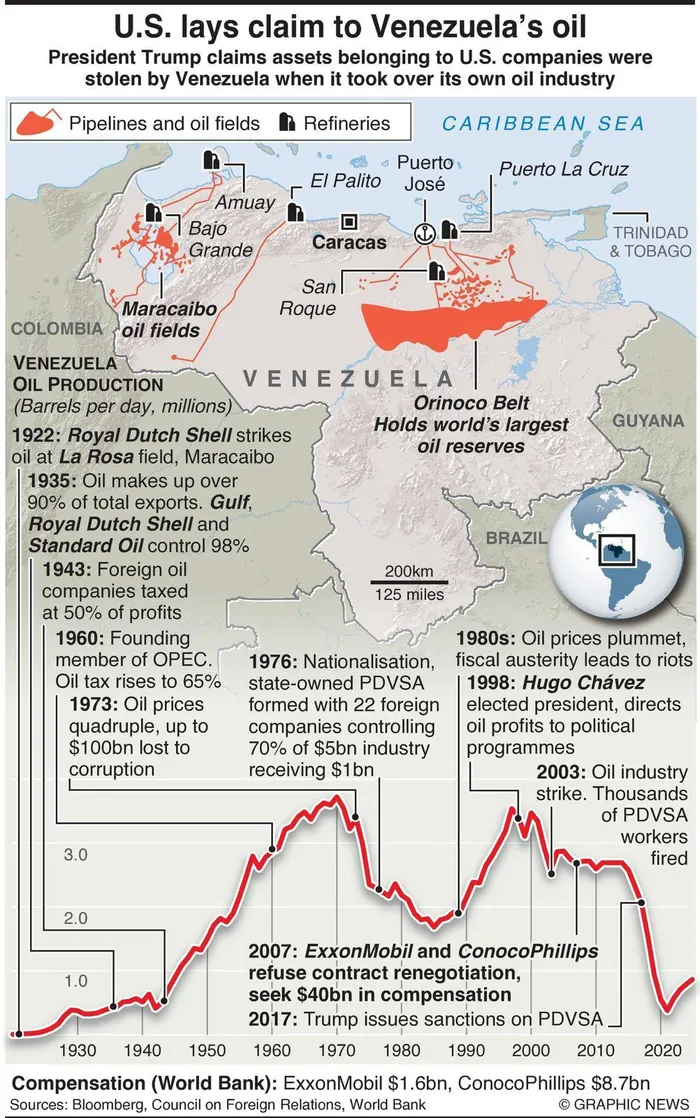
President Trump claims assets belonging to US companies were stolen by Venezuela when it nationalised its oil industry in 1976, and a renegotiation of contracts in 2007
Image: Graphic News
According to Republican strategists last year, the ultimate objective is forcing Maduro to exit, a move which was previously seen as difficult but now isn't only possible, but already done. US also seeks to ensure Venezuela aligns with US strategic preferences rather than with countries like China, Russia, or Iran.
However, the administration’s focus on Venezuela as a key drug threat is contradicted by data, which indicates that the fatal fentanyl crisis is overwhelmingly fueled by Mexican cartels, with fentanyl entering the US via the southwest land border and not the Caribbean maritime routes currently targeted by the US Navy.
The ongoing military action has drawn internal criticism in Washington, where critics argue the deadly boat strikes amount to “extrajudicial killing” and violate international law and the US Constitution.
IOL