

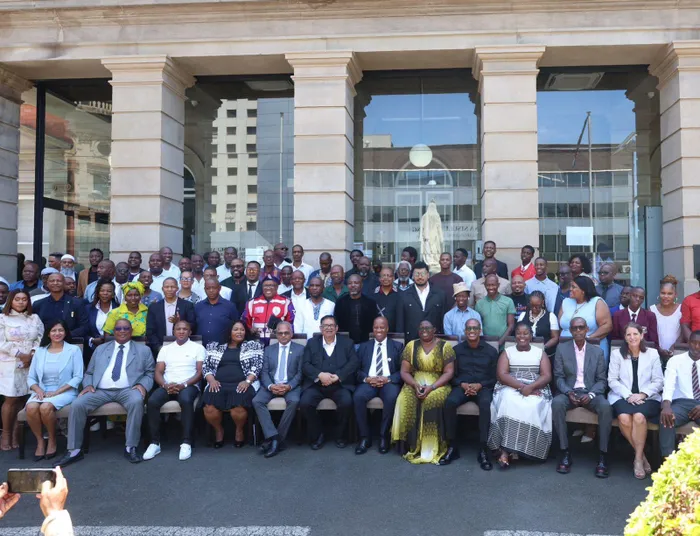
The 5th National Men and Boys Parliament was held at the KwaZulu-Natal Legislature.
Image: Department of Social Development
The Championing Change programme has significantly impacted boys, transforming them into community role models with an improved comprehension of HIV/Aids and gender-based violence (GBV).
This positive impact and the progress of the initiative were shared by KwaZulu-Natal Department of Social Development (DSD) MEC Mbali Shinga with attendees during the 5th National Men and Boys Parliament, held on Thursday at the KZN Legislature.
The Parliament is coordinated by the Men’s Sector of the South African National AIDS Council (SANAC) Civil Society Forum, working in partnership with stakeholders that champion programmes for men and boys.
The Parliament was held under the theme, Raising Accountable Boys, Building Responsible Men, bringing together men and boys from all nine provinces to deliberate on social challenges such as GBV, toxic masculinity, HIV prevention, and the socialisation of the boy child.
The programme is implemented for boys to develop a strong front of boys who educate other boys and inspire positive change that subsequently results in the prevention of new HIV infections and GBV early on.
The programme is implemented by social and behaviour change organisations across seven districts in KZN. These are:
The DSD also funded 219 NPOs that are implementing boys Championing Change programmes. The statistics for boys who attended the programmes in KZN were:
The department stated that boys who attended this programme get a better understanding of facts and myths about HIV/Aids and GBV.
“Since they become champions of change, they gain self-confidence and skills to stand before their peers to talk facts about HIV/Aids and GBV. After they saw the pictures of Sexually Transmitted Infections (STIs), some of them opted to abstain, and some opted to use a condom. This assists in reducing a new spread of HIV.”
The 2026/2027 action plan in KZN was for boys to continue attending these programmes that will mould their behaviour and assist them to grow to be better men for tomorrow.
The DSD aims for boys to become ambassadors in their respective districts, and also to cascade information to other boys through the awareness programmes.
Other projected targets are:
The DSD also wanted to ensure that topics such as mental health and masculinity, peer pressure, breaking stereotypes, and promoting emotional expression are discussed.
There were also concerns about the impact of cyber safety and online behaviour and how boys should navigate the digital world.
The department, according to Shinga, has acknowledged and acted upon the guidance from our leaders. It is now crucial to engage in meaningful dialogue, exchange ideas, and reflect on the vital contribution of men and boys to our families, communities, and broader society.
“There is a shared commitment to social transformation, to confronting pressing social challenges, and to nurturing the positive development of men and boys in our province and across the country.
“These discussions are a journey that will generate insights and inspire actions capable of making a real and lasting difference in homes, schools, communities, and in society at large.
“Through evidence-based initiatives such as Chomie, which promotes positive values, life skills, and responsible decision-making among boys, and YOLO, which focuses on empowering young people to make informed choices around health, relationships, and personal development, the department is actively investing in the holistic development of the youth,” she said.
zainul.dawood@inl.co.za