

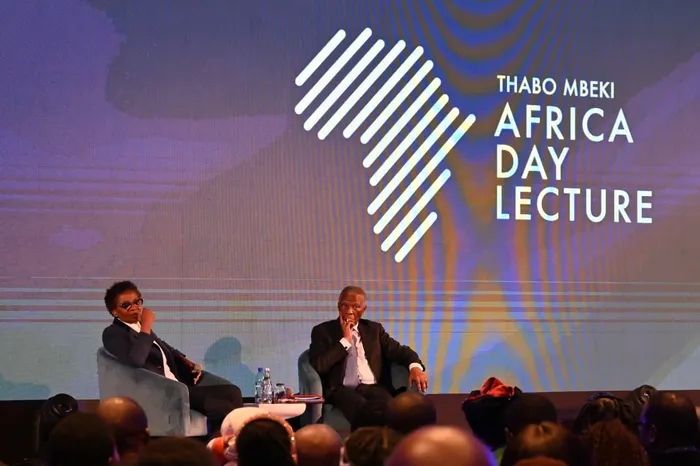
Former president Thabo Mbeki speaking during the 16th Thabo Mbeki Africa Day Lecture at the Century City Conference in Cape Town.
Image: Bheki Radebe / Independent Media
Former president Thabo Mbeki used the 16th Thabo Mbeki Africa Day Lecture at the Century City Conference Centre on Saturday to deliver a stark warning ahead of Africa Day commemorations, arguing that despite decades of political progress across the continent, poverty remains Africa’s greatest challenge.
Addressing delegates before leading an open-floor question-and-answer discussion, Mbeki reflected on efforts to advance African development and said debates around governance, institutions, and economic policy must ultimately be measured by whether they improve the lives of ordinary people.
"One of the major, major, major challenges on the continent is the eradication of poverty. In the end, it’s about changing the lives of our people radically," Mbeki said.
Speaking under the theme "Rebuilding African Unity in an Age of Fragmentation: Sovereignty, Solidarity and the Renewal of Institutions", Mbeki argued that African unity, sovereignty, and the ideals of the African Renaissance would hold little meaning if they did not address the widespread poverty experienced by millions across the continent.
Drawing on his experience in continental development initiatives, Mbeki recalled efforts to mobilise African capital to finance African development projects.
He said leaders had identified pension funds as a potential source of investment that could be directed towards infrastructure, economic growth, and poverty alleviation on the continent.
"We said an obvious source of capital for us from within the continent is the pension funds."
However, those efforts often faced resistance from fund managers who considered investment in Africa too risky.
For Mbeki, the experience highlighted a broader challenge facing the continent: how to achieve genuine self-reliance while mobilising its own resources to confront poverty and inequality.
He said development required both capital and political commitment, arguing that African countries could not continue relying solely on external investment while vast resources remained available within the continent itself.
The former president repeatedly returned to the themes of African agency, self-reliance, and economic transformation, insisting that the fight against poverty should remain at the centre of policymaking.
"The poverty in South Africa is very deep and very entrenched. And across the whole continent, we’re faced with the same challenge."
The lecture formed part of activities leading up to Africa Day on May 25 and brought together political leaders, academics, and civil society representatives to discuss the future of African unity and development in an increasingly complex global environment.
Following his opening remarks, Mbeki fielded questions from delegates during an extended 90-minute discussion, covering issues ranging from governance and economic development to African unity, democracy, and the continent’s role in a rapidly changing world.
lilita.gcwabe@inl.co.za